
Key Takeaways
- The Philippines has a foundation to build on. Its strong electronics export base and established IT-BPM industry could support more advanced technology and services work if new investments materialize.
- BPO opportunities could move beyond traditional call center work. AI, semiconductor, and advanced technology companies may create demand for technical support, data operations, compliance, finance, and human-in-the-loop services.
- The risks and unanswered questions remain significant. Concerns around governance, sovereignty, environmental impact, resource use, labor standards, and local economic value should remain part of the conversation.
- Pax Silica presents potential opportunities, not guaranteed gains. Its impact on investment, jobs, and technology development will depend heavily on execution, infrastructure, and workforce readiness.
- The bigger question is what kind of work the Philippines can earn. Long-term success may be measured less by the number of jobs created and more by whether Filipino companies and workers move into higher-value, technology-enabled roles.
The Philippines’ participation in Pax Silica has opened a larger conversation about the country’s place in the global technology economy.
For supporters, the initiative represents an opportunity to attract advanced manufacturing, artificial intelligence, semiconductor, data infrastructure, and related investments. For critics, it raises legitimate questions about sovereignty, resource use, labor conditions, environmental pressure, and how much long-term economic value will actually remain in the Philippines.
Both sides matter.
But away from the geopolitical debate, there is another question businesses will eventually have to answer: If more international technology companies establish operations in the Philippines, who will support the increasingly complex work surrounding those investments?
That is where the Philippine business process outsourcing sector could find a new role.
Rather than simply adding another wave of call center seats, Pax Silica could push local outsourcing providers toward technical operations, AI-assisted workflows, data services, compliance support, finance and administration, customer operations, and other functions surrounding a more sophisticated technology ecosystem.
The opportunity is significant. It is also far from automatic
What Is Pax Silica?
Pax Silica is a U.S.-led initiative focused on strengthening technology and supply chain security among participating countries, covering areas such as critical minerals, semiconductors, advanced manufacturing, computing, artificial intelligence, and data infrastructure. The Philippines formally joined the initiative on April 16, 2026.
As part of the cooperation, plans were announced for an approximately 4,000-acre industrial development in New Clark City, within the Luzon Economic Corridor. The site has been described as the first “Golden Node,” an investment acceleration hub intended to support AI and advanced industrial activity.
Interest from international companies has already emerged. In May, representatives from more than a dozen U.S. companies joined a visit to the proposed New Clark City site, while Foxconn Chairman Young Liu was also part of the delegation. At the same time, many details of the long-term framework were still being negotiated.
That distinction is important.
Pax Silica should not yet be treated as a completed industrial ecosystem with thousands of foreign companies already operating locally. It is better understood as a developing framework that could influence where future investment, infrastructure, and technology operations are located.
The Philippines Already Has Two Pieces of the Puzzle
The country is not starting from zero.
First, electronics already account for a major portion of Philippine exports. In June 2026, electronic products generated about $5.25 billion and represented 59.9% of the country’s merchandise exports for the month, according to the Philippine Statistics Authority.
Second, the Philippines already operates one of the world’s largest IT-BPM industries. IBPAP projected the sector could reach approximately $42 billion in export revenues and nearly 1.97 million employees in 2026.
Pax Silica could bring these two economic strengths closer together.
Historically, semiconductor manufacturing and business process outsourcing have often been discussed as separate industries. One produces physical technology. The other delivers services.
AI is making that distinction less rigid.
Modern technology companies need far more than engineers and factories. Behind them sit large operational systems involving customer support, technical service desks, finance, procurement, data management, documentation, HR administration, cybersecurity operations, vendor coordination, quality assurance, and increasingly, human oversight of AI systems.
These functions create potential room for Philippine outsourcing providers.
BPO May Need to Move Beyond the Traditional Call Center Model
That does not mean traditional customer service becomes irrelevant.
Global technology firms still need people answering customers, resolving billing issues, handling technical inquiries, coordinating logistics, and providing after-sales support.
What changes is the complexity surrounding those roles.
A semiconductor company may need a support team that understands technical product documentation. An AI company may need specialists who can review machine-generated outputs or escalate edge cases. A hardware manufacturer may need multilingual order management, warranty administration, supplier coordination, or technical customer support.
Traditional BPO remains useful for many of these functions. But providers pursuing the Pax Silica ecosystem may need capabilities that go beyond offering labor capacity.
The differentiators become domain knowledge, cybersecurity, process discipline, AI literacy, governance, quality assurance, and integration with client technology.
In other words, the next outsourcing conversation may be less about how many seats a provider can fill and more about what responsibilities those teams can reliably own.
Human-in-the-Loop Operations Could Become More Important
Ironically, greater AI investment could increase demand for certain kinds of human work.
AI systems can process enormous volumes of information quickly. They can summarize documents, classify requests, detect patterns, draft responses, and automate repetitive workflows.
But businesses still face cases where someone needs to verify whether an output is correct.
For high-risk or high-value processes, that distinction matters.
A human-in-the-loop model places trained professionals at specific points in an AI-enabled workflow to review outputs, handle exceptions, make judgment calls, or take responsibility for decisions that should not be fully automated.
For Philippine BPO providers, this could create opportunities in areas such as:
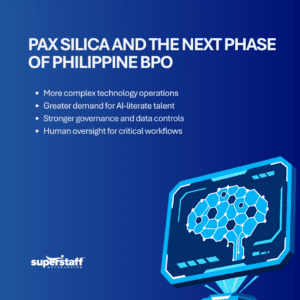
- AI output validation and quality assurance
- Technical and structured data operations
- Exception handling and escalation
- Content or transaction review
- Customer support enhanced by AI copilots
- Back-office processes requiring human approval
- Compliance documentation and monitoring
- Human supervision of automated workflows
This does not mean every BPO worker suddenly becomes an AI engineer.
It means outsourced teams may increasingly work alongside AI rather than operate separately from it.
Foreign Firms Will Still Face a Local Operations Challenge
Technology investment does not happen inside a vacuum.
Companies entering a new market still have to recruit talent, administer payroll, understand labor requirements, manage facilities, secure data, establish local vendors, implement controls, train employees, and support day-to-day operations.
That creates another potential role for local outsourcing firms: becoming operating partners rather than simply staffing vendors.
A company entering the Philippines may choose to establish its own entity and build these capabilities internally. Others may use employers of record, professional service firms, outsourcing providers, or combinations of several partners.
There is no single correct model.
The important question is whether the local partner understands both Philippine operating conditions and the security expectations of an increasingly sensitive global technology supply chain.
For businesses working with proprietary AI models, semiconductor technology, customer information, or other sensitive data, cost alone is unlikely to be sufficient.
Information security, access controls, workforce screening, business continuity, data governance, process documentation, and accountable human oversight become part of the outsourcing proposition.
The Opportunity Comes With Questions the Industry Should Not Ignore
Pax Silica has also drawn domestic criticism, and outsourcing companies should be careful not to treat those concerns as irrelevant to business.
Environmental, agricultural, and civil society groups have raised concerns about possible pressure on water and electricity resources, land use, mineral extraction, community impact, and whether sufficiently strong safeguards will accompany large-scale technology infrastructure.
Questions have also been raised about governance and sovereignty. The Management Association of the Philippines, while supporting the economic potential of Pax Silica, has emphasized that activities should remain subject to Philippine laws, taxes, labor standards, environmental requirements, and national jurisdiction.
The framework itself is also still evolving. As of May 2026, Reuters reported that the Philippines and the United States were continuing to negotiate the long-term structure of the proposed economic security zone.
These are not minor details.
If Pax Silica creates investment without meaningful technology transfer, local capability development, competitive wages, environmental safeguards, or opportunities for Filipino companies to move into higher-value work, the economic upside could be more limited than headline investment figures suggest.
BCDA has projected that the development could eventually generate between 130,000 and 190,000 direct jobs, but these remain projections tied to a project that is still being developed.
The more important measurement may ultimately be the quality of those jobs.
What Global Technology Firms Should Look for in a Philippine BPO Partner
If Pax Silica does accelerate AI and semiconductor investment, foreign companies evaluating outsourcing providers should look beyond labor arbitrage.
The strongest partners will likely combine local operating knowledge with technology-enabled delivery.
That means evaluating whether a provider can recruit specialized talent, protect sensitive information, integrate with client platforms, document processes, support compliance requirements, and continuously train employees as technology changes.
It also means asking how AI is actually used inside the operation.
A provider claiming to be “AI-powered” should be able to explain which tasks are automated, where employees intervene, how outputs are validated, how sensitive information is protected, and who remains accountable when automated systems make mistakes.
That transparency may become increasingly valuable as AI becomes embedded in everyday business operations.
A Different Kind of Opportunity for Philippine Outsourcing
Pax Silica could become an important chapter in Philippine industrial development. It could also fall short of some of the ambitions currently attached to it.
Much will depend on policies, infrastructure, investment commitments, workforce development, environmental safeguards, and the final structure of the initiative.
For the Philippine BPO sector, however, the direction is already worth watching.
If more advanced technology operations come to the country, outsourcing providers will have an opportunity to move further into specialized services that sit around AI, semiconductors, digital infrastructure, and global technology operations.
The winners may not necessarily be the providers promising the cheapest seats or the most automation.
They may be the ones capable of combining technology with trained human judgment, strong governance, secure operations, and enough local expertise to help international companies navigate the Philippine business environment.
That is a more demanding version of outsourcing.
It is also potentially a more valuable one.
The Bottom Line
Pax Silica should neither be treated as a guaranteed economic breakthrough nor dismissed as irrelevant to the outsourcing sector.
For foreign AI and semiconductor companies, the Philippines offers an established electronics base, a large IT-BPM workforce, and growing interest in advanced technology investment. But operating successfully in the country will require more than locating facilities or hiring inexpensive labor.
For Philippine BPO providers, the opportunity is to prove they can participate higher up the value chain.
That means building technical capability, developing AI-literate talent, protecting sensitive operations, and keeping humans accountable at the points where technology alone is not enough.
If Pax Silica does reshape the Philippine technology landscape, the most important BPO story may not be how many new jobs it creates.
It may be what kind of work the Philippines is trusted to do.
Frequently Asked Questions About Pax Silica
- What is Pax Silica?
Pax Silica is a U.S.-led initiative focused on strengthening cooperation around semiconductors, AI, critical minerals, advanced manufacturing, and secure technology supply chains. - Why is the Philippines involved in Pax Silica?
The Philippines is being positioned as a potential contributor to regional technology and supply chain development, supported by its semiconductor sector, workforce, and strategic location. - What could Pax Silica mean for the Philippine economy?
It could encourage new investment, technology development, and demand for specialized talent, although the scale of its impact will depend on implementation, infrastructure, and workforce readiness. - Will Pax Silica directly benefit the BPO industry?
Not necessarily. However, growth in AI, semiconductor, and technology-related investment could create indirect demand for services such as technical support, back-office operations, finance, recruitment, data services, and human-in-the-loop support. - What are the key issues to watch?
Businesses should monitor investment commitments, infrastructure development, talent availability, policy changes, and whether planned projects translate into sustained jobs and broader economic activity.
Build Your Philippines Operations from Clark
If your company is exploring opportunities in the Philippines as the Pax Silica ecosystem develops, SuperStaff can help you build the operational support you need on the ground.
With established operations in Clark, one of the country’s key business and investment hubs, SuperStaff provides scalable teams across customer support, back-office operations, technical support, finance, recruitment, and AI-enabled human-in-the-loop services.
Strengthen Your Philippines Operations with SuperStaff
Launch a dedicated team around your workflow with compliant operations, experienced local talent, and scalable support designed for growing global businesses.