IT budgets rarely shrink. Software, hardware, cybersecurity, and user support create continuous financial pressure. Leaders seek ways to manage these costs without losing oversight of critical systems. Offshore IT outsourcing provides a structured way to reduce expenses while keeping visibility and control firmly in place.
Organizations today rely on technology for daily operations, customer service, finance, and communication. As tools multiply, so do support requirements. Internal IT teams often struggle to keep up with requests while also managing infrastructure and security. Offshore IT outsourcing introduces operational relief without sacrificing accountability.
IT Costs Continue to Rise Across Organizations
Technology supports every department. Licensing fees grow. Infrastructure expands. Support tickets increase as teams adopt more tools.
Internal IT staff often spend their time reacting to issues instead of improving systems. This pattern drives higher labor costs and delays strategic work. Many leaders are beginning to explore offshore IT outsourcing as a way to balance cost and performance.
As companies scale, additional devices, users, and applications increase complexity. Each addition requires monitoring, maintenance, and support. Without a structured solution, IT spending grows faster than revenue in many midmarket organizations.
Control Remains the Top Concern for Decision Makers
Executives worry about losing visibility. Questions arise around accountability, data protection, and performance tracking.
Modern offshore IT outsourcing addresses these concerns through structured reporting, shared tools, and clear escalation paths. Teams operate within defined frameworks that mirror internal processes. This setup delivers the offshore IT outsourcing benefits leaders expect without sacrificing governance.
Leaders also want assurance that offshore teams follow internal standards. Clear documentation, access protocols, and communication channels remove uncertainty. Control becomes part of the design, not an afterthought.
Shared Systems Create Full Operational Transparency
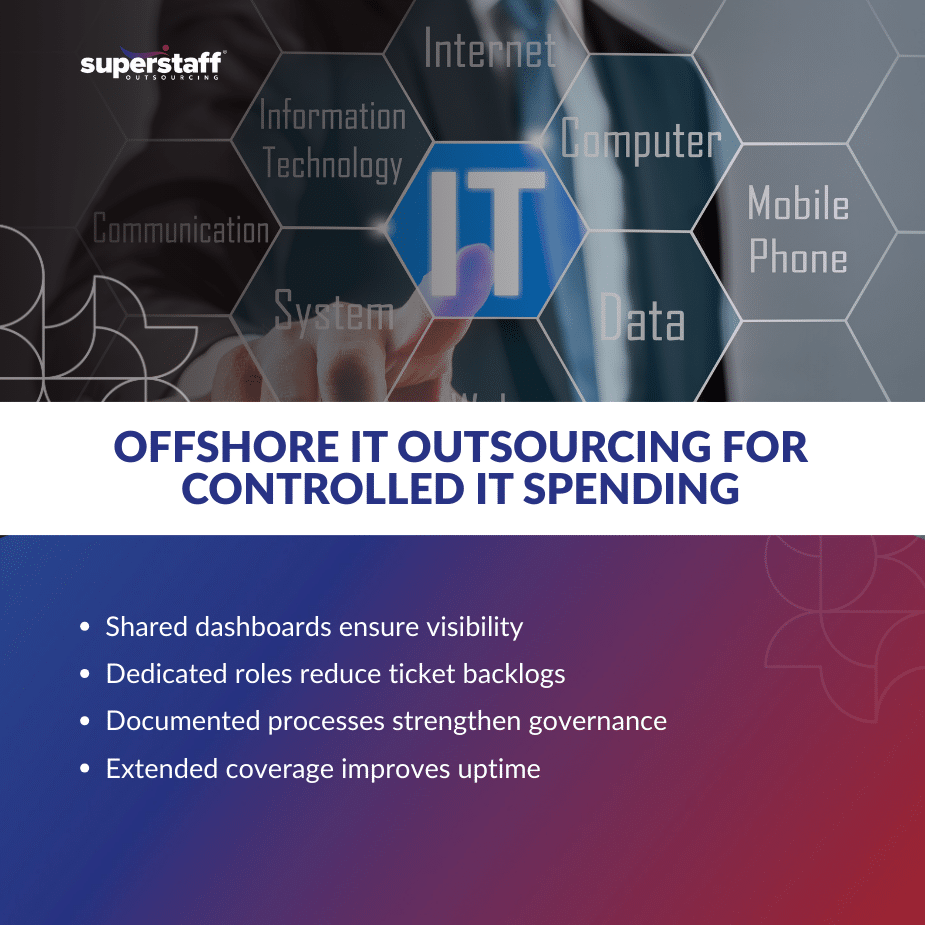
Offshore teams work inside the same ticketing systems and dashboards as internal staff. Every request, resolution, and escalation is visible.
Daily reports, KPI tracking, and performance reviews provide measurable oversight. Leaders see exactly how systems are managed. This transparency shows how offshore IT outsourcing reduces operational costs while maintaining clarity.
Managers can review response times, ticket volumes, and system performance in real time. These insights allow leadership to make data-backed decisions about IT resources and priorities.
Specialized Roles Reduce Internal IT Burden
Helpdesk support, system administration, and network monitoring become dedicated offshore roles. Each function follows defined responsibilities.
Faster response times reduce ticket backlogs. Internal staff no longer handle routine troubleshooting. Offshore IT outsourcing allows specialization that improves service consistency.
This structure prevents internal IT teams from being overwhelmed by repetitive requests. Instead, they gain capacity to focus on planning, upgrades, and technology improvements.
Predictable Costs Replace Reactive Spending
Hiring IT staff locally involves recruitment costs, onboarding time, and retention challenges. Overtime and contractor fees add further unpredictability.
Offshore IT cost savings come from stable staffing models and clear monthly costs. Budget planning becomes easier. Leaders gain financial clarity through offshore IT outsourcing benefits that extend beyond labor rates.
Finance teams appreciate the predictability. Instead of reacting to sudden hiring needs, organizations can plan IT expenses as part of their long-term operating model.
Process Discipline Improves IT Governance
Offshore teams follow documented procedures. Standard operating procedures guide every action.
Incident logs, change management records, and system documentation remain updated. This structure strengthens governance. Offshore IT outsourcing supports compliance through disciplined execution.
Well-documented processes also make audits easier. Leadership can trace actions, approvals, and system changes without relying on informal communication.
Extended Coverage Improves System Reliability
Time zone differences create operational advantages. Offshore teams monitor systems outside local business hours.
Alerts receive immediate attention. Overnight issues are resolved before the workday begins. Offshore IT outsourcing improves uptime without adding internal shifts.
Continuous monitoring reduces downtime and improves employee productivity. Teams start their day with systems already stable and functioning.
Structured Communication Maintains Leadership Visibility
Weekly reviews and performance discussions keep leadership informed. Shared dashboards present real-time metrics.
Accountability remains clear. Data-driven reporting shows how offshore IT outsourcing reduces operational costs while improving service levels.
Regular communication builds trust between internal leaders and offshore teams. This partnership model ensures alignment with business priorities.
Security and Compliance Are Embedded in Workflows
Access controls limit system entry. Data handling follows strict protocols. Secure environments protect sensitive information.
Offshore teams align with internal IT policies and compliance requirements. These safeguards reinforce trust in offshore IT outsourcing.
Security reviews, audits, and permissions management become routine practices rather than reactive measures.
Internal IT Teams Focus on Strategic Priorities
Routine troubleshooting consumes valuable time. Offshore support handles these operational tasks.
Internal IT leaders can focus on modernization, automation, and digital planning. Offshore IT outsourcing creates room for innovation without increasing budgets.
Teams gain the opportunity to evaluate new systems, improve workflows, and support broader company goals instead of constantly resolving minor issues.
Offshore IT Outsourcing Benefits Long Term Scalability
As businesses grow, IT demands increase. Adding users, systems, and tools requires additional support.
Offshore IT outsourcing allows companies to scale support capacity without restarting the hiring cycle. Additional roles can be added quickly while maintaining the same reporting structure and governance model.
This flexibility helps organizations adapt to growth without financial strain.
Measurable Performance Creates Continuous Improvement
Offshore teams operate with performance benchmarks. KPIs track resolution time, system uptime, and service quality.
Leaders can identify trends, address inefficiencies, and improve processes. This measurable approach highlights how offshore IT outsourcing reduces operational costs through performance management.
Continuous improvement becomes part of daily operations rather than an occasional initiative.
Control and Cost Efficiency Can Coexist
Offshore IT outsourcing allows organizations to control technology spending while maintaining oversight of systems, security, and performance. Structured processes, transparent reporting, and dedicated roles ensure that leaders remain fully informed. Offshore IT outsourcing delivers measurable value through visibility, governance, and predictable costs.
SuperStaff provides offshore IT teams that operate as reliable extensions of internal departments. Explore how SuperStaff can help your organization reduce costs without losing control.