

Reshoring manufacturing has become one of the most discussed strategies among global companies. Businesses that once relied heavily on offshore production are now bringing some operations closer to home. This change is not only reshaping how products are made but also affecting outsourcing decisions across different industries.
While reshoring manufacturing is meant to strengthen supply chains and reduce risks, it also creates a new set of opportunities and challenges for outsourcing providers. Companies are adjusting how they manage services, from logistics and customer support to IT and research. Understanding the effects of reshoring helps businesses, consultants, and investors plan ahead and adapt their strategies.
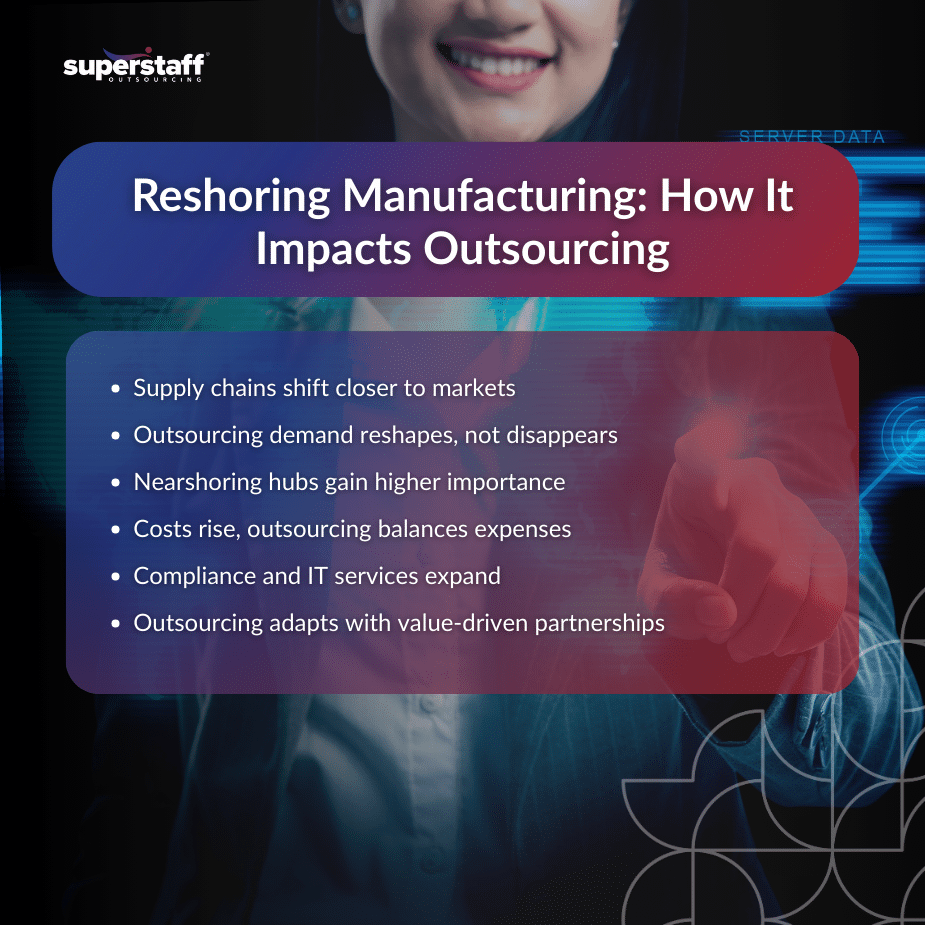
Why Reshoring Manufacturing Matters for Outsourcing
Reshoring is not only about moving production facilities back to domestic or nearshore locations. It influences the way businesses look at outsourcing as part of their global strategy. Some firms reduce their dependence on offshore outsourcing, while others shift to nearshore or domestic providers. The overall goal is to create more flexible and resilient operations.
1. Shifts in Global Supply Chain Strategy
Reshoring manufacturing changes how companies design their supply chains. With production moving closer to consumer markets, outsourcing partners in logistics and distribution play a new role. This adjustment also links closely to supply chain reshoring, where service providers must meet stricter delivery timelines and higher expectations for reliability.
2. Changing Demand for Outsourced Services
Global manufacturing outsourcing does not disappear when companies reshore. Instead, the demand shifts. Some services, such as offshore administrative support, may decline, but others, like compliance, IT support, and regional logistics outsourcing, increase. This creates a rebalanced outsourcing market.
3. Increased Role of Nearshoring
Nearshoring often goes hand in hand with reshoring manufacturing. Companies that move production back to North America or Europe may choose outsourcing partners in nearby regions for efficiency. Latin America and Eastern Europe, for example, gain attention as nearshore hubs for services like IT development and customer support.
4. Pressure on Cost Structures
Domestic labor and production costs are higher. To balance this, businesses may outsource non-core tasks such as payroll, HR, or IT management. This shows why companies’ reshoring manufacturing reduces outsourcing in some areas but increases it in others, creating a mixed model that balances cost and quality.
5. Impact on BPO and KPO Providers
Business process outsourcing (BPO) and knowledge process outsourcing (KPO) firms feel the impact of reshoring trends. Instead of offering only cost savings, they must prove value in expertise, speed, and flexibility. Services like analytics, R&D, and engineering support become more important as manufacturing moves closer to home.
Challenges Outsourcing Companies Must Address
Reshoring manufacturing does not eliminate outsourcing, but it changes how businesses select providers. Outsourcing companies must be aware of the challenges that come with this shift.
1. Reduced Demand for Offshore Services
Some companies scaling back offshore manufacturing may cut down related offshore services. This is especially true for functions tied directly to factory operations abroad.
2. Competition With Domestic Providers
As reshoring grows, outsourcing providers may compete with local service firms. Clients may prefer nearby vendors for easier coordination.
3. Adjusting to New Client Priorities
Reshoring puts more focus on speed, compliance, and adaptability. Outsourcing companies must show they can align with these new goals.
4. Smaller Contract Sizes
Large offshore contracts may shrink as businesses spread operations across multiple providers. This requires outsourcing companies to handle smaller, more specialized projects.
5. Need for Stronger Partnerships
Companies want providers who can act as long-term partners rather than low-cost vendors. This requires more investment in building trust and industry expertise.
Opportunities for Outsourcing in a Reshoring Era
Although reshoring changes the outsourcing landscape, it also creates new opportunities. Outsourcing providers that adapt can continue to grow.
1. Support for Supply Chain Reshoring
Outsourcing companies can expand services in logistics, transportation, and distribution to support reshoring efforts. This makes them valuable partners in building shorter supply chains.
2. IT and Technology Integration
Reshored manufacturing operations rely heavily on digital systems. IT outsourcing companies that provide software support, cybersecurity, and system integration are in demand.
3. Compliance and Risk Management
Companies bringing production back home face strict labor, safety, and environmental regulations. Outsourcing firms specializing in compliance services can support these needs.
4. Workforce Training and Development
BPO companies can help manufacturers manage workforce development, HR, and training programs that support reshored operations.
5. Specialized Service Niches
Outsourcing providers that focus on engineering support, product testing, or customer engagement gain new business as manufacturing transitions.
Long-Term Outlook on Reshoring and Outsourcing
The relationship between reshoring manufacturing and outsourcing will continue to evolve. Instead of seeing one replace the other, businesses will use both in combination. Outsourcing remains valuable for cost efficiency, flexibility, and access to talent, while reshoring supports control and reliability in production.
1. Hybrid Business Models
Many companies will adopt models that combine domestic production with outsourced services. This provides the best balance between control and cost savings.
2. Stronger Regional Hubs
Nearshoring hubs will expand as businesses look for partners close to their reshored operations.
3. Growing Demand for Value-Added Services
Instead of only low-cost tasks, outsourcing providers will handle higher-value functions that require specialized expertise.
4. Strategic Partnerships
Outsourcing relationships will shift toward deeper, long-term partnerships built on trust and shared goals.
5. Broader Global Distribution
Even with reshoring, some operations will stay offshore, creating a more balanced global network of providers.
Reshoring Reshapes the Outsourcing Landscape
Reshoring manufacturing is not the end of outsourcing. Instead, it redefines how outsourcing fits into the global business model. By bringing production closer while continuing to outsource key services, companies gain both control and efficiency.
SuperStaff understands these shifts and supports businesses in finding the right outsourcing solutions during this transition. Whether through supply chain support, IT services, or specialized outsourcing functions, SuperStaff helps clients build strategies that align with reshoring while maintaining flexibility and long-term growth.
Explore Outsourcing Opportunities in a Reshoring Era
Reshoring manufacturing is changing how businesses think about outsourcing, but it does not remove its importance. Companies can still benefit from outsourcing by choosing providers that adapt to this new environment. From logistics to IT, outsourcing remains an essential tool for balancing costs and improving operations.
SuperStaff works with companies to evaluate emerging opportunities in outsourcing while reshoring strategies take shape. By focusing on cost efficiency, skilled talent, and operational stability, SuperStaff helps businesses succeed in a reshoring era.