Business growth often brings new demands on employees, managers, and daily operations. As companies take on more customers, projects, and responsibilities, their existing teams may struggle to keep up. Hiring additional employees can help, but recruitment takes time and requires resources that businesses may need for other priorities.
Partnering with an outsourced staffing team gives companies another way to manage these demands. It allows them to access qualified professionals, assign tasks based on business needs, and increase workforce capacity without handling every part of recruitment internally.
With the right staffing arrangement, businesses can respond to changing workloads, manage operating costs, and support expansion while keeping their internal teams focused on their main responsibilities.
How an Outsourced Staffing Team Works
An outsourced staffing team provides employees or professionals who handle specific business functions on behalf of a company. These workers may support customer service, administrative tasks, recruitment, technical support, data processing, and other daily operations.
The arrangement depends on the company’s requirements. Some businesses need additional staff for a short-term project, while others require dedicated teams to manage ongoing tasks. The outsourcing provider can help source candidates, assess their qualifications, and coordinate the hiring process.
This approach also reduces the amount of recruitment work handled internally. Instead of managing every hiring step alone, businesses can work with a provider that already has recruitment processes and access to potential candidates. Companies can review outsourced recruitment solutions to understand how external recruitment support can help them find suitable employees.
Challenges of Scaling Operations In-House
Building an internal workforce can become difficult when business needs change quickly. Recruitment teams may have to fill several positions at once, review large numbers of applications, and coordinate interviews while managing their existing responsibilities.
These demands can delay hiring and leave important positions vacant. When teams operate with fewer employees than needed, current staff may have to take on extra work. This can affect productivity, service quality, and employee satisfaction.
Hiring also involves costs beyond salaries. Businesses need to consider recruitment expenses, training, equipment, software access, and employee benefits. These costs can place pressure on budgets, especially when companies need to expand across several departments.
For businesses with changing workloads, relying only on internal hiring may not provide enough flexibility. A staffing plan that includes external support can help companies respond to workforce needs without placing all recruitment and administrative responsibilities on their internal teams.
Why Businesses Choose Outsourced Staffing
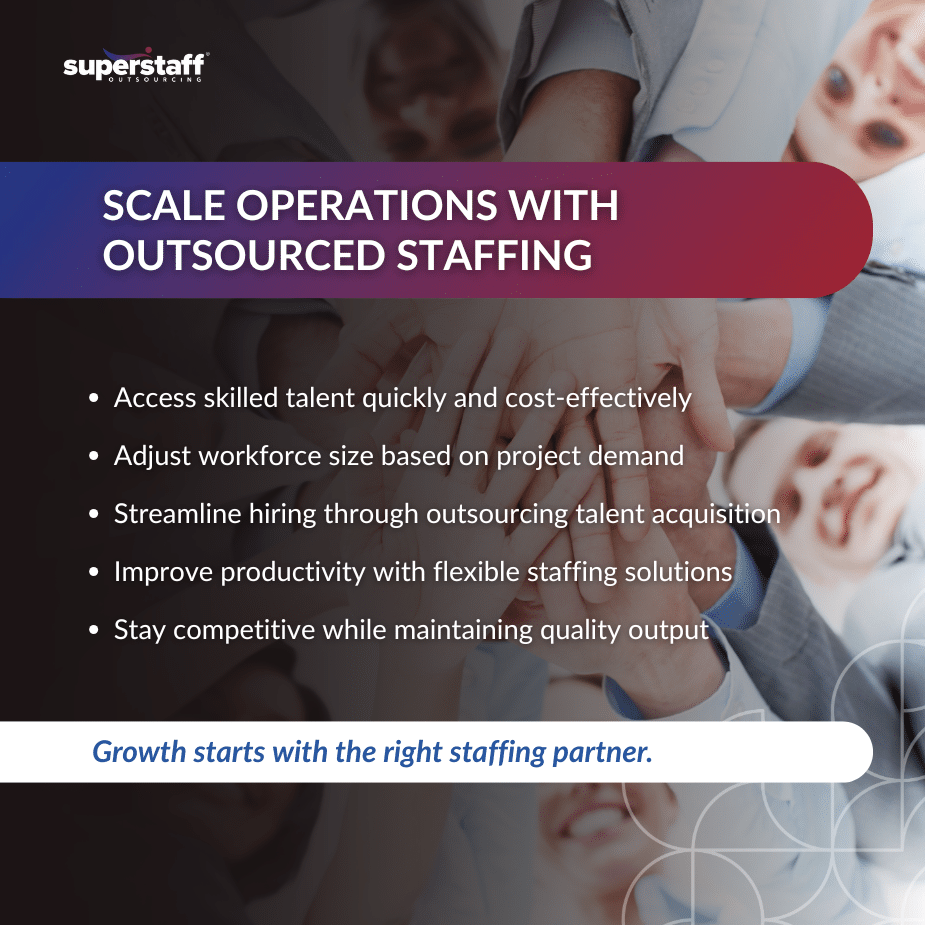
Companies choose outsourced staffing because it gives them access to additional workers without requiring them to manage every part of recruitment. This can be useful when a business needs to fill several positions, support a new project, or maintain service levels during periods of increased demand.
An external staffing provider can help identify candidates with the skills and experience required for specific roles. This may reduce the time internal teams spend searching for applicants and reviewing qualifications. Businesses can then focus on selecting people who match their operational requirements.
Workforce planning also plays a role in making these decisions. The Society for Human Resource Management discusses recruitment challenges and changing talent needs in its 2025 Talent Trends research. Understanding these workforce changes can help companies assess when external staffing support may be useful.
Outsourcing does not mean giving up control of business operations. Companies can still set performance standards, define responsibilities, and monitor the work completed by outsourced employees. The provider supports staffing requirements while the business maintains oversight of its goals and processes.
Why Businesses Choose Outsourced Staffing
Companies choose outsourced staffing because it gives them access to additional workers without requiring them to manage every part of recruitment. This can be useful when a business needs to fill several positions, support a new project, or maintain service levels during periods of increased demand.
An external staffing provider can help identify candidates with the skills and experience required for specific roles. This may reduce the time internal teams spend searching for applicants and reviewing qualifications. Businesses can then focus on selecting people who match their operational requirements.
Workforce planning also plays a role in making these decisions. The Society for Human Resource Management discusses recruitment challenges and changing talent needs in its 2025 Talent Trends research. Understanding these workforce changes can help companies assess when external staffing support may be useful.
Outsourcing does not mean giving up control of business operations. Companies can still set performance standards, define responsibilities, and monitor the work completed by outsourced employees. The provider supports staffing requirements while the business maintains oversight of its goals and processes.
Improving Productivity Through Better Workload Distribution
When employees handle too many responsibilities, important tasks can take longer to complete. Managers may also spend more time resolving workload issues instead of focusing on planning, performance, and business development.
An outsourced staffing team can help distribute work across a larger group of employees. For example, a company may assign customer inquiries, appointment scheduling, data entry, or order processing to an external team. This gives internal employees more time to handle tasks that require company-specific knowledge or direct management attention.
Clear role assignments are important for this arrangement to work. Businesses should identify which tasks can be outsourced, define expected output, and establish reporting procedures. Both internal and outsourced employees should understand their responsibilities and how their work supports the same business goals.
Regular communication also helps prevent duplicated tasks and missed responsibilities. Managers can review workloads, discuss concerns, and make adjustments when business requirements change.
How Outsourced Staffing Supports Business Growth
An outsourced staffing arrangement can support growth by helping companies increase their workforce capacity when demand rises. Businesses may need additional employees when entering new markets, handling more customer requests, launching services, or managing larger projects.
Instead of waiting for a full internal recruitment cycle, companies can work with a staffing provider to identify people who meet their requirements. This can help them respond to new opportunities while keeping existing operations running.
Outsourcing can also provide access to different skill sets. A company may need customer support representatives, administrative staff, technical specialists, or other professionals without having to build every function internally. Businesses looking at this approach can also review outsourcing talent acquisition to understand how external recruitment support can help with hiring needs.
However, adding more employees does not automatically improve performance. Companies still need proper onboarding, clear instructions, suitable tools, and regular performance reviews. These steps help ensure that new team members can contribute effectively and meet the expected standards.
Best Practices for Managing an Outsourced Team
Managing an outsourced team requires clear expectations and consistent communication. Businesses should establish processes that help external employees understand their roles and work effectively with internal departments.
1. Set Clear Roles and Responsibilities
Before work begins, businesses should explain the tasks involved, expected output, reporting structure, and performance standards. This helps employees understand what they need to deliver and how their work will be evaluated. Clear responsibilities also reduce duplicated tasks and confusion between internal and outsourced teams.
2. Maintain Regular Communication
Companies should assign an internal point of contact who can coordinate with the outsourcing provider. This person can handle questions, share updates, review concerns, and make sure both teams follow the agreed processes. Regular meetings can also help managers address problems before they affect daily operations.
3. Provide Proper Training and Monitor Performance
Even experienced employees need to understand company policies, internal systems, customer requirements, and work procedures. Providing suitable training materials can help reduce errors and improve consistency.
Performance reviews should focus on measurable results. Depending on the role, businesses may monitor response times, task completion rates, accuracy, customer feedback, or productivity. Reviewing these measures regularly helps managers identify issues and decide when additional training or process changes are needed.
Choosing the Right Staffing Partner
The success of an outsourced staffing arrangement depends partly on the provider’s ability to understand and meet the company’s needs. Businesses should review a provider’s recruitment process, experience, available talent, communication practices, and ability to support different staffing requirements.
It is also important to understand how the provider handles candidate screening, onboarding, training, and performance concerns. Companies should discuss service expectations before signing an agreement, including staffing timelines, responsibilities, reporting procedures, and costs.
Data security and confidentiality should also be part of the evaluation. If outsourced employees will access customer records, internal systems, or company information, businesses should confirm that the provider follows suitable security procedures and access controls.
SuperStaff offers Recruitment Process Outsourcing services to support candidate sourcing, screening, and onboarding. Companies can assess whether this type of service fits their hiring needs and workforce plans.
Planning for Sustainable Business Expansion
Businesses should review their workforce requirements regularly instead of hiring only when workloads become difficult to manage. A clear staffing plan helps managers understand which roles are essential, where skill gaps exist, and when additional support may be needed.
1. Review Current and Future Workloads
Companies can review sales forecasts, customer demand, project schedules, and departmental workloads to estimate future staffing requirements. This makes it easier to decide whether to hire internally, outsource specific functions, or use a combination of both.
2. Compare Staffing Costs
Budget planning is equally important. Businesses should compare the costs of different staffing arrangements and consider expenses such as recruitment, training, equipment, management, and employee benefits. The goal is to choose an approach that supports business needs without creating unnecessary costs.
3. Adjust Staffing Plans as Operations Change
A staffing model that works for a small team may need adjustments when the business serves more customers or takes on additional responsibilities. Regular reviews help ensure that workforce capacity remains aligned with business goals and that the company has enough support for its next stage of growth.
Build a Stronger Workforce With Smart Outsourcing
Expanding a business requires enough people to manage increasing workloads and maintain service quality. However, handling every recruitment and staffing requirement internally can take time away from other business priorities. An outsourced staffing team gives companies another way to access qualified professionals and support daily operations.
SuperStaff provides staffing and outsourcing solutions for customer service, back-office operations, technical support, and other business functions. With the right arrangement, companies can add workforce capacity, improve task distribution, and respond to changing operational requirements.
Before choosing a provider, businesses should identify the roles they need to fill, the tasks they want to outsource, and the level of support required. Clear goals and regular performance reviews can help ensure that the arrangement continues to meet business needs.
Companies looking for staffing support can contact SuperStaff to discuss their workforce requirements and find an outsourcing arrangement that fits their operational goals.