Logistics leaders today face constant pressure to move faster while keeping costs predictable. Customer expectations continue to rise. Delivery windows are tighter. Visibility gaps are less tolerated. In this environment, supply chain outsourcing services are no longer viewed as a support function. They are becoming a core enabler of scale, resilience, and operational discipline.
For U.S. SMEs and midmarket companies, Colombia has emerged as a practical location for building outsourced logistics support teams. The value is not rooted in labor arbitrage alone. It comes from proximity, talent alignment, and the ability to extend operations without introducing unnecessary complexity.
This article explores how companies use Colombia-based outsourcing models to strengthen logistics operations while maintaining control and accountability.
Why Logistics Scalability Is Harder Than It Looks
Growth exposes friction. Order volumes rise faster than internal processes mature. Manual workarounds multiply. Teams stretch beyond capacity. These pressures often surface first inside logistics and supply chain functions.
Many organizations respond by adding internal headcount. That approach works in the short term. Over time, it introduces fixed costs and operational rigidity. Others invest in new systems before stabilizing workflows. That path can create expensive underutilization.
A growing number of operators instead turn to supply chain outsourcing services to add capacity where it matters most. The goal is to scale execution without overbuilding internal teams.
Why Colombia Fits the Logistics Support Model
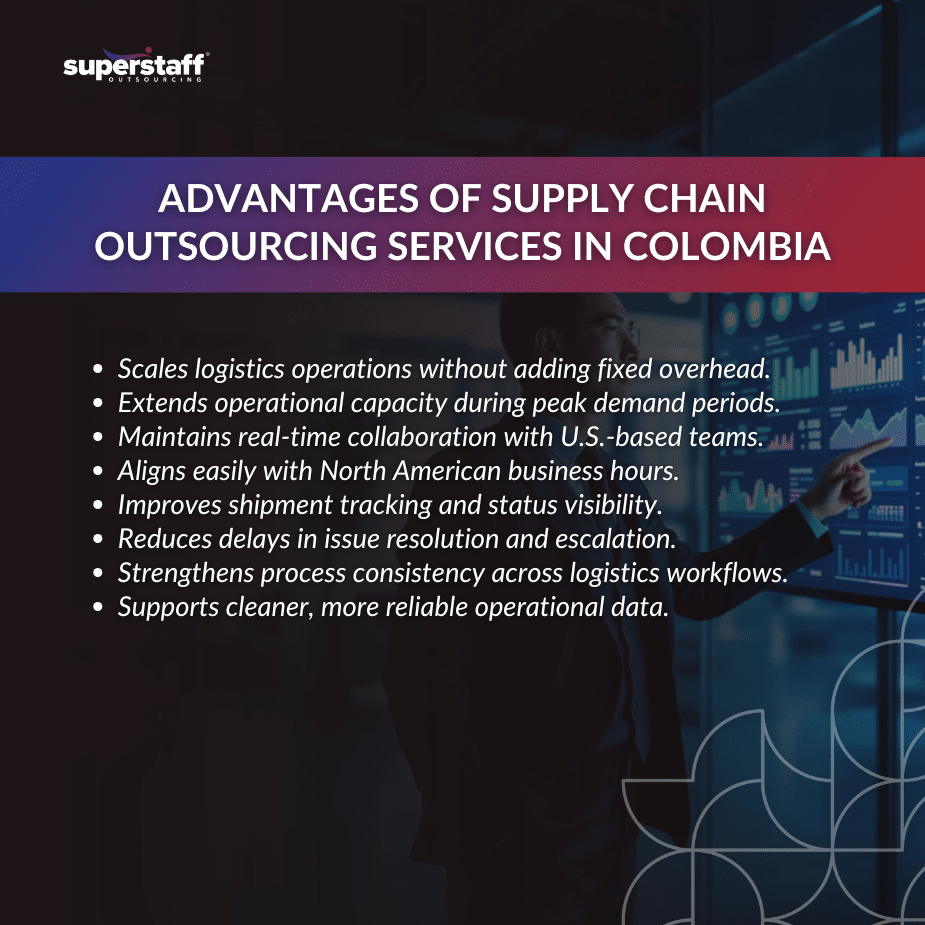
Colombia offers practical advantages for logistics support roles that require accuracy, responsiveness, and real-time coordination. Time zone alignment with the U.S. enables same-day collaboration. Cultural compatibility supports clear communication. Workforce availability allows teams to scale gradually.
Nearshore models also reduce escalation delays. Issues that once waited overnight can be addressed during the same business day. For logistics operations, that timing difference has a tangible impact on service levels.
Companies that adopt supply chain outsourcing services in Colombia often start with back-office logistics functions. Over time, many expand into more integrated support roles as trust and process maturity grow.
Logistics Functions Commonly Outsourced to Colombia
Outsourcing does not mean handing over strategic control. It means distributing execution to the right teams. In logistics operations, several functions lend themselves well to nearshore support.
Typical outsourced roles include shipment tracking and updates, order management, documentation support, and carrier coordination. Exception handling and data validation are also common. These tasks require consistency more than proximity to physical goods.
When structured correctly, supply chain outsourcing services free internal teams to focus on planning, vendor strategy, and customer relationships. Execution becomes more predictable. Bottlenecks are easier to spot.
Improving Visibility Without Adding Complexity
Visibility is often discussed as a technology challenge. In reality, it is an operational discipline issue. Systems only work as well as the data entered and monitored.
Colombia-based logistics outsourcing services play a critical role here. Dedicated staff monitor shipments, update systems, and flag exceptions before they escalate. This creates cleaner data flows across platforms.
Organizations using supply chain outsourcing services in this way often experience fewer surprises. Delays are identified earlier. Customer communications become more proactive. Internal reporting improves without additional tooling.
Supporting Peak Demand Without Permanent Overhead
Seasonality is a constant in logistics. Promotions, weather events, and market shifts can strain teams quickly. Hiring full-time staff to manage temporary surges creates inefficiency.
Outsourced logistics teams offer elasticity. Headcount can be adjusted based on volume patterns. Training investments are preserved within the provider model rather than recreated internally.
For many firms, supply chain outsourcing services provide a buffer against volatility. Operations remain stable during peaks without locking in long-term costs during slower periods.
Strengthening Compliance and Process Consistency
As companies grow, process drift becomes a risk. Different teams develop different ways of handling the same task. Errors increase. Audit trails weaken.
Outsourced logistics support teams operate within documented workflows. Quality checks and performance metrics are built into delivery models. This reinforces consistency across transactions.
Organizations that rely on supply chain outsourcing services often gain stronger process governance. Standard operating procedures are followed more closely. Exceptions are logged and reviewed instead of absorbed silently.
Nearshore Collaboration Improves Decision Cycles
Logistics decisions rarely happen in isolation. They require coordination between sales, operations, and customer support. Time zone misalignment slows that collaboration.
Colombia’s alignment with U.S. business hours reduces friction. Daily stand-ups include outsourced teams without scheduling strain. Escalations are resolved in real time.
This collaborative rhythm enhances the value of supply chain outsourcing services. Outsourced teams feel embedded rather than detached. Decision cycles shorten. Accountability improves.
Risk Management Through Distributed Operations
Concentration risk is often overlooked in logistics planning. Single-location teams are vulnerable to disruptions. Distributed models offer resilience.
Nearshore outsourcing introduces geographic diversity without the coordination challenges of far-off locations. Political stability, mature infrastructure, and growing professional services sectors support continuity.
Companies using supply chain outsourcing services as part of a broader risk strategy benefit from operational redundancy. Critical tasks continue even when internal teams face disruption.
Making Outsourcing Work at the Execution Level
Success depends on structure. Clear role definitions matter. Performance metrics must be aligned with business outcomes. Communication rhythms should be deliberate.
Effective supply chain outsourcing services are integrated, not siloed. Teams receive context, not just tasks. Leaders on both sides review performance together and adjust processes collaboratively.
This operating model shifts outsourcing from a transactional arrangement to a strategic extension of the organization.
How SuperStaff Supports Scalable Logistics Operations
SuperStaff works with U.S. companies to build nearshore teams that strengthen logistics execution. The focus is on alignment, accountability, and long-term value creation.
Teams are trained on client-specific workflows and systems. Management structures emphasize transparency and performance tracking. Scaling decisions are guided by operational needs, not fixed templates.
By integrating supply chain outsourcing services into a broader support strategy, SuperStaff helps logistics leaders extend capacity without losing control.
Turn to SuperStaff Colombia for Supply Chain Outsourcing Services
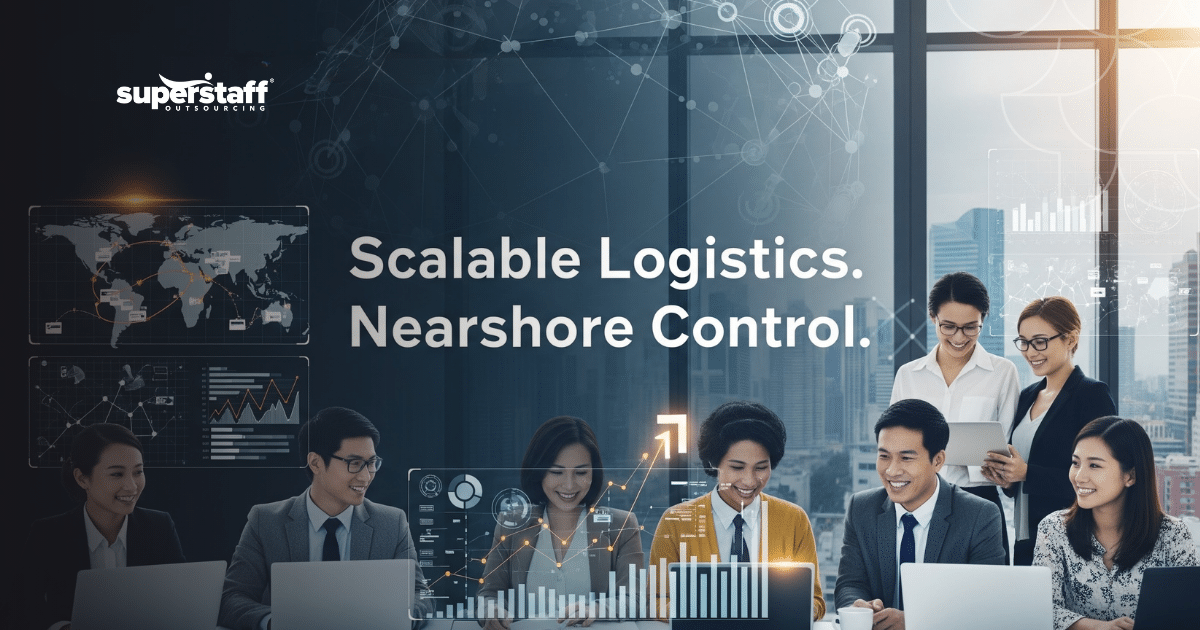
Logistics scalability is no longer optional. It is a requirement for competing in dynamic markets. Colombia offers a practical nearshore environment for building responsive, disciplined support teams. When implemented thoughtfully, supply chain outsourcing services enable growth while reinforcing visibility, compliance, and resilience.
SuperStaff partners with SMEs and midmarket companies to design logistics support models that scale with confidence. Explore how SuperStaff can help strengthen your logistics operations and build a supply chain ready for what comes next.