Business leaders face a familiar challenge. Teams operate across multiple systems, yet the tools that support them often remain disconnected. Customer data sits in one platform. Support tickets appear in another. Financial workflows move through separate software. These gaps slow teams down and make operations harder to scale.
Many companies are now turning to automation integration services to close these gaps. By connecting systems and workflows, organizations can create smoother operations between in-house teams and outsourced support groups.
For companies exploring outsourcing, this approach creates a more efficient way to manage processes, technology, and people at the same time.
Why Businesses Struggle With Disconnected Systems
Many organizations grow quickly by adding new tools over time. A CRM may handle sales activity. A help desk platform tracks support tickets. Finance teams rely on separate accounting tools. While each system works well on its own, problems arise when they do not communicate with each other.
Disconnected systems create operational friction.
- Customer data must be entered multiple times
• Support agents switch between platforms to resolve issues
• Managers struggle to see performance across teams
• Reporting requires manual consolidation
As companies scale, these issues multiply. Employees spend valuable time managing systems instead of serving customers or improving operations.
Automation integration services help remove these barriers by connecting systems and streamlining workflows. Once systems communicate, teams can focus on higher-value work.
This growing need is why automation integration is becoming a central part of outsourcing strategies.
How Automation Integration Supports Outsourcing Success
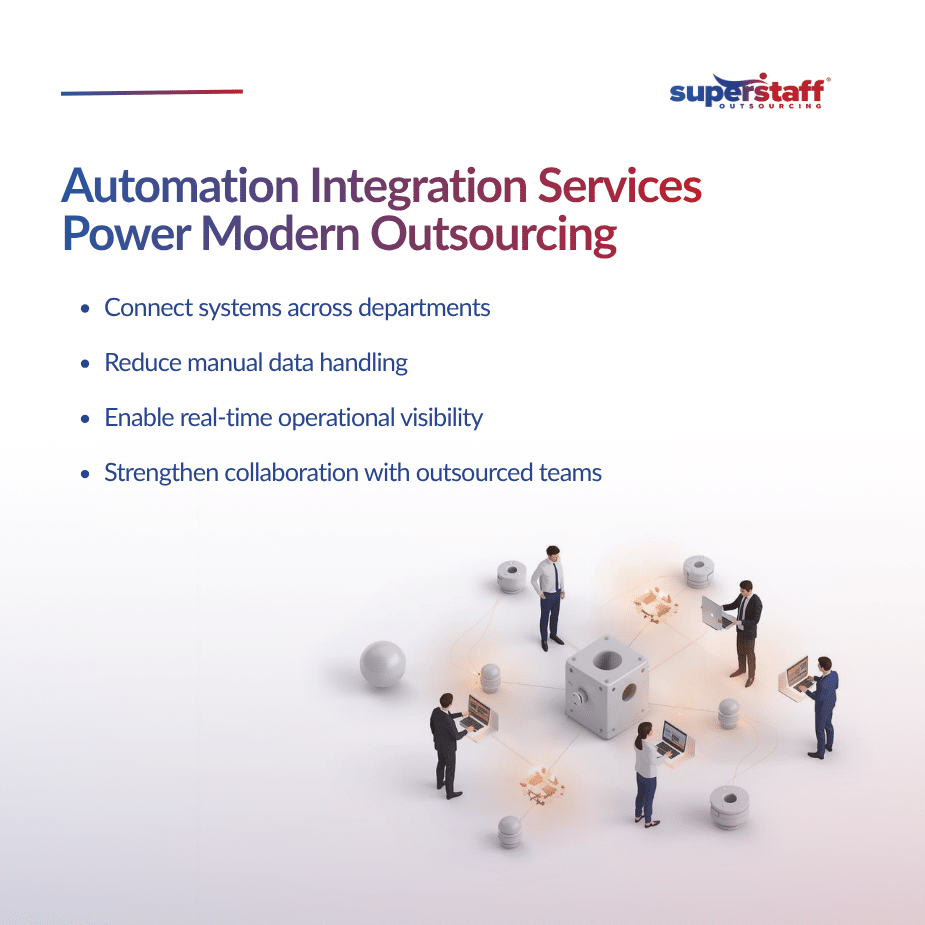
Outsourcing has traditionally focused on talent and cost efficiency. Today, technology integration is just as important. When systems are properly connected, outsourced teams operate with the same visibility and efficiency as internal staff.
Automation integration services create that connection between platforms and people.
For example, a U.S. company may outsource customer support to a team in the Philippines. Without integrated systems, agents must navigate several platforms to access order information, shipping details, and customer history.
However, when systems are integrated:
- Customer data flows automatically into the support platform
• Tickets sync with internal CRM systems
• Order updates appear instantly for agents
As a result, outsourced teams can work faster and provide more consistent service.
Technology alignment strengthens outsourcing relationships and ensures that remote teams operate as an extension of the core business.
Automation Integration Improves Operational Visibility
Leadership teams need clear visibility across operations. Yet fragmented systems often make it difficult to see performance in real time.
Automation integration services solve this challenge by creating connected data environments.
Integrated platforms allow companies to monitor:
- Customer support volumes
• Response times and service levels
• Operational bottlenecks
• Team productivity
With automated data flow, reporting becomes more accurate and timely.
For example, a customer support platform may automatically update a CRM system when a ticket is resolved. Management dashboards can then display real-time service metrics across internal and outsourced teams.
This visibility helps leaders make informed decisions about staffing, workflow improvements, and resource allocation.
Creating Seamless Workflows Between Teams
One of the biggest advantages of automation integration services is the ability to create smooth workflows between departments and locations.
When processes rely on manual handoffs, delays are common. Tasks sit in queues while teams wait for updates from other systems.
Automation reduces these delays.
Consider a logistics company that outsources track and trace support. When shipment updates are integrated with the support platform, agents receive real-time information automatically.
That allows them to:
- Respond to customer inquiries faster
• Provide accurate shipment updates
• Reduce internal coordination delays
As a result, the outsourced team becomes tightly aligned with the company’s operational systems.
Seamless workflows strengthen collaboration between internal staff and external partners.
Automation Reduces Manual Work and Errors
Manual data entry is one of the most common causes of operational errors. When employees must copy information across systems, mistakes become unavoidable.
Automation integration services address this issue by enabling systems to exchange information automatically.
Benefits include:
- Fewer duplicate data entries
• Reduced risk of human error
• Faster transaction processing
• Improved data accuracy across platforms
For customer support teams, this improvement is significant.
Agents can access complete customer histories without switching systems or manually searching for information. That leads to faster resolution times and better service experiences.
Automation also supports compliance and recordkeeping by ensuring data remains consistent across platforms.
Supporting Scalable Growth
Scaling operations often introduces new complexity. As companies grow, they adopt additional tools to manage marketing, sales, finance, and support.
Without integration, these tools create operational silos.
Automation integration services allow organizations to scale more efficiently by linking these systems together.
For example, when new customer accounts are created in a CRM, automation can trigger several processes:
- Customer onboarding workflows begin automatically
• Support profiles are created instantly
• Billing systems receive account details
This level of integration ensures that growth does not overwhelm operations.
Outsourced teams benefit as well because they can immediately access updated information without waiting for manual updates.
Strengthening Customer Experience Through Integrated Systems
Customer expectations continue to rise. Clients expect fast responses and accurate information across every interaction.
When systems are disconnected, agents struggle to deliver consistent service. They must search across multiple tools to answer even simple questions.
Automation integration services help resolve this challenge.
Integrated systems allow customer support teams to view:
- Order history
• Previous support interactions
• Account status
• Delivery updates
With this information available in a single interface, agents can resolve issues faster.
Customers benefit from quicker responses and more accurate answers. Companies benefit from improved satisfaction and retention.
Automation integration therefore plays a direct role in customer experience performance.
Why Automation Integration Expands the Role of Outsourcing
Outsourcing used to focus mainly on operational tasks such as customer support or back-office processing. However, automation integration services are expanding the strategic value of outsourced teams.
Today, outsourcing providers can help companies:
- Connect multiple software platforms
• Manage automated workflows
• Maintain integrated support systems
• Improve operational reporting
These capabilities allow outsourcing partners to contribute to broader digital transformation efforts.
For many organizations, outsourcing providers now serve as operational partners that help manage both talent and systems.
This shift increases the strategic importance of outsourcing relationships.
Practical Use Cases for Automation Integration
Automation integration services support many different business functions. Several use cases illustrate how organizations benefit from integrated systems.
Customer support operations
Integrated CRM and help desk platforms allow outsourced agents to access customer records instantly.
E-commerce order management
Order systems, inventory tools, and support platforms sync automatically, giving agents real-time updates.
Finance and billing coordination
Invoices generated in accounting systems automatically update customer service platforms when payment issues arise.
Logistics and shipping support
Tracking systems connect with support platforms so agents can quickly respond to shipment inquiries.
Each example shows how integration connects systems and teams in practical ways.
When systems communicate seamlessly, outsourced teams can operate with speed and accuracy.
Why the Philippines Is a Strategic Location for Automation-Enabled Outsourcing
The Philippines has long been a leading destination for outsourcing. Strong English proficiency, customer service expertise, and a mature BPO industry make it an attractive option for global companies.
Today, automation integration services are strengthening that position.
Many outsourcing providers in the Philippines now combine operational support with technology expertise. Teams are trained to work within integrated platforms and automated workflows.
For U.S. companies, this combination offers several advantages:
- Skilled professionals familiar with global software platforms
• Support teams that adapt quickly to new systems
• Providers that understand both operations and technology
This environment makes it easier for companies to implement automation while maintaining strong service delivery.
Outsourcing partners in the Philippines can help organizations connect systems and teams in a structured way.
Building an Automation-Ready Outsourcing Strategy
Companies interested in automation integration services should begin by evaluating their current systems and workflows.
Key questions include:
- Which systems currently operate in isolation
• Where manual data entry slows operations
• Which workflows require multiple platform updates
• Which teams depend on cross-system coordination
Once these areas are identified, businesses can begin designing integration strategies.
Automation may involve connecting CRM systems with support platforms, integrating logistics tools with customer service dashboards, or linking billing systems with account management platforms.
Outsourcing partners can support this process by providing teams that already work within integrated systems.
This combination of technology and operational expertise allows companies to scale more effectively.
Building Stronger Operations With the Right Partner
Automation integration is reshaping how companies manage operations. Businesses no longer need to choose between talent and technology. Instead, the most effective strategies combine both.
Automation integration services allow organizations to connect systems, streamline workflows, and support distributed teams.
When these integrations are paired with skilled outsourced professionals, companies gain both efficiency and flexibility.
SuperStaff helps businesses build these capabilities. Our teams in the Philippines support customer service, back-office operations, and workflow coordination while working within integrated systems that align with your technology stack.
If your organization is exploring ways to connect systems, improve efficiency, and scale operations, the next step may involve combining outsourcing with automation integration services.
Explore how SuperStaff can help you build a smarter, more connected support model.