For many growing U.S. companies, technical issues are no longer limited to software users or IT departments. Customers expect quick answers when a portal fails, a payment tool freezes, an app update creates confusion, or a device does not connect as expected. This is why tech support remote has become a practical operating model for SMEs and midmarket companies that need reliable support without building a large internal team from scratch.
The challenge is not simply answering tickets. The real challenge is protecting trust while keeping service levels consistent, costs manageable, and internal teams focused on higher-value work. When technical support is slow, customers do not separate the support experience from the product experience. They see one brand.
For companies under pressure to scale, SuperStaff helps build dedicated support teams in the Philippines that combine technical process discipline with strong customer care. The result is a support function that feels professional, responsive, and aligned with the business.
Why Tech Support Remote Matters For Growing Companies
A tech support remote model gives businesses access to trained support talent without relying only on local hiring. This matters for companies that are expanding across time zones, serving more digital customers, or launching products that require hands-on user assistance.
Many SMEs reach a point where their internal team can no longer manage technical questions efficiently. Product managers answer user tickets. Operations leaders chase unresolved issues. Developers get pulled into repetitive troubleshooting.
That setup creates hidden costs.
Common signs that a company needs a stronger support model include:
- Technical tickets are slowing down internal teams
• Customers repeat the same issues across channels
• Response times change depending on staff availability
• Support documentation exists, but no one uses it consistently
• Escalations reach engineers too often
• Customers need help outside regular business hours
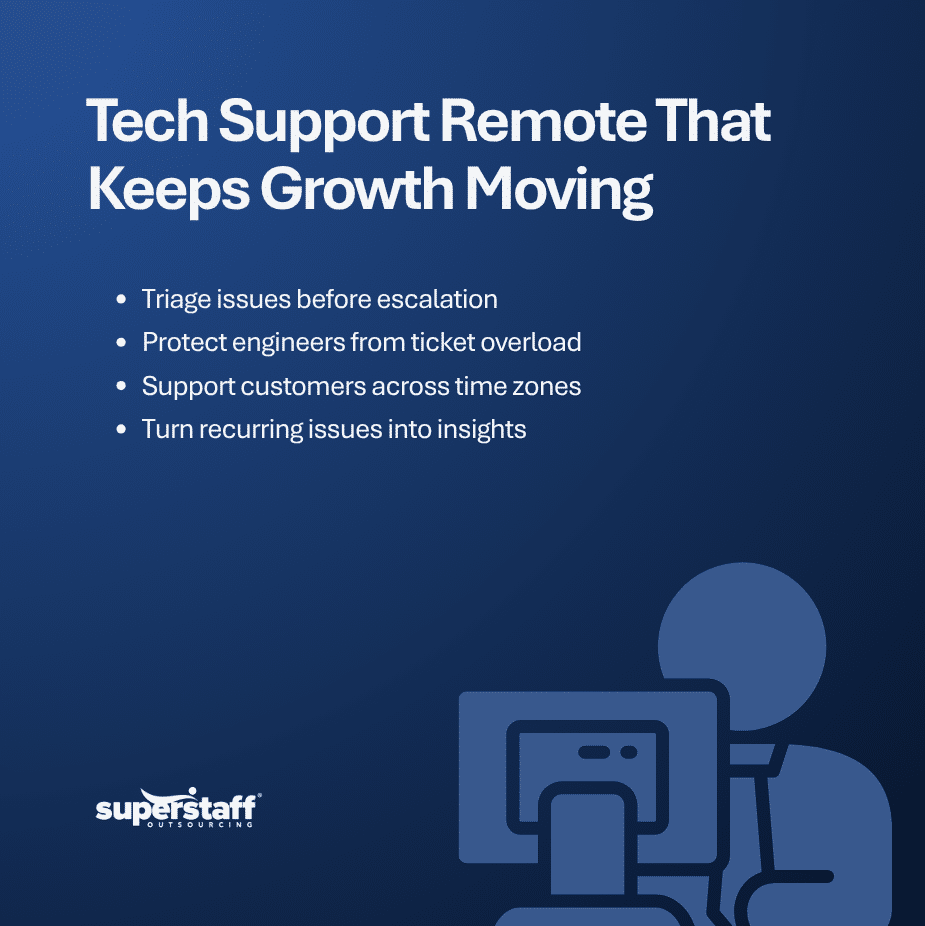
A tech support remote team helps remove that pressure. It creates a structured first line of support that can handle common issues, document recurring problems, and escalate only when needed.
The Real Value Is Operational Control
Many leaders first consider outsourcing because of cost. That is valid, but cost should not be the only reason. The bigger value of tech support remote operations is control.
A well-managed remote support team can help standardize how customer issues are received, categorized, resolved, and reported. This gives leaders better visibility into the customer experience.
For example, if customers keep asking the same setup questions, that may point to a product onboarding gap. If tickets spike after every update, that may show where release notes or user education need improvement. If certain issues always require escalation, that may reveal where knowledge base content is weak.
This is where outsourcing becomes more strategic. A tech support remote team is not only answering questions. It is helping the business understand where friction happens.
That insight can support:
- Better product documentation
• Faster issue triage
• Cleaner escalation paths
• More accurate customer feedback loops
• Stronger post-sale support
• Lower pressure on internal technical teams
This is also where keyword planning matters in SEO, but in operations, the “keyword” is clarity. Leaders need clear data, clear workflows, and clear ownership.
Why The Philippines Fits Technical Support Work
The Philippines has long been a trusted destination for customer support because of its strong English proficiency, service culture, and experience supporting U.S. customers. Those same strengths translate well into tech support remote programs.
Technical support requires more than product knowledge. Agents must explain steps clearly, remain patient with frustrated users, and know when an issue needs escalation. The best support agents do not overwhelm customers with technical language. They guide them through the fix in a way that feels calm and professional.
That communication style is critical for U.S. SMEs and midmarket companies. Many customers contacting support are not technical users. They may be business owners, patients, shoppers, employees, vendors, or field staff who simply need a tool to work.
A tech support remote team in the Philippines can help companies deliver that balance of technical accuracy and human support.
What A Strong Remote Tech Support Team Can Handle
A tech support remote team can support a wide range of business needs, depending on the company’s tools, products, and support maturity.
Common support functions include:
- Password resets and account access support
• Basic troubleshooting for software and platforms
• Ticket intake, tagging, and prioritization
• Live chat and email technical assistance
• Help desk support for employees or customers
• Product setup guidance
• Knowledge base updates
• Order, portal, or system navigation support
• Escalation coordination with internal IT or development teams
• Follow-up communication after issue resolution
For a software company, this may mean helping users troubleshoot login issues or understand platform features. For an e-commerce brand, it may involve helping customers navigate order tracking tools or payment errors. For a healthcare business, it may involve supporting patient portals, scheduling platforms, or secure account access.
The structure changes by industry, but the goal stays the same. A tech support remote team helps customers get unstuck quickly.
The Executive Question Is Not Whether Remote Works
For decision-makers, the question is not whether remote support can work. It already does for many global businesses. The better question is whether the company has the right partner, process, training, and governance to make it work well.
A poor setup can create problems. Agents may lack product context. Escalations may be unclear. Reporting may be too shallow. Customers may receive inconsistent answers.
That is why the operating model matters.
Before launching a tech support remote program, leaders should define:
- Which issues agents can resolve independently
• Which issues require escalation
• What response times should apply by channel
• What tools agents will use
• How quality will be monitored
• How product updates will be shared
• How customer feedback will reach internal teams
These decisions create the foundation for reliable support. Without them, outsourcing becomes reactive. With them, it becomes scalable.
How SuperStaff Builds A Better Support Experience
SuperStaff helps companies build remote teams that are aligned with their customer experience goals, not treated as disconnected vendors. This matters because technical support represents the brand in some of the most sensitive customer moments.
When a customer contacts support, something has already gone wrong or become unclear. The quality of that interaction can influence whether the customer stays, upgrades, complains, or leaves.
SuperStaff’s approach to tech support remote operations focuses on building dedicated teams that understand the client’s product, workflows, tone, escalation process, and customer expectations. The goal is to create a support experience that feels integrated, not outsourced.
For SMEs and midmarket companies, that can mean starting with a small team and expanding as ticket volume grows. It can also mean building coverage for specific channels, such as email, chat, voice, or internal help desk requests.
This flexibility is important for companies that want support capacity without overcommitting too early.
What Leaders Should Look For In A Partner
Choosing a tech support remote partner should involve more than comparing rates. The right partner should help protect customer trust and reduce operational noise.
Leaders should look for a provider that can support:
- Clear onboarding and product training
• Strong English communication skills
• Quality assurance and coaching
• Documentation discipline
• Escalation management
• Performance reporting
• Secure handling of customer information
• Team stability and retention
• Flexible scaling based on business needs
The provider should also understand that technical support is part of the larger customer journey. It affects renewals, referrals, reviews, and brand reputation.
When support is handled well, customers feel guided. Internal teams regain focus. Leaders gain visibility into recurring issues. That is the value of a well-structured tech support remote model.
Why This Matters Now For U.S. SMEs
Many SMEs and midmarket companies are trying to grow while staying lean. They want enterprise-level support quality without enterprise-level overhead. They also want to keep internal teams focused on product development, sales, operations, and strategic priorities.
A tech support remote team helps create that balance. It gives companies trained support capacity without forcing them to slow growth or stretch internal staff too thin.
This is especially valuable for companies with digital platforms, subscription services, online customer portals, healthcare systems, logistics tools, e-commerce operations, or internal IT needs. In these environments, support is not a back-office task. It is part of the product experience.
The companies that manage support well can respond faster, learn from customer issues, and build stronger relationships over time.
Build Technical Support That Customers Can Trust
A strong tech support remote model gives U.S. businesses a practical way to improve responsiveness, reduce internal workload, and protect the customer experience. It works best when the team is trained, structured, and integrated into the company’s service standards.
SuperStaff helps SMEs and midmarket companies build reliable support teams in the Philippines that can handle technical questions with professionalism, care, and consistency.
Explore SuperStaff’s outsourcing services today and see how a dedicated remote support team can help your business deliver faster, clearer, and more dependable customer support.