
Global businesses are moving beyond basic outsourcing and shifting toward services that require deeper expertise. This shift has led to the rise of knowledge process outsourcing, which focuses on specialized skills such as research, data analysis, legal services, and financial consulting. Unlike traditional BPO, knowledge process outsourcing supports advanced decision-making and drives long-term value. Companies in finance, healthcare, law, and technology now rely on KPO providers to manage critical work that was once kept strictly in-house.
As the KPO industry expands, it is reshaping how businesses handle operations and create strategies for growth. To better understand how knowledge process outsourcing is changing global business, we will explore seven key ways it is making an impact.
Understanding Knowledge Process Outsourcing
Knowledge process outsourcing (KPO) is a form of outsourcing where specialized, knowledge-based services are transferred to external providers. Unlike BPO, which covers transactional tasks, KPO handles complex services requiring advanced training and expertise.
- Examples include financial research, legal research, clinical data management, and market analysis.
- Global companies use KPO to improve efficiency, access skilled professionals, and cut costs.
- The rise of KPO industry trends shows that more firms are adopting it as part of their growth strategy.
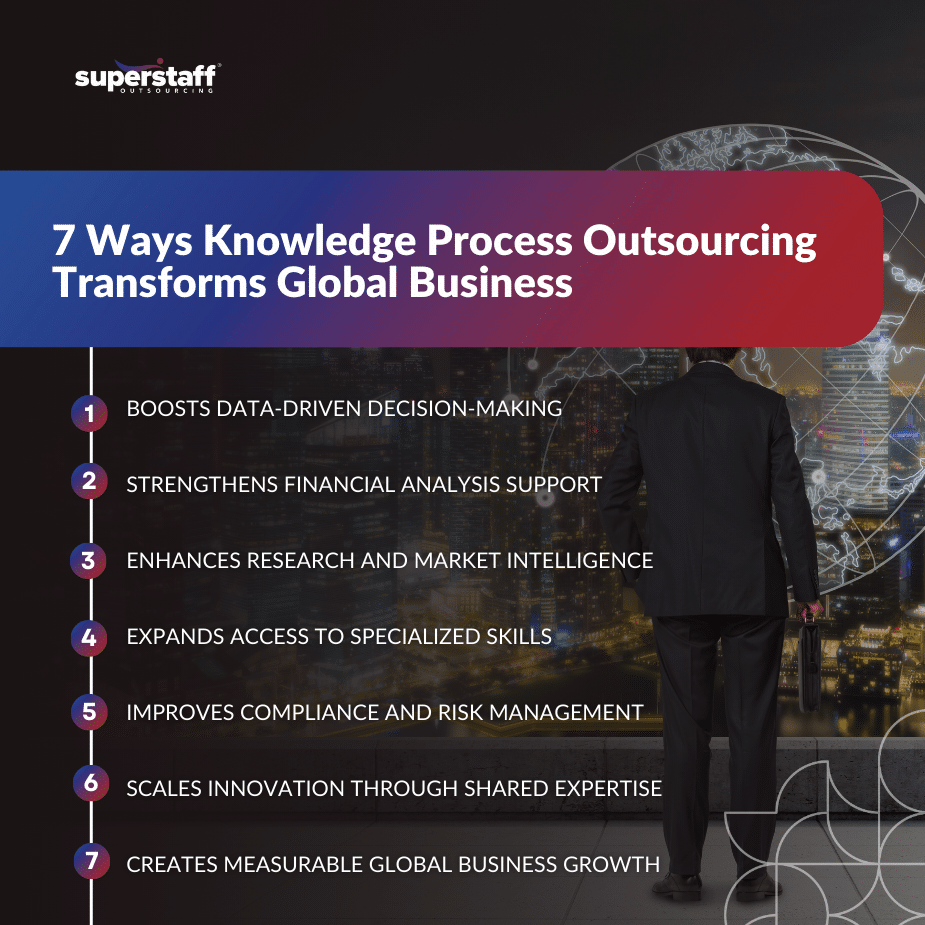
7 Ways Knowledge Process Outsourcing Is Transforming Global Business
Knowledge process outsourcing has changed how companies compete, operate, and expand across industries.
1. Enhancing Data-Driven Decision Making
KPO providers deliver advanced data analysis and reporting, helping businesses make accurate decisions. Companies benefit from insights that guide investments, customer strategies, and long-term planning.
2. Improving Financial and Market Research
Global organizations use knowledge process outsourcing for investment analysis, risk assessment, and market forecasting. This support helps firms stay competitive in global markets while managing financial risks more effectively.
3. Supporting Healthcare and Life Sciences
The KPO sector assists healthcare providers with clinical research, regulatory compliance, and medical data management. These services improve patient care while helping organizations meet international standards.
4. Driving Innovation in Technology and R&D
Tech firms rely on KPO companies for patent research, product development studies, and competitive intelligence. By outsourcing these functions, companies accelerate innovation without overspending on internal teams.
5. Strengthening Legal and Compliance Functions
Legal process research, contract management, and compliance monitoring are core KPO services. These functions reduce the workload of in-house legal teams and ensure regulations are followed.
6. Boosting Intellectual Property Management
Knowledge process outsourcing firms assist with patent filings, trademark monitoring, and IP portfolio oversight. This protects company assets and allows innovation to move forward without legal barriers.
7. Expanding Global Workforce Access
Through KPO, businesses connect with highly skilled professionals across borders. This global talent access improves efficiency while maintaining cost savings compared to local hiring.
Comparing KPO With Other Outsourcing Models
KPO offers more advanced services than standard outsourcing models, creating a clear difference in value.
- BPO vs. KPO – BPO focuses on routine tasks like customer service and payroll, while KPO covers specialized research and strategic work.
- LPO vs. KPO – Legal process outsourcing is a subset of KPO, but KPO covers multiple industries.
- Rising Adoption – Companies are shifting from transactional outsourcing toward knowledge-based outsourcing because of its long-term impact.
Knowledge process outsourcing is not just an alternative to BPO but an evolution in the outsourcing industry.
Opportunities in Knowledge Process Outsourcing
Businesses gain several advantages when they adopt knowledge process outsourcing.
- Access to Expertise: KPO providers supply advanced skills that many firms cannot develop internally.
- Cost Efficiency: Even with highly trained staff, outsourcing remains more affordable than in-house operations.
- Scalability: Companies can expand or reduce teams based on project needs.
- Innovation Support: By freeing up internal teams, companies focus more on strategy and development.
- Global Reach: Outsourcing connects businesses with skilled professionals worldwide.
These opportunities explain how knowledge process outsourcing is changing global business and why adoption continues to grow.
Challenges Businesses Should Consider
While KPO provides many benefits, companies should also be aware of potential challenges.
- Data Privacy: Sensitive information must be protected with strong security protocols.
- Quality Control: Businesses need to ensure providers meet performance standards.
- Vendor Dependency: Relying too heavily on outsourcing partners can limit flexibility.
- Cultural Differences: Working with global teams requires careful communication management.
- Compliance Risks: Companies must confirm that outsourced providers follow international regulations.
Understanding these challenges allows businesses to prepare and manage KPO partnerships effectively.
KPO Industry Trends Driving Growth
The rapid expansion of knowledge process outsourcing is fueled by key industry trends.
- Increased demand for advanced analytics and big data management
- Growing reliance on outsourcing for healthcare and pharmaceutical research
- Expansion of legal and compliance outsourcing across global markets
- Integration of digital tools in knowledge-based services
- Rising interest from SMEs, not only large corporations
These KPO industry trends show that the sector is becoming an essential part of modern business strategies.
The Future of Knowledge Process Outsourcing
Knowledge process outsourcing will continue to grow as businesses seek advanced expertise.
- Global Expansion – More companies will adopt KPO in finance, healthcare, and tech.
- Workforce Development – Countries like the Philippines and India will remain strong hubs for KPO talent.
- Industry Specialization – Providers will develop niche services tailored to industries.
- Integration with Business Strategy – KPO will be seen as a core part of business growth, not just a support service.
- Sustained Demand – As competition increases worldwide, knowledge-based outsourcing will remain vital.
The long-term outlook confirms that knowledge process outsourcing is shaping the next stage of global business.
Smarter Global Growth Through KPO
Knowledge process outsourcing is no longer limited to large corporations. It is accessible to businesses of different sizes that want to improve research, decision-making, and operational efficiency. With growing demand across industries, KPO will remain a strong driver of global business transformation.