
Cost pressure is no longer episodic for manufacturers. It is persistent, compounding, and closely tied to how organizations structure their operations. As companies look toward 2026, resilience has become a board-level concern, not an operational afterthought.
Manufacturing outsourcing increasingly plays a role in that discussion. When used intentionally, it supports cost stability, operational continuity, and long-term planning. When treated as a short-term reaction, it often introduces new risks instead of resolving old ones.
The difference lies in how leaders frame the strategy.
Cost volatility is now a planning reality
Manufacturers are operating in an environment where variability is the norm. Order volumes fluctuate. Supply timelines shift. Customer expectations around responsiveness continue to rise.
Internal teams are rarely designed for constant adjustment. Headcount models assume predictability. Training cycles take time. When demand shifts faster than staffing can respond, costs increase in less visible ways.
Overtime grows. Errors increase. Managers spend more time firefighting than improving systems. These indirect costs are often higher than the labor expense leaders focus on initially.
Manufacturing outsourcing enters the picture when companies recognize that flexibility must be built into the operating model itself.
Short-term fixes create long-term friction
Some organizations turn to outsourcing under pressure. A backlog grows. Attrition spikes. A quick solution feels necessary.
In these cases, manufacturing outsourcing is framed as temporary relief. Work is transferred quickly. Processes remain loosely defined. Success is measured narrowly around speed and cost.
This approach usually creates friction. Knowledge stays siloed. Quality becomes inconsistent. Internal teams struggle to coordinate with external support that was never designed to be part of the system.
Over time, leaders conclude that outsourcing failed. In reality, the strategy was never given the structure needed to succeed.
Reframing manufacturing outsourcing as an operating decision
A more resilient approach treats manufacturing BPO services as an operating decision, not a staffing shortcut. Leaders start by identifying functions where continuity matters more than physical proximity.
These functions often include customer service, order processing, warranty administration, inventory coordination, scheduling support, and supplier communication. They sit at the intersection of operations, finance, and customer experience.
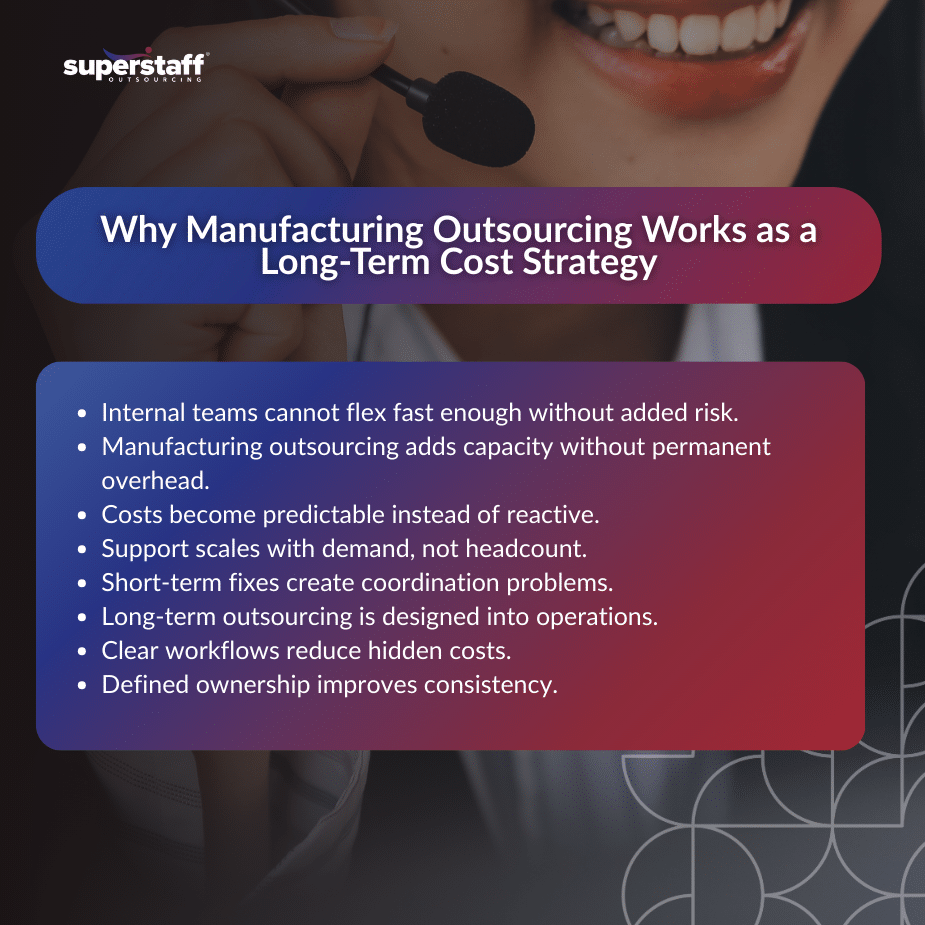
Manufacturing outsourcing allows these roles to be handled by dedicated teams with stable coverage and defined accountability. Instead of redistributing work internally during every disruption, companies rely on a consistent support layer.
That consistency is what stabilizes cost over time.
Cost control comes from predictability, not compression
Many cost strategies focus on compression. Reduce headcount. Lower hourly rates. Cut budgets quickly.
Resilient strategies focus on predictability. Leaders want to know what their operating costs will look like across different demand scenarios. They want fewer surprises.
Manufacturing outsourcing supports this goal by converting variable internal strain into structured external capacity. Volumes can increase or decrease without triggering hiring cycles or layoffs.
Costs become easier to forecast. Financial planning becomes more reliable. This predictability is often more valuable than short-term savings alone.
Why customer-facing roles matter more than expected
In manufacturing environments, customer-facing roles are sometimes underestimated. They are seen as downstream functions rather than strategic ones.
In reality, these roles influence cash flow, retention, and operational efficiency. Delayed responses lead to escalations. Escalations pull engineers, planners, and managers away from core work.
Outsourced manufacturing solutions strengthen these touchpoints when customer service teams are trained on products, processes, and escalation protocols. Offshore agents handle inquiries, track orders, and resolve issues before they disrupt production teams.
This reduces internal interruptions. It also improves the customer experience without increasing internal headcount.
Process clarity drives resilience
Resilience does not come from location alone. It comes from process clarity.
Organizations that succeed with manufacturing outsourcing invest heavily in defining workflows. They document handoffs. They establish service levels. They clarify decision rights.
This structure allows offshore teams to operate with confidence. It reduces dependency on individual employees. It supports consistent performance even when conditions change.
Without this clarity, outsourcing becomes reactive. With it, outsourcing becomes durable.
Scaling operations without destabilizing teams
Growth creates its own risks. As volumes rise, internal teams often stretch beyond sustainable limits. Hiring lags demand. Training absorbs leadership attention.
Manufacturing outsourcing enables scale without destabilizing core teams. External capacity expands in parallel with demand. Coverage increases without restructuring internal departments.
This approach protects institutional knowledge. It also prevents burnout among employees who no longer absorb every surge personally.
Over time, this balance supports retention and performance across the organization.
Governance separates strategy from experimentation
Governance is the dividing line between strategic manufacturing outsourcing and ongoing experimentation. Without it, expectations drift and performance varies.
Strong governance includes regular reviews, clear metrics, and shared accountability. Leaders track outcomes tied to business goals, not just activity levels.
This discipline keeps offshore teams aligned with evolving priorities. It also provides early visibility into issues before they become costly.
Governance does not slow operations. It stabilizes them.
The Philippines as a long-term support hub
The Philippines has developed deep expertise in complex support functions. This matters for manufacturers seeking long-term partners rather than transactional vendors.
Teams are experienced in customer-facing roles. Communication standards align with U.S. expectations. Operational discipline supports consistent delivery.
Manufacturing outsourcing to the Philippines works best when companies invest in onboarding, training, and integration. Over time, offshore teams build product knowledge and process fluency that mirrors internal capability.
This continuity strengthens resilience rather than fragmenting it.
Aligning outsourcing with executive priorities
For executives, the real value of manufacturing outsourcing lies in alignment. Cost strategy must support growth, customer experience, and risk management simultaneously.
Leaders who frame outsourcing decisions around these priorities avoid reactive moves. They design support models that hold up under pressure.
This perspective turns outsourcing into a lever for stability rather than a response to crisis.
Preparing for 2026 with intention
Resilience in 2026 will favor manufacturers that plan for variability instead of resisting it. Manufacturing outsourcing supports that planning when applied deliberately.
It creates capacity without fragility. It improves responsiveness without inflating fixed costs. It allows internal teams to focus on what truly differentiates the business.
The organizations that benefit most are those that commit early and govern consistently.
Manufacturing Outsourcing: Finding a Strategic Path Forward With SuperStaff
Manufacturing outsourcing delivers long-term value when it is treated as a cost strategy built for resilience, not as a temporary fix. That mindset shapes everything from scope design to performance management.
SuperStaff works with manufacturers to build dedicated offshore support teams in the Philippines that integrate directly into daily operations. Our focus is on stability, accountability, and continuity across customer service and operational support functions.
If your leadership team is planning for 2026 and beyond, now is the time to explore how SuperStaff can help you implement a manufacturing outsourcing strategy that strengthens resilience while keeping costs predictable.
Get in touch with us to reap the benefits of long-term manufacturing outsourcing strategies!