
Under pressure to scale fast, many U.S. companies reach a point where internal HR teams become a bottleneck instead of an enabler. Hiring more HR staff seems logical at first. Over time, that approach adds cost, complexity, and uneven execution across regions.
This is where global HR outsourcing enters the conversation. Not as a tactical fix, but as a structural decision tied to growth, risk management, and operational focus.
Leaders who make this shift are not trying to replace HR strategy. They are redesigning how HR work gets done so internal teams can stay focused on people, culture, and leadership priorities.
Why Internal HR Teams Struggle to Scale Cleanly
HR demand rarely grows in a straight line. It spikes during hiring surges, restructures, acquisitions, and compliance changes. Internal teams often struggle to flex at the same pace.
Adding headcount solves the problem temporarily. It also introduces fixed costs, onboarding time, and management overhead. Over time, leaders notice diminishing returns.
Global HR outsourcing provides elasticity. It allows companies to scale HR operations up or down without rebuilding the organization every time demand shifts.
The Hidden Cost of Expanding HR Headcount
HR work looks deceptively simple from the outside. Payroll processing, benefits administration, employee data management, and compliance tracking feel routine.
In practice, these functions demand precision, consistency, and constant monitoring. Errors create legal exposure. Delays frustrate employees. Inconsistencies erode trust.
Global HR outsourcing reduces this risk by placing these tasks with teams built specifically for operational accuracy. Internal leaders gain predictability instead of constant firefighting.
When HR Work Becomes Operational Heavy Lifting
As companies grow, HR roles split into two categories. Strategic work focuses on leadership, culture, and workforce planning. Operational work handles volume, documentation, and systems.
Problems arise when the same team tries to do both. Strategy gets crowded out by transactions. Leaders spend time reviewing forms instead of shaping talent decisions.
An efficient global HR outsourcing process separates these layers cleanly. Transactional workloads move offshore, while strategic ownership stays in-house where it belongs.
Why the Philippines Fits HR Operations Well
The Philippines has supported global service delivery for decades. HR operations are a natural extension of that maturity.
Strong English fluency supports clear communication. Cultural alignment favors process adherence and documentation discipline. Experience with U.S. employment structures reduces training friction.
Companies using global HR outsourcing in the Philippines benefit from teams already familiar with HRIS platforms, compliance workflows, and service level expectations.
Consistency Across Locations and Time Zones
Distributed workforces create new HR challenges. Policies must apply evenly. Employee records must stay accurate across regions. Support must remain responsive outside U.S. business hours.
Internal teams struggle to maintain this coverage without burning out. Outsourced teams solve the problem structurally.
Global HR outsourcing enables follow the sun support models. Employees receive timely responses. Leaders gain confidence that processes run continuously without constant oversight.
Faster Scaling Without Organizational Disruption
Hiring HR staff takes time. Recruiting, onboarding, and training delay impact. During high growth phases, those delays compound.
Outsourced HR teams are already trained. Capacity expands faster than internal hiring cycles allow. This speed matters when headcount growth accelerates suddenly.
Global HR outsourcing gives leaders a buffer. Growth continues while internal teams remain stable and focused.
Risk Management and Compliance Control
HR errors carry real consequences. Misfiled documents. Missed deadlines. Incomplete records. Each one introduces compliance risk.
Outsourced teams operate with documented workflows and quality controls. Processes are designed for repeatability and audit readiness.
Global HR outsourcing shifts execution to environments built for compliance discipline. Internal teams retain oversight without managing every step.
Where Global HR Outsourcing Delivers the Most Value
Not every HR function belongs offshore. The highest value appears where volume and structure dominate. This is why many companies choose to outsource payroll and benefits.
Some of the most commonly outsourced functions include:
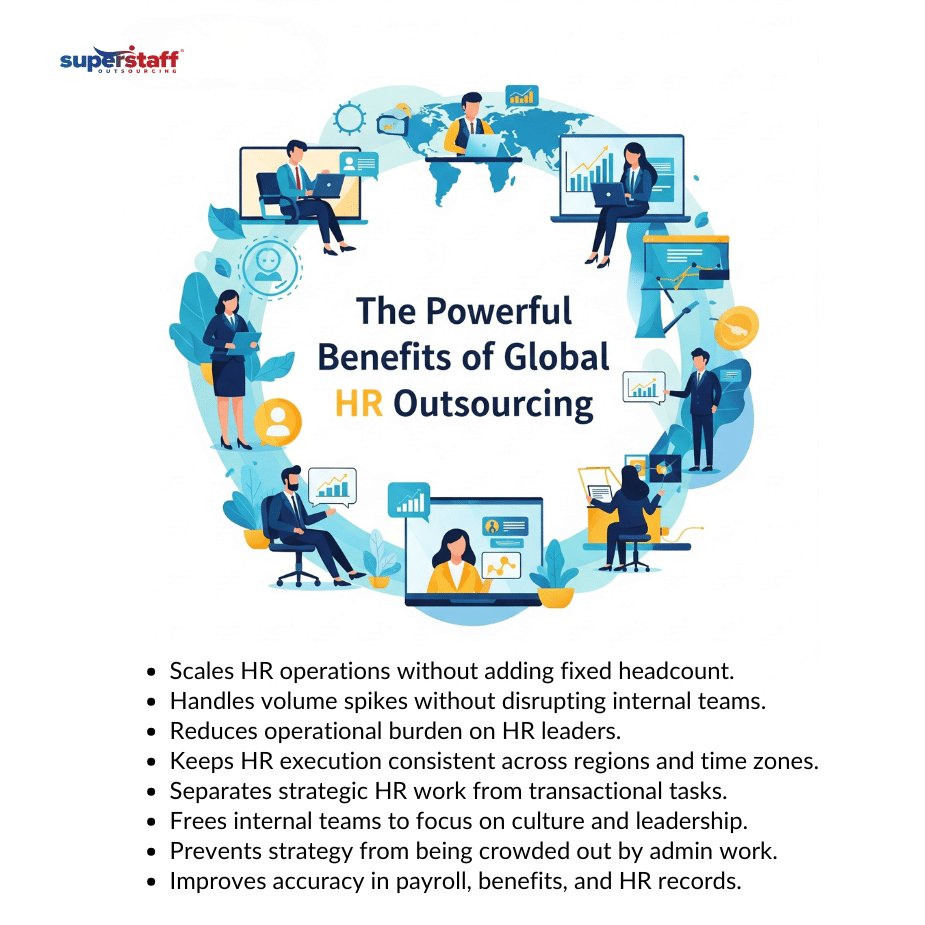
- Employee data management and HRIS updates
- Payroll coordination and timekeeping support
- Benefits enrollment and administration
- Onboarding documentation and compliance tracking
- HR reporting and workforce analytics preparation
These tasks demand accuracy more than strategic judgment. Global HR outsourcing aligns perfectly with that profile.
What Internal HR Teams Gain in Return
The real benefit is not cost reduction alone. It is regained capacity.
Internal HR leaders spend more time on leadership development, employee engagement, and workforce planning. Conversations shift from transactions to outcomes.
Global HR outsourcing supports this shift quietly. Work continues. Strategy improves. Employees experience smoother service without understanding the backend change.
Addressing Concerns About Control and Culture
Some leaders worry outsourcing weakens cultural connection. In practice, the opposite often happens.
Clear documentation improves consistency. Defined service levels reduce confusion. Internal teams gain space to focus on culture directly instead of managing paperwork.
With global HR outsourcing, control improves because processes become visible and measurable rather than informal and fragmented.
Why SMEs and Midmarket Firms Benefit Most
Large enterprises have long used outsourcing to stabilize operations. SMEs and midmarket firms now face similar complexity without the same resources.
Smaller HR teams feel pressure faster. Growth exposes gaps sooner. Mistakes carry proportionally higher risk.
Global HR outsourcing gives these firms access to enterprise level execution without enterprise level overhead.
Building a Sustainable HR Operating Model
HR maturity is not defined by team size. It is defined by clarity, consistency, and accountability.
Companies that scale successfully design HR as an operating system. Strategy remains internal. Execution runs reliably in the background.
Global HR outsourcing for payroll, benefits, and compliance supports this design. It keeps the system stable as the organization evolves.
Choosing the Right Outsourcing Partner
Execution quality matters. HR touches people directly. Errors affect trust quickly.
Partners must understand U.S. employment structures. They must operate with transparency and integrate cleanly with internal teams.
This is where experience and process maturity matter more than price alone.
The Long Term View for HR Leaders
HR leaders are no longer evaluated only on policy knowledge. They are measured on impact, retention, and organizational readiness.
Operational overload blocks that impact. Structural support unlocks it.
Global HR outsourcing is a leadership decision. It reshapes how HR delivers value at scale.
Partner With SuperStaff for Global HR Outsourcing Solutions
As organizations grow more distributed and complex, internal HR teams cannot do everything without tradeoffs. The smartest leaders redesign the model instead of stretching the team thinner.
Global HR outsourcing offers a practical path forward. It strengthens execution, protects compliance, and frees internal leaders to focus on people and strategy.
SuperStaff supports U.S. companies with dedicated HR operations teams in the Philippines built for accuracy, scale, and alignment. Explore how SuperStaff can help you modernize HR delivery while keeping control where it matters most.