
Automation dominates business conversations today. Yet even the most advanced systems rely on structured inputs.
Without clean and consistent data, automation breaks down quickly. This is why data entry process outsourcing continues to play a meaningful role in modern operations.
Leaders who recognize this reality tend to build more reliable automation strategies and stronger long term efficiency.
Automation Still Depends on Clean Inputs
AI systems perform well only when data is structured and accurate. Automation tools cannot correct flawed datasets on their own. Errors at the input stage multiply downstream.
Many companies invest heavily in automation platforms. However, they overlook the operational discipline needed to maintain clean data streams. This gap often slows adoption and reduces ROI.
- AI outputs rely on input quality
- Standardization remains a challenge
- Human validation prevents compounding errors
This dependency makes data management a strategic concern rather than a clerical task.
Manual Workflows Have Not Disappeared
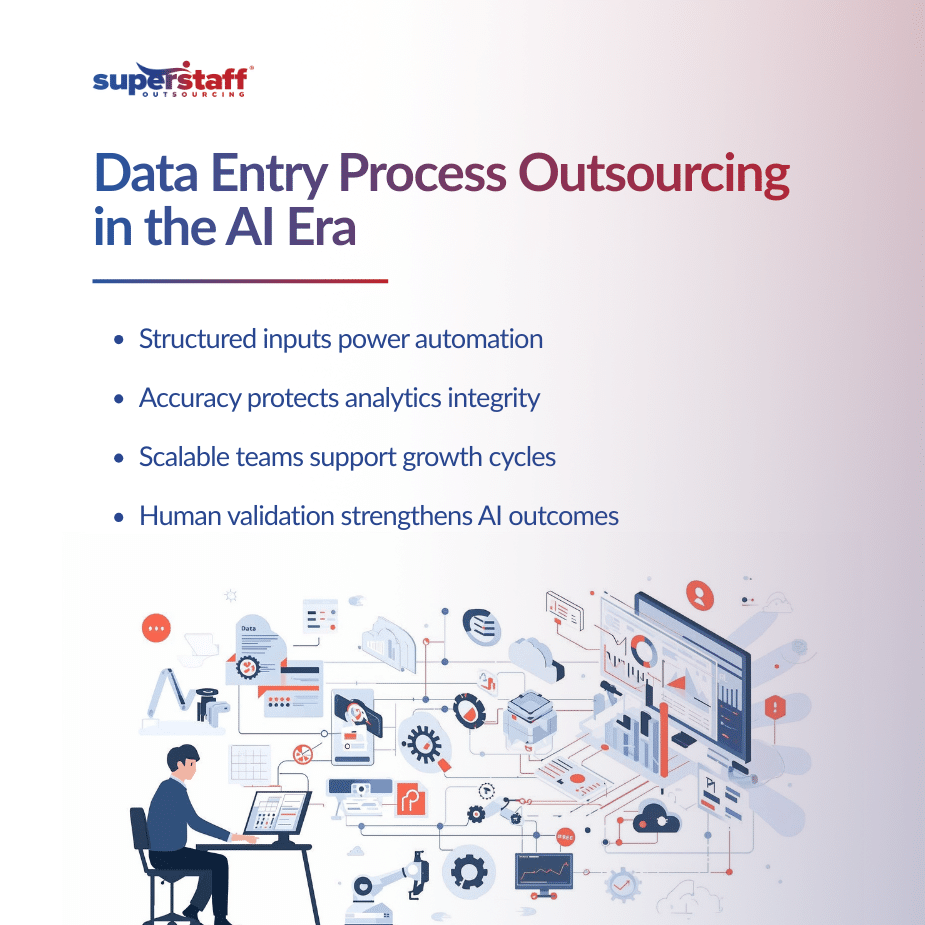
Digital transformation does not eliminate manual workflows. It reshapes them. Many organizations still manage hybrid systems that combine legacy tools and modern platforms.
Unstructured documents, PDFs, emails, and scanned files still enter business pipelines daily. Someone must structure that information. This is where data entry process outsourcing becomes operationally relevant.
- Legacy system dependencies persist
- Cross platform normalization remains necessary
- Hybrid workflows are the norm
Ignoring these realities creates hidden inefficiencies.
Accuracy Drives Business Intelligence
Data accuracy directly influences reporting quality. Leadership decisions depend on reliable dashboards and forecasts. Even small errors can distort insights.
When datasets are inconsistent, analytics lose credibility. Teams spend more time validating numbers than acting on them. This slows execution and weakens strategic agility.
Data entry process outsourcing helps enforce accuracy standards through defined workflows and validation layers.
- Financial reporting requires precision
- Customer insights depend on consistency
- Forecasting relies on trustworthy inputs
Accuracy becomes a competitive advantage.
Process Discipline Creates Predictability
Specialized outsourcing providers introduce structured workflows. They rely on standard operating procedures and layered quality controls. This creates operational consistency.
Internal teams often lack the time to design repeatable frameworks. Outsourcing partners bring maturity developed across multiple clients and industries.
Data entry process outsourcing introduces:
- Defined SOP execution
- Multi level quality assurance
- Continuous performance tracking
Predictability allows leadership teams to plan with confidence.
Scalability Without Operational Strain
Business volumes rarely stay static. Growth phases, product launches, and seasonal demand create unpredictable spikes. Internal teams struggle to absorb these fluctuations.
Outsourcing adds elasticity. Companies can scale processing capacity without expanding fixed headcount. This flexibility supports both growth and cost discipline.
Data entry process outsourcing supports:
- Rapid volume expansion
- Temporary surge handling
- Flexible resource allocation
Scalability becomes a built in capability instead of a constraint.
Compliance Depends on Structured Data
Regulated industries face constant documentation pressure. Healthcare, finance, logistics, and legal sectors rely on structured records for audits and reporting.
Poor data entry practices increase compliance risk. Missing details or inconsistent formatting can create audit gaps. Structured workflows reduce exposure.
Data entry process outsourcing strengthens compliance readiness by ensuring documentation accuracy and consistency.
- Audit trail integrity improves
- Documentation becomes standardized
- Regulatory readiness increases
Compliance becomes proactive instead of reactive.
Faster Digital Transformation
Many organizations want to modernize systems but face internal bandwidth limits. Transformation initiatives demand both strategic thinking and operational execution.
Outsourcing routine data workflows allows internal teams to focus on modernization. Leaders can redirect attention toward innovation rather than administrative tasks.
Data entry process outsourcing supports:
- System migrations
- Data cleansing initiatives
- Platform integrations
This alignment accelerates transformation timelines.
Operational Resilience Through Global Teams
Resilience has become a leadership priority. Companies want continuity even during disruptions. Distributed teams help achieve this goal.
Outsourcing introduces geographic diversification. Work continues across time zones and operational risks are distributed.
Data entry process outsourcing enhances resilience through:
- Around the clock processing
- Built in redundancy
- Global continuity planning
Resilience shifts from theory to operational reality.
Why the Philippines Stands Out
The Philippines has long been a trusted outsourcing destination. Its workforce combines process discipline with strong communication skills. This makes it well suited for data intensive roles.
English proficiency supports clear documentation and collaboration. Cultural alignment with Western markets simplifies integration. A service oriented mindset reinforces consistency.
Data entry process outsourcing in the Philippines offers:
- Mature BPO ecosystems
- Strong training infrastructure
- Process driven execution
These factors contribute to reliable outcomes for global clients.
Supporting AI and Automation Futures
The future of operations will blend human workflows with automation. AI requires curated datasets, validation loops, and continuous refinement. Human input remains essential.
Outsourced teams often support AI readiness through structured data preparation. They contribute to data labeling, validation, and ongoing quality checks.
Data entry process outsourcing complements automation by strengthening foundational data layers.
- Supports AI training workflows
- Enables validation cycles
- Improves model reliability
Automation becomes stronger when supported by disciplined human processes.
Strategic Framing for Decision Makers
Forward thinking leaders no longer treat data entry as a back office afterthought. They see it as infrastructure. Reliable data enables analytics, automation, and customer experience improvements.
Reframing the function changes how organizations allocate resources. Instead of minimizing investment, they optimize execution through partnerships.
Data entry process outsourcing becomes a strategic lever that improves efficiency while preserving internal focus.
Strong Automation Starts With Strong Data
Automation may dominate headlines, but reliable data workflows remain essential to execution. Organizations that prioritize accuracy, scalability, compliance, and resilience often revisit how they manage foundational operations. This is where data entry process outsourcing continues to deliver meaningful value.
SuperStaff helps companies strengthen operational foundations through experienced offshore teams in the Philippines.
If your organization is investing in automation or scaling operations, now is the time to evaluate how structured data workflows support long term success. Explore how SuperStaff can help you build stronger, more reliable operations today.