The start of the year gives companies an opportunity to review customer service performance and address problems that affected operations during the previous months. Many teams begin the year with unresolved inquiries, high ticket volumes, inconsistent workflows, and outdated internal documentation. These issues can slow response times and make it harder for employees to provide accurate assistance.
Early-year planning helps businesses identify service gaps and establish better ways to manage customer interactions. Companies can update response guidelines, improve communication procedures, review staffing requirements, and organize customer records. These changes help teams handle requests more efficiently while preparing for new service demands.
Outsourced customer service teams can also support these improvements by managing inquiries, processing routine requests, and providing additional coverage. This allows internal employees to focus on service improvements without leaving daily customer responsibilities unattended.
This article explains the steps businesses can take at the start of the year to strengthen customer experience through better processes, organized workflows, and outsourced support.
Why Companies Strengthen Customer Experience Early in the Year
Businesses begin the year by reviewing how their customer service operations performed during the previous quarter. Managers examine response times, unresolved tickets, customer complaints, and recurring service issues to determine which areas need attention.
These reviews help identify problems that may have developed during busy periods. For example, customers may have experienced delayed responses because of limited staffing. Agents may also have provided inconsistent information when internal guidelines were outdated or difficult to access.
Companies can use these findings to establish clearer service expectations. They may update frequently asked questions, revise escalation procedures, and improve the way customer requests move between departments.
Businesses that want to improve their service structure should also consider the operational requirements involved in managing customer service outsourcing. Proper training, defined responsibilities, and clear service procedures help maintain consistent customer interactions.
Outsourced support can provide additional coverage while these improvements take place. External personnel can manage selected inquiries and routine assignments, allowing internal teams to focus on reviewing performance and implementing necessary changes.
Key Year-Start Steps Businesses Take To Improve Customer Experience
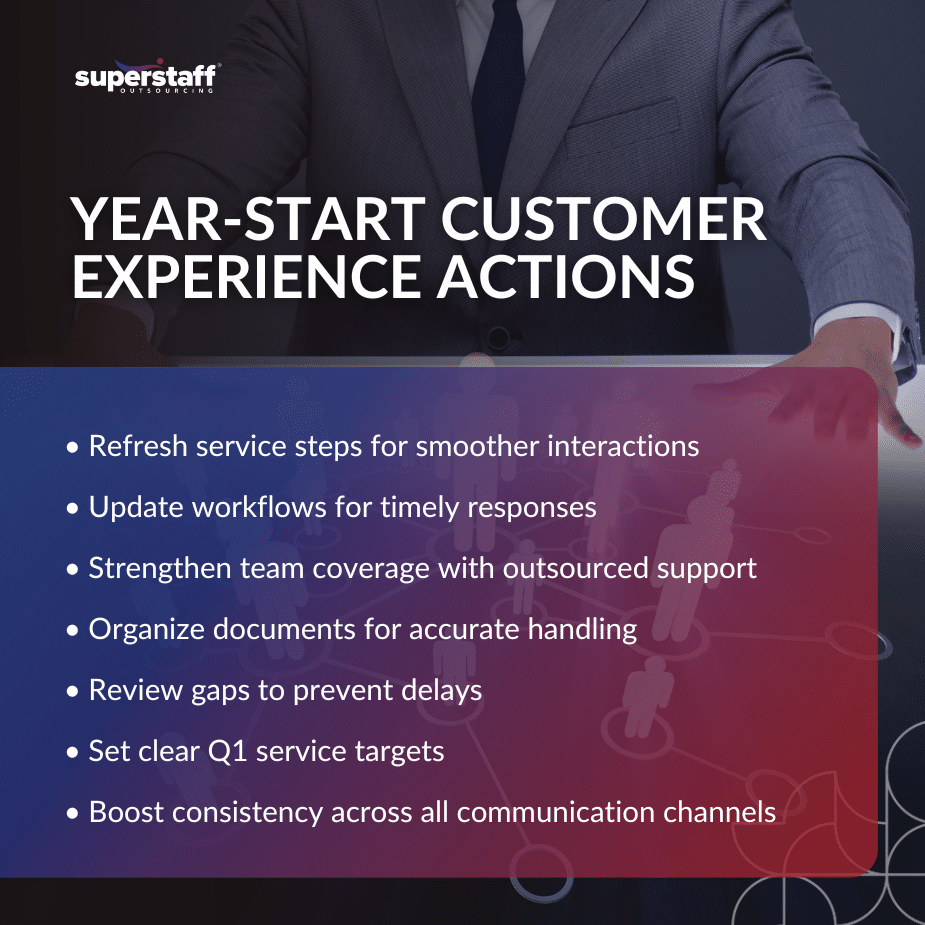
Improving customer experience requires more than setting new service targets. Companies need practical steps that address the problems customers and employees encounter during daily interactions.
1. Review service gaps from the previous quarter
Managers should examine customer complaints, unresolved tickets, long waiting times, and repeated service issues. These records help identify areas where existing procedures are not meeting customer expectations.
For example, repeated complaints about delayed order updates may indicate a communication problem between customer service and fulfillment teams. Identifying the cause helps businesses correct the process rather than repeatedly addressing the same complaint.
2. Update customer response guidelines
Response guidelines help agents provide accurate and consistent information. Businesses should review existing scripts, frequently asked questions, and standard responses to ensure they reflect current policies and services.
Outdated instructions can lead to incorrect answers and unnecessary escalations. Updated references help employees resolve common concerns without repeatedly asking supervisors for clarification.
3. Standardize communication procedures
Customers may contact a company through email, phone, live chat, and social media. Each channel should follow consistent service standards so customers receive the same information regardless of how they reach the business.
Companies should establish guidelines for greetings, response times, information verification, and issue resolution. This helps employees maintain a consistent communication approach across channels.
4. Organize customer documentation
Accurate customer records help agents understand previous interactions and avoid asking customers to repeat information. Businesses should review account details, ticket histories, internal notes, and frequently used reference materials.
Organized documentation also makes it easier to transfer unresolved concerns between departments. Employees can review previous actions and continue assisting customers without starting the process again.
5. Improve ticket routing and escalation
Customer requests should reach the correct department or employee as quickly as possible. Businesses should review how tickets are categorized, assigned, and escalated.
Clear routing procedures prevent inquiries from remaining unattended in the wrong queue. They also help agents recognize which concerns require technical assistance, management approval, or specialized support.
6. Adjust staffing plans based on service demand
Companies should review inquiry volumes and identify periods when additional customer service coverage may be necessary. Historical data can help managers estimate staffing requirements and distribute schedules more effectively.
If internal recruitment cannot immediately meet these needs, outsourced personnel can provide additional coverage. This helps businesses maintain response capacity without waiting for every vacant position to be filled.
7. Introduce outsourced specialists where needed
External customer service professionals can handle selected responsibilities such as basic inquiries, order updates, account assistance, and routine follow-ups.
Companies should define which tasks outsourced personnel can manage independently and which require internal approval. This allows external staff to contribute to daily operations while maintaining clear accountability.
8. Conduct regular quality checks
Managers should review customer interactions to determine whether agents follow communication standards and provide correct information. Quality checks can cover call recordings, email responses, chat conversations, and ticket documentation.
These reviews help identify training needs and recurring mistakes. They also give managers a way to measure whether recent service improvements are producing better results.
9. Identify recurring customer concerns
Customer complaints and feedback can reveal problems that are not immediately visible through performance reports. Businesses should group similar concerns and determine whether they are caused by unclear instructions, product issues, delivery delays, or service limitations.
Addressing recurring problems helps prevent additional complaints and reduces the number of customers who need to contact support more than once.
10. Set measurable service benchmarks for Q1
Companies should establish clear targets for response times, ticket resolution, customer satisfaction, and service quality. These measurements give managers a consistent way to review performance throughout the quarter.
Targets should reflect actual business capacity and customer requirements. Regular reviews also help managers determine whether additional staffing, training, or process changes are necessary.
How Outsourced Teams Support Customer Experience Improvements
Outsourced customer service teams help businesses maintain service coverage while internal departments work on operational improvements. They can manage incoming inquiries, process routine requests, update customer records, and follow established escalation procedures.
For example, an outsourced agent can handle common account questions while internal specialists focus on complicated technical concerns. This division of responsibilities helps prevent routine inquiries from taking up time that could be spent resolving more complex problems.
External teams can also support multiple communication channels. Depending on the service arrangement, personnel may handle phone calls, emails, live chats, and social media messages. Consistent training and shared response guidelines help maintain the same service standards across these channels.
Companies looking at ways to improve customer interactions can also consider how empathy and professional communication influence customer experience outsourcing. The quality of each interaction depends not only on response speed but also on how well agents understand and address customer concerns.
Factors to Evaluate When Strengthening Customer Experience With Outsourced Support
Businesses should establish clear requirements before integrating external personnel into their customer service operations. These factors help maintain service quality and protect customer information.
Communication processes
Internal and outsourced teams should follow agreed communication schedules and reporting procedures. Managers need visibility into ongoing concerns, unresolved tickets, and service issues that require attention.
Information security
Customer service employees may access personal details, account records, and transaction information. Companies should establish access restrictions, confidentiality requirements, and secure data-handling procedures.
Documentation practices
Updated reference materials help agents provide accurate answers. Businesses should maintain organized knowledge bases, service guidelines, and escalation instructions that both internal and external employees can access when authorized.
Defined responsibilities
Companies should identify which tasks outsourced personnel can complete and which require internal involvement. Clear responsibilities prevent duplicate work and reduce confusion when customer concerns need escalation.
Training alignment
External personnel should receive training on company policies, products, communication standards, and service expectations. Training should also be updated when procedures or customer requirements change.
Accuracy monitoring
Managers should review service interactions and track performance indicators such as response times, resolution rates, and customer satisfaction. These measurements help identify areas that require further improvement.
Scalability
Customer inquiry volumes can change throughout the year. Businesses should determine whether their outsourcing partner can adjust staffing levels and provide additional coverage when service demand increases.
Companies can also use the International Customer Service Standard as an external reference when reviewing organizational approaches to customer service quality and performance.
How Outsourced Staff Strengthen Daily Customer Service Operations
Daily customer service involves several responsibilities beyond answering inquiries. Agents must verify information, update records, document conversations, process requests, and coordinate with other departments.
When internal teams have limited capacity, these activities can compete with more complicated customer concerns. Outsourced personnel help distribute the workload by managing assigned responsibilities according to established procedures.
For example, external agents can handle routine order inquiries and account updates while internal employees investigate billing disputes or technical problems. This arrangement helps customers receive assistance while giving specialized employees more time to resolve issues that require closer attention.
Consistent documentation also supports service continuity. When an inquiry needs to be transferred, complete records help the next employee understand the concern and review the steps already taken.
Use Cases Where Outsourced Customer Support Provides Value
Outsourced teams can support different customer service activities depending on the company’s industry, communication channels, and service requirements.
Common assignments include customer inquiry management, order and account updates, ticket documentation, data verification, follow-up communication, multi-channel support, basic troubleshooting, feedback collection, and service-related administrative work.
For an e-commerce company, outsourced agents may provide order updates and respond to delivery questions. A software business may assign basic troubleshooting and account inquiries to external personnel while its internal technical team handles more complex issues.
These arrangements help companies maintain customer service coverage without requiring every responsibility to remain with the same internal department. Clear task assignments and escalation procedures ensure that customers receive the appropriate level of assistance.
How Outsourced Customer Service Teams Support Internal Staff
Outsourced support helps internal employees manage their workload by taking responsibility for recurring customer service activities. This gives in-house teams more time to focus on process improvements, complex complaints, product concerns, and decisions that require specialized knowledge.
It also helps managers distribute responsibilities more effectively. Instead of assigning every incoming request to available internal employees, companies can establish specific tasks for external personnel and monitor their performance through regular reports.
However, successful coordination requires clear communication between both groups. Internal supervisors should provide updated instructions, review escalated concerns, and share feedback about service performance.
When responsibilities are properly defined, outsourced and internal teams can work together without creating unnecessary duplication or confusion.
Choosing the Right Outsourcing Partner for Customer Experience Support
Businesses should evaluate outsourcing providers based on their ability to maintain service quality and follow established company procedures. A provider should have experience handling customer inquiries, managing communication channels, and supporting different types of service requirements.
Companies should also review recruitment standards, training procedures, communication systems, information security practices, and performance reporting. These factors help determine whether the provider can meet the company’s expectations.
Scalability is another important consideration. Businesses may need additional support during product launches, seasonal demand, or periods when internal staffing is limited. A provider with flexible staffing arrangements can help manage these changes.
Before starting the partnership, companies should agree on service targets, reporting schedules, escalation procedures, and quality requirements. These arrangements give both teams a clear understanding of their responsibilities.
SuperStaff Customer Service Support Solutions
SuperStaff helps businesses manage customer interactions through trained customer service professionals and structured operational processes. Its teams can support phone, email, chat, and other customer communication channels based on business requirements.
Through its customer experience and omnichannel support solutions, businesses can access personnel who assist with customer inquiries, multilingual communication, technical support, and other service activities.
SuperStaff also supports organized workflows, performance monitoring, and staffing arrangements that can adjust to changing business needs. These capabilities help companies maintain customer service coverage while internal teams focus on service planning and improvements.
Let SuperStaff Strengthen Your Customer Experience Operations
Strengthening customer experience at the start of the year requires a clear understanding of existing service problems and the changes needed to address them. Reviewing performance, updating documentation, improving ticket routing, and setting measurable targets can help businesses establish more consistent customer service operations.
Outsourced support provides additional capacity for companies that need to maintain daily service while working on these improvements. With trained personnel, defined responsibilities, and consistent communication, internal and external teams can work together to meet customer needs.
SuperStaff provides customer service professionals and organized support structures that help businesses maintain reliable service across different channels. Companies planning to improve their customer service operations can discuss their customer support requirements with SuperStaff and identify an arrangement that fits their needs.