
Strong customer experiences rarely happen by accident. They are built through systems, training, and leadership alignment. Improving customer service in call center environments requires a mix of operational clarity and human-centered execution.
Leaders who treat service as a strategic capability tend to outperform competitors in retention and brand perception. That is especially true for SMEs and midmarket firms competing with larger players.
In this helpful guide, you’ll learn how to improve call center performance. With the right structure, even lean teams can deliver consistently high-quality interactions that reinforce trust and loyalty.
Align Service Goals With Business Outcomes
Customer service should not operate in isolation. It needs to support revenue, retention, and brand experience. When teams understand how their work impacts broader goals, performance becomes more intentional.
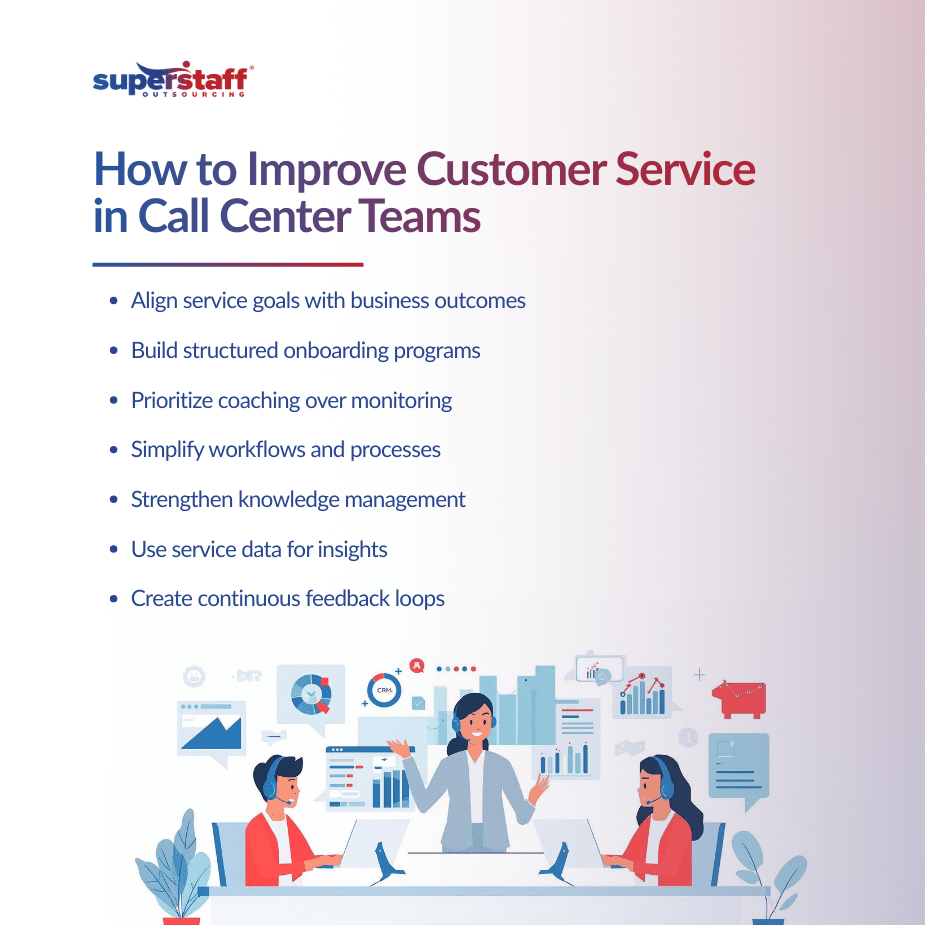
To improve customer service in call center teams, align metrics with business priorities:
- Tie service KPIs to churn reduction and lifetime value
- Align quality scorecards with brand tone and positioning
- Connect support data to product and marketing feedback loops
This alignment gives agents a sense of purpose. It also helps leaders justify investments in service improvements by linking outcomes to measurable business impact.
Invest in Structured Agent Onboarding
Here are vital call center customer service tips you should know: First impressions shape long-term performance.
A rushed onboarding process leads to inconsistent service and higher attrition. On the other hand, structured onboarding builds confidence and reduces early mistakes that affect customer perception.
Building a strong onboarding framework should include:
- Clear process training and role expectations
- Scenario-based learning for real conversations
- Shadowing sessions with experienced agents
- Gradual ramp-up with coaching checkpoints
Organizations that prioritize onboarding create stronger foundations for customer service in call center operations. New hires become productive faster and require fewer corrections later.
Build a Coaching Culture Instead of a Monitoring Culture
Many organizations rely heavily on audits and compliance scoring. While monitoring has value, improvement comes from coaching. Teams grow faster when feedback is collaborative and consistent.
Replace pure QA oversight with coaching rituals:
- Weekly one-on-one feedback sessions
- Call listening workshops for peer learning
- Coaching plans tied to individual development
This model encourages accountability without creating unnecessary pressure. It also helps agents build confidence when handling complex or emotional customer conversations.
Simplify Processes to Reduce Friction
Complex workflows slow agents down. Customers feel the impact through longer handling times and inconsistent responses. Simplification often delivers faster improvements than adding new tools or software.
Audit your workflows regularly:
- Remove redundant documentation steps
- Standardize scripts for recurring scenarios
- Streamline escalation paths
Reducing friction helps agents focus on conversations rather than navigation. As processes improve, customer service in call center teams becomes more consistent and easier to scale.
Strengthen Knowledge Management
Access to accurate information determines service quality. Agents cannot deliver confident responses without reliable resources. A well-maintained knowledge base improves both speed and accuracy.
Focus on three core elements:
- Centralized documentation accessible in real time
- Regular content updates based on new trends
- Clear ownership for knowledge maintenance
Strong knowledge systems reduce dependency on senior agents. They also shorten training cycles and support quality consistency across shifts and locations.
Use Data to Identify Experience Gaps
Service data is often underutilized. Call recordings, transcripts, and resolution patterns reveal opportunities for improvement. Leaders who analyze this data gain a clearer view of customer pain points.
Practical ways to leverage insights include:
- Reviewing repeat contact drivers
- Identifying top escalation triggers
- Mapping journey breakdowns
These insights help refine training and workflows. Over time, customer service in call center environments becomes more predictive rather than reactive, allowing teams to prevent issues before they escalate.
Empower Agents to Make Decisions
Rigid escalation structures create delays. Customers prefer faster resolutions over perfect policy adherence. Empowered agents can resolve issues with confidence and speed.
Empowerment can include:
- Flexible refund thresholds
- Clear decision frameworks
- Defined boundaries for exceptions
When agents feel trusted, they communicate with greater ownership. That translates into stronger customer experiences and improved satisfaction scores.
Reinforce Emotional Intelligence
Technical skills matter, but tone often defines perception. Customers remember how they felt during the interaction. Emotional intelligence helps agents navigate tense or complex conversations without escalating the situation.
Develop emotional intelligence through:
- Role-play scenarios for difficult calls
- Training on tone modulation and empathy
- Coaching focused on listening skills
Improving emotional intelligence elevates customer service in call center settings without requiring major technology investments. It is one of the most practical ways to enhance perceived quality.
Optimize Workforce Management
Service quality declines when staffing models are misaligned. Understaffed teams rush conversations. Overstaffed teams struggle with productivity and morale issues.
Balanced workforce planning includes:
- Accurate demand forecasting
- Flexible scheduling models
- Cross-trained agents for surge coverage
Better workforce planning stabilizes both experience and efficiency. It also protects agent well-being and reduces burnout, which directly impacts consistency in customer service in call center environments.
Integrate Technology Thoughtfully
Technology should enable agents, not replace judgment. Tools like CRM platforms, analytics dashboards, and AI assistance can enhance service when implemented correctly. Poor implementation, however, adds complexity.
Focus on practical technology use cases:
- Unified dashboards for customer context
- AI-assisted call summaries for efficiency
- Automation for repetitive back-office tasks
Thoughtful adoption ensures technology supports human interactions instead of distracting from them. This balance is critical for maintaining authentic customer experiences.
Consider Strategic Outsourcing for Scale
Many SMEs reach a point where internal teams plateau. Growth introduces complexity that requires additional expertise and infrastructure. Strategic outsourcing helps bridge this gap without overwhelming internal resources.
Outsourcing enables companies to:
- Access trained agents quickly
- Extend support hours without burnout
- Introduce proven quality frameworks
- Scale operations without large capital investments
For U.S. companies, the Philippines remains a preferred destination. Strong English proficiency and a service-oriented culture make Filipino teams highly effective in delivering customer service in call center programs that require empathy and professionalism.
Create a Feedback Loop With Customers
Improvement requires listening. Customer feedback offers direct insight into service effectiveness. Structured feedback loops help organizations refine both strategy and execution.
Effective feedback systems include:
- Post-interaction surveys
- Social listening and review monitoring
- Customer advisory panels
Feedback should translate into action. When customers see changes based on their input, trust increases and brand perception improves.
Improve Customer Service in Call Center With a Reliable Outsourcing Partner
Improving customer service in call center teams requires a deliberate and structured approach. Success depends on alignment, coaching, process clarity, and empowered agents. Organizations that treat service as a strategic capability gain a meaningful edge in retention and customer loyalty.
For companies looking to accelerate results, partnering with an experienced provider can shorten the learning curve. SuperStaff helps businesses elevate customer service in call center operations through trained teams, scalable support models, and a people-first approach rooted in Philippine service excellence.
Are you wondering how to improve customer service in a call center? If you are ready to strengthen your customer experience, explore how SuperStaff can support your growth today.