
Outsourcing has moved far beyond its original role as a tactical response to cost pressure. In 2026, it plays a central role in how organizations design, govern, and scale their operations. For SMEs and midmarket companies, this shift places outsourcing firmly within strategic business solutions rather than treating it as a temporary fix or a last resort. Leaders now evaluate outsourcing based on how well it supports long-term priorities, execution discipline, and customer trust.
This evolution reflects a broader change in how executives think about strategy itself. Strategy is no longer confined to planning cycles and leadership decks. It lives or fails in daily execution. Outsourcing has become one of the most practical ways to close that gap.
Strategy now lives in execution
Business leaders face an environment defined by tighter margins, faster customer feedback loops, and higher service expectations. Strategic plans break down quickly when operations cannot keep up. Internal teams become overloaded. Decision-making slows. Service quality becomes uneven.
Outsourcing supports strategic business solutions by creating operational clarity where internal structures struggle to scale. Call center operations illustrate this clearly. Customer demand does not rise in neat increments. It spikes. It shifts across channels. It extends beyond traditional business hours.
An outsourced model introduces structure. Roles are clearly defined. Service levels are standardized. Performance is monitored continuously. This consistency allows leadership teams to move forward with confidence, knowing execution will not derail strategic intent.
When execution is stable, leaders can focus on growth instead of constant problem-solving.
BPO Services 2026: Outsourcing as part of organizational design
Many companies still approach outsourcing reactively. They wait for strain to appear before acting. A product launch overwhelms customer support. Turnover rises. Costs increase unpredictably.
In contrast, forward-looking organizations embed outsourcing into their operating model from the outset. They treat it as part of strategic business solutions rather than as a corrective measure. This mindset shapes how partners are selected, how responsibilities are divided, and how success is measured.
Business process outsourcing becomes a design choice. Coverage hours align with revenue patterns. Support capacity reflects customer lifecycle needs. Quality standards mirror brand commitments.
This approach changes the relationship. Outsourcing becomes an extension of the organization, not an external patch. Leaders gain predictability, which improves planning and risk management.
Why execution stability matters more than speed
Speed often dominates strategic discussions. Leaders want faster launches, faster responses, and faster scaling. Speed without stability, however, creates long-term risk.
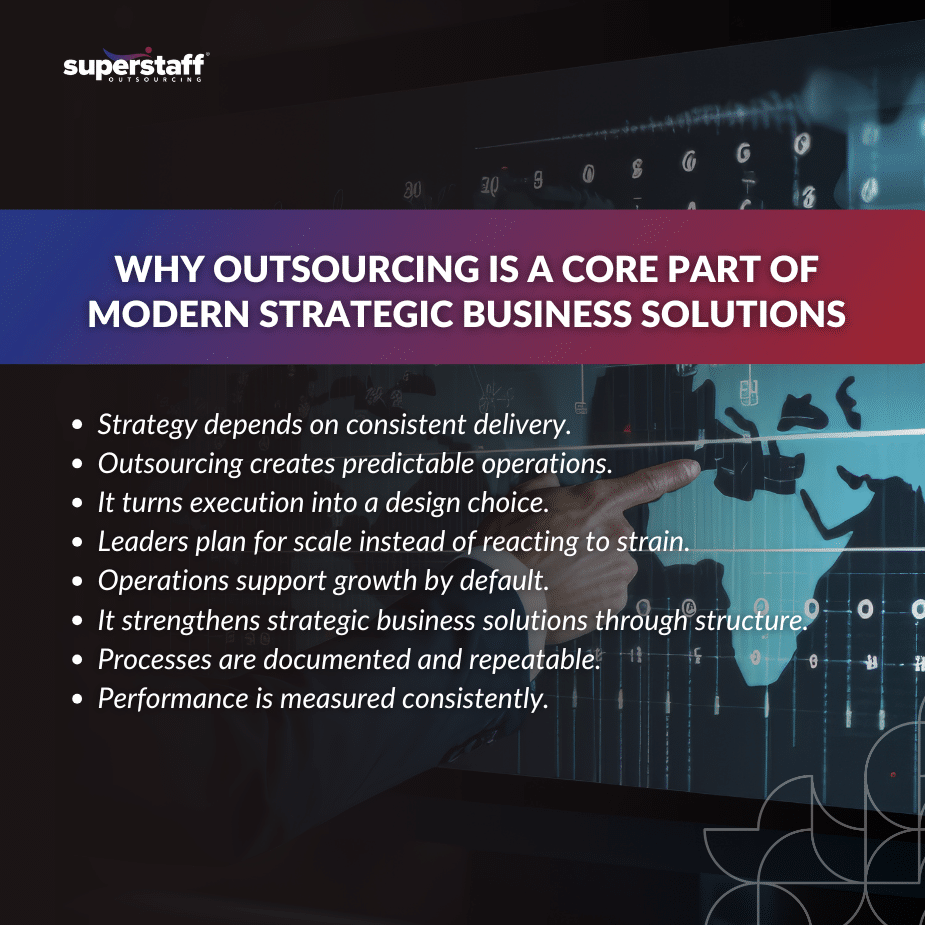
Here’s why outsourcing is a core part of modern business strategy in 2026: It strengthens strategic business solutions by anchoring execution in repeatable processes. Call center teams operate under documented workflows. Training follows defined standards. Quality assurance is continuous rather than reactive.
This stability reduces rework and miscommunication. It also improves decision quality. Leaders base adjustments on performance trends instead of anecdotal feedback.
As a result, strategy evolves through informed iteration rather than constant course correction.
The Philippines as a foundation for service-led strategies
The Philippines continues to be a preferred location for global service operations. The reasons are operational rather than promotional. Talent availability supports scale. Communication standards align with U.S. customer expectations. Service orientation remains strong.
For organizations building strategic business solutions, these factors matter. Call center agents represent the brand in moments that influence loyalty and retention. They must follow the process while exercising sound judgment.
Philippine-based teams consistently deliver this balance. They adapt to complex workflows. They support multichannel environments. They integrate well into structured quality and coaching programs.
This reliability allows U.S. companies to expand customer-facing operations without diluting service standards or overburdening internal teams.
From cost control to operational leverage
Cost efficiency still matters, but it no longer defines the outsourcing conversation. Leaders now focus on leverage. They ask how outsourcing strengthens the business model rather than how much it reduces expenses.
Outsourcing contributes to strategic business solutions by converting fixed operational challenges into flexible capabilities. Staffing adjusts with demand. Coverage expands without internal burnout. Performance management remains consistent across time zones.
Call center outsourcing also clarifies accountability. Internal teams retain ownership of strategy and customer promise. Outsourced teams execute within clearly defined parameters. This separation improves focus on both sides.
Over time, this model increases organizational resilience. Growth does not require constant restructuring.
Governance turns outsourcing into a strategic asset
Outsourcing only delivers strategic value when governance is deliberate. Without it, misalignment grows and confidence erodes.
Strong governance connects outsourced operations to strategic business solutions through shared metrics and transparent reporting. Performance dashboards align with executive priorities. Coaching focuses on outcomes, not activity. Escalation paths are clearly defined.
This structure builds trust across teams and geographies. Leaders understand what is happening in real time. Adjustments are timely and measured. Strategy remains grounded in operational reality.
As governance matures, outsourcing becomes less visible as a separate function and more embedded in daily operations.
Customer experience as a strategic differentiator
Customer experience increasingly defines competitive advantage. It is shaped by consistency more than by isolated moments of excellence.
Outsourcing supports strategic business solutions by creating predictable customer interactions across channels and time zones. Call center teams follow unified standards. Messaging remains aligned. Resolution paths are consistent.
This consistency reinforces brand credibility. Customers experience reliability rather than variability. Over time, trust strengthens and retention improves.
For leadership teams, this translates into measurable business impact without constant operational firefighting.
Decision-making improves with operational visibility
Strategy depends on accurate information. Outsourcing improves visibility by standardizing how performance data is captured and reviewed.
Within strategic business solutions, outsourced call centers provide structured insight into customer behavior, demand patterns, and service gaps. These insights inform planning and prioritization.
Leaders no longer rely on fragmented internal reports. They see trends clearly and respond with intent. Strategy becomes iterative and evidence-based.
This feedback loop strengthens alignment between leadership goals and frontline execution.
What this means for SMEs and midmarket leaders
The outsourcing question has evolved. The focus is no longer whether outsourcing fits the business. The focus is how well it integrates with long-term objectives.
Organizations that treat outsourcing as part of strategic business solutions gain flexibility without sacrificing control. They scale support operations without eroding quality. They protect leadership focus while maintaining execution discipline.
Call center operations sit at the center of this shift. Customer conversations shape perception, loyalty, and growth. Managing those conversations strategically requires partners built for consistency, accountability, and scale.
Partner With SuperStaff to Strengthen Strategic Business Solutions This 2026
In 2026, outsourcing stands alongside planning and governance as a core pillar of strategic business solutions. When designed intentionally, it strengthens execution, supports focus, and enables sustainable growth.
SuperStaff works with SMEs and midmarket companies to build call center operations that align with long-term strategy rather than short-term pressure. Explore how SuperStaff can help you design a structured, scalable outsourcing model that supports your business goals today and into the future.