Healthcare organizations depend on technology to keep operations stable and care delivery uninterrupted. Clinical systems, billing platforms, scheduling tools, and internal networks all play a role in how patients experience care. When those systems fail or slow down, the impact is immediate. Healthcare IT outsourcing has become a practical response for U.S. healthcare organizations that need reliable support without overburdening internal teams.
Many SMEs and midmarket providers face the same challenge. IT demand keeps growing, but internal resources stay flat. Leadership teams are expected to modernize infrastructure, strengthen security, and maintain uptime at the same time. Outsourcing support functions allows organizations to protect performance while keeping strategic control in-house.
Why healthcare IT support pressure keeps rising
Healthcare IT environments rarely simplify over time. Systems accumulate. Integrations multiply. Security expectations tighten. Meanwhile, user populations expand to include clinicians, administrative staff, remote workers, and third-party partners.
Internal IT teams often carry responsibility for both daily operations and long-term planning. That combination creates friction. Routine tickets interrupt strategic work. Backlogs grow during peak periods. Response quality varies depending on who is available.
This pressure explains why healthcare IT outsourcing has moved from optional to essential for many organizations. External teams absorb volume-driven work while internal leaders focus on governance, architecture, and optimization.
Defining the scope of outsourced healthcare IT support
Effective outsourcing starts with clarity. Healthcare organizations benefit most when support roles are clearly defined and aligned to operational needs rather than generic IT functions.
Outsourced healthcare IT teams commonly support:
- Tier 1 and Tier 2 helpdesk functions for clinical and administrative users
- Application troubleshooting for EHR, scheduling, and revenue cycle systems
- User access management and onboarding support
- Incident documentation and service request tracking
- Initial triage for device, connectivity, and system performance issues
These responsibilities form the foundation of a structured healthcare service desk. When processes are consistent, users receive predictable support regardless of location or time.
Helpdesk operations that match healthcare realities
Healthcare does not operate on a nine-to-five schedule. Clinics run extended hours. Hospitals function continuously. After-hours system issues can delay care, admissions, or documentation.
Outsourcing to offshore teams in the Philippines allows organizations to extend coverage without exhausting internal staff. Teams operate within U.S. workflows while covering night and weekend shifts naturally.
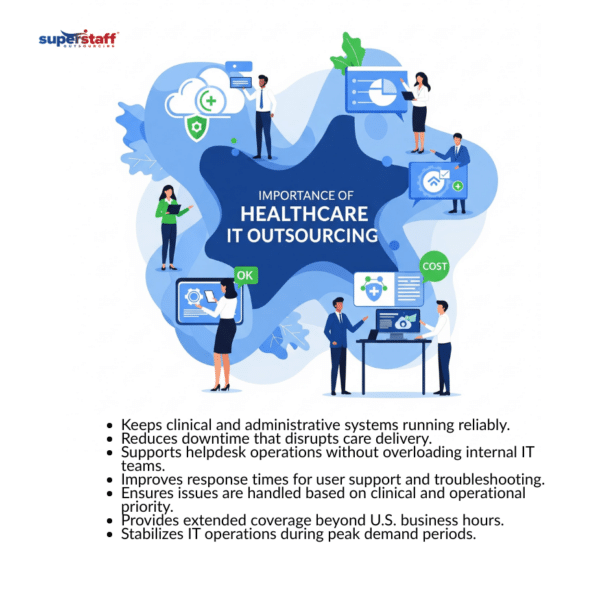
This coverage model strengthens healthcare IT outsourcing outcomes by ensuring issues are addressed when they occur rather than queued until the next business day. Over time, organizations experience fewer disruptions and smoother handoffs between shifts.
Troubleshooting that prioritizes clinical impact
Not all IT issues carry equal weight. A delayed login for a clinician differs from a reporting issue in finance. Healthcare troubleshooting requires judgment as much as technical skill.
Offshore teams trained for healthcare environments learn to assess urgency based on operational context. They follow escalation paths designed to protect patient care and data integrity. Documentation captures both the technical issue and its business impact.
This approach is where medical IT outsourcing for troubleshooting and support proves its value. The goal is not speed alone. The goal is accuracy under pressure.
User support that reduces friction instead of adding it
End users often experience IT support during moments of frustration. Systems are slow. Access fails. Work is interrupted.
Strong outsourced teams focus on clear communication and fast resolution. Scripts guide interactions, but empathy and process discipline matter more. Knowledge bases reduce repeat questions. First-contact resolution becomes a priority.
As support quality stabilizes, users regain confidence in systems. That trust improves adoption and reduces workarounds. In this way, healthcare IT outsourcing contributes to broader operational efficiency beyond ticket volume.
Integrating outsourced teams into healthcare managed IT models
Some organizations worry that outsourcing creates fragmentation. In practice, fragmentation occurs only when roles are unclear.
Healthcare managed IT models define ownership across internal and external teams. Strategy, compliance oversight, and vendor relationships remain internal. Execution and monitoring shift outward.
Outsourced teams follow established policies. Reporting aligns with internal dashboards. Leadership retains visibility while reducing operational strain. This structure allows healthcare IT outsourcing to support scale without sacrificing control.
Managing risk and maintaining compliance discipline
Healthcare IT support operates close to sensitive systems and data. That proximity demands strong governance.
Outsourced teams work under defined access controls. Training emphasizes compliance awareness and documentation standards. Activity logs support audit readiness.
While offshore teams do not replace internal compliance leadership, they operate within established frameworks. Clear boundaries reduce exposure and reinforce accountability across the support ecosystem.
Financial predictability and operational stability
Cost control remains a central concern for SMEs and midmarket healthcare organizations. Recruiting, training, and retaining specialized IT staff is expensive, particularly when demand fluctuates.
Outsourcing introduces predictability. Staffing levels scale with ticket volume. Costs align with usage rather than fixed headcount. Budget planning becomes more stable.
Importantly, quality does not decline when processes mature. In many cases, healthcare IT outsourcing improves consistency because teams focus on defined roles instead of juggling competing priorities.
Why the Philippines stands out for healthcare IT support
The Philippines offers a strong talent base with experience supporting U.S. healthcare systems. English proficiency supports clear communication. Cultural alignment supports service professionalism.
Many professionals are familiar with healthcare workflows, documentation expectations, and escalation protocols. That familiarity reduces onboarding time and improves accuracy.
For U.S. organizations, healthcare IT outsourcing to the Philippines often feels like extending the internal team rather than managing a distant vendor.
Designing a sustainable outsourced support structure
Outsourcing succeeds when it is treated as a strategic capability, not a short-term fix.
Effective healthcare IT support models include:
- Defined ticket categories with priority rules
- Clear escalation paths tied to operational impact
- Shared documentation and knowledge management
- Regular performance reviews linked to business outcomes
These elements transform the healthcare service desk into a stabilizing function rather than a reactive one.
How SuperStaff supports healthcare IT operations
SuperStaff builds healthcare IT support teams with operational discipline. Roles are clearly scoped. Training focuses on healthcare environments, not generic IT theory.
Teams integrate into existing workflows. Reporting aligns with U.S. leadership expectations. Communication remains clear, professional, and consistent.
Rather than offering rigid packages, SuperStaff tailors healthcare IT outsourcing models to match each organization’s scale, systems, and risk profile.
Streamline processes with SuperStaff’s healthcare IT outsourcing solutions
Healthcare organizations cannot afford unreliable IT support. Technology underpins care delivery, compliance, and financial performance. When support falters, the consequences spread quickly. Healthcare IT outsourcing provides a way for SMEs and midmarket providers to stabilize help desk operations, improve troubleshooting, and support users without overwhelming internal teams.
SuperStaff helps U.S. healthcare organizations build dependable offshore IT support teams in the Philippines. Explore how SuperStaff can strengthen your helpdesk, troubleshooting, and healthcare managed IT operations with a support model designed for consistency and long-term value.