
Customer expectations have changed quietly but permanently. Speed still matters, and accuracy still matters. However, neither one defines loyalty anymore.
Today, the customer service experience is evaluated through continuity, context, and consistency. Consumers expect brands to recognize them, remember past interactions, and resolve issues without friction. Every touchpoint contributes to a broader relationship, not a single transaction.
For U.S. SMEs and midmarket companies, this shift raises the bar. Support is no longer a cost center; It has become a visible extension of brand credibility.
Why Transaction-Based Support No Longer Works
For years, customer service success was measured by volume. Calls handled. Tickets closed. Average handle time reduced.
Those metrics still have value. Yet they no longer reflect how customers judge service quality.
A transactional approach focuses on ending interactions quickly. Meanwhile, a relationship-based model focuses on solving problems completely. The difference shows up immediately in repeat contacts and customer confidence.
When the customer service experience feels rushed or fragmented, customers notice. They interpret repetition as disorganization and associate inconsistency with a lack of accountability.
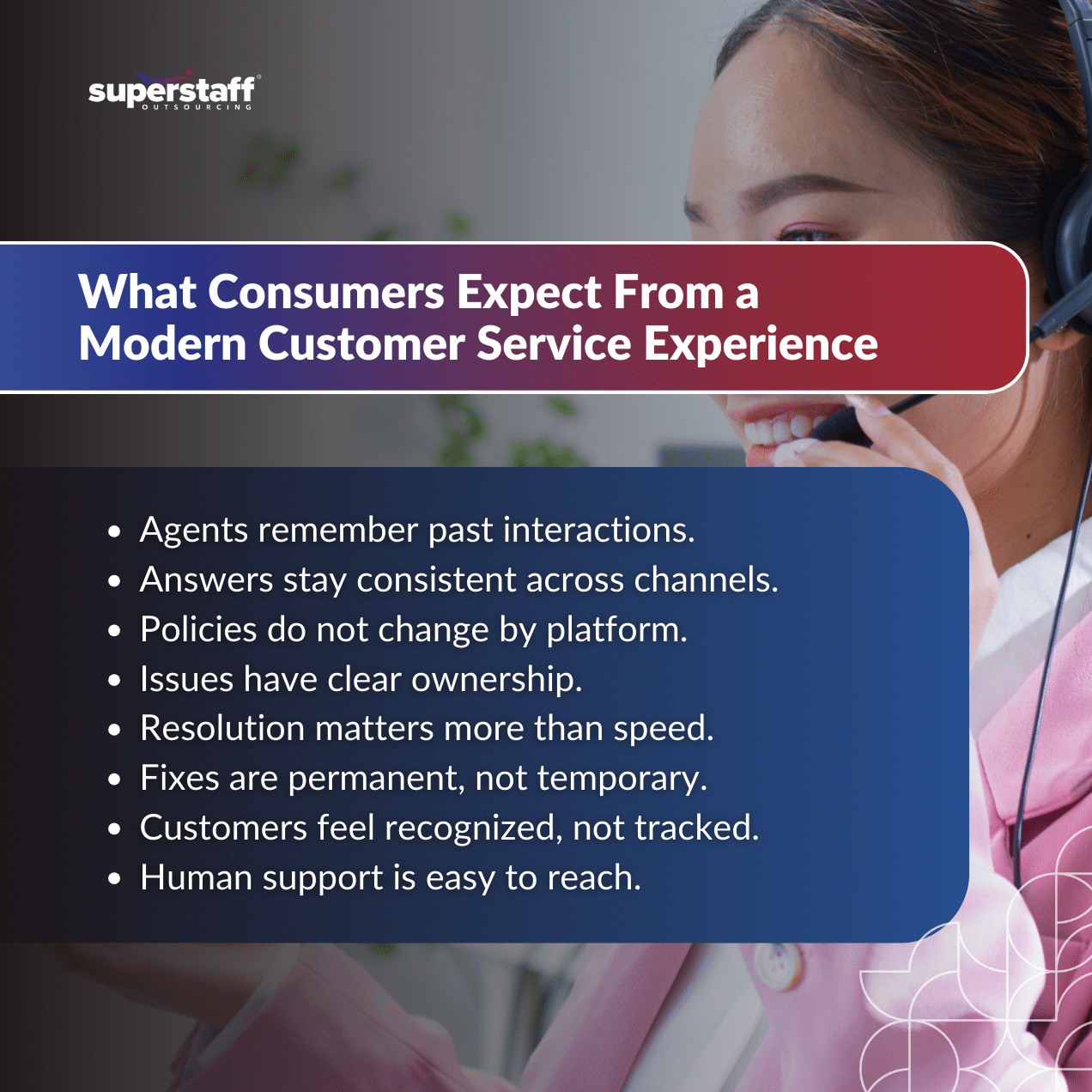
Modern service requires a shift in mindset. Today, resolution matters more than speed, and understanding matters more than scripting.
Continuity Is Now the Baseline Expectation
Customers no longer separate channels in their minds. They see one brand, not multiple departments.
Today’s buyers expect agents to know what happened yesterday. They expect context to carry over from email to chat to phone, and they do not want to explain the same issue twice.
A reliable customer service experience depends on systems and people working together. CRM tools alone are not enough. Agents must be trained to read, interpret, and apply customer history effectively.
This level of continuity requires stable teams because high turnover breaks knowledge flow. Dedicated offshore teams help preserve institutional memory as operations scale.
Why Consistency Matters More Than Personal Charm
Customers appreciate friendly agents, but what they trust is consistency. This consistency in communication is one of the benefits of omnichannel customer service outsourcing.
Policies must be applied the same way. Answers must align across channels, and escalations must follow predictable paths.
An inconsistent customer service experience creates doubt even when individual interactions feel pleasant. Customers begin testing the system. They try different channels to get different answers.
That behavior increases support volume and internal strain. This is why consistency, not charm, prevents it.
Centralized offshore teams excel at this discipline. They operate from shared playbooks and reinforce standards through ongoing quality monitoring.
Empathy Must Be Operationalized
Empathy is no longer optional; It is expected. However, empathy without structure leads to uneven outcomes. Agents may care but still fail to resolve issues effectively.
A strong customer service experience requires empathy paired with process. Agents must know when to listen, when to clarify, and when to act. They also need confidence in escalation protocols.
This balance comes from training depth. Short onboarding cycles limit judgment, while long-term investment builds capability.
Philippine-based teams benefit from a service-oriented work culture where communication roles are treated as professions. And that stability enables deeper skill development over time.
Personalization Should Feel Helpful, Not Intrusive
Customers want recognition. They do not want surveillance.
A modern customer service experience uses data to reduce effort, not to overwhelm conversations. Referencing past interactions should eliminate repetition. However, it should never feel like unnecessary monitoring.
This distinction requires human judgment. Automation supports efficiency, while people maintain trust.
Offshore teams trained in compliance and discretion handle this balance well. They follow defined data boundaries while still delivering personalized support where it adds value.
Speed Is Table Stakes, Not a Differentiator
Fast responses no longer impress customers. They expect them.
What differentiates brands now is what happens after the response: Is the answer accurate, and is the solution permanent?
A dependable customer service experience values clarity over haste. Customers accept waiting when expectations are set clearly. They reject fast answers that lead to repeated follow-ups.
This reality reshapes staffing requirements. Agents need time to investigate issues properly. Overloaded teams default to temporary fixes.
Offshore support allows capacity planning without constant pressure on internal teams. That breathing room improves both quality and morale.
Structure Determines Service Quality at Scale
Strong service operations do not rely on heroics. They rely on systems. A scalable customer service experience is built on:
- Defined escalation paths
- Clear role ownership
- Standardized workflows
- Continuous quality assurance
- Regular coaching and feedback
Without these elements, performance becomes unpredictable. Growth amplifies weaknesses rather than strengths.
Dedicated offshore teams are designed for this level of structure. They ensure that processes are documented and training is repeatable.
That discipline allows service quality to remain steady even as volume increases.
Why Internal Teams Often Plateau
In-house teams perform well early. However, challenges emerge as demand grows.
Hiring becomes reactive. Training loses consistency. Managers shift from coaching to crisis control.
At that point, the customer service experience suffers quietly. Customers do not complain immediately. Instead, they disengage.
Offshore teams provide an alternative growth path. Capacity scales without disrupting existing operations, and standards remain intact.
This approach protects customer relationships while allowing internal leaders to focus on strategy rather than staffing volatility.
Outsourcing as a Brand Protection Strategy
Outsourcing fails when it is treated as a shortcut. It succeeds when it is treated as an extension. This is why BPO partnerships must be treated as a long-term customer engagement communication strategy rather than a short-term fix.
A relationship-driven customer service experience requires alignment with brand values. Agents must understand tone, priorities, and decision boundaries. They must feel accountable to outcomes, not just scripts.
The Philippines continues to lead in this area. Cultural alignment with U.S. customers reduces friction. Strong communication skills support complex service interactions.
When offshore teams are integrated properly, customers cannot tell where support is located. They only notice reliability.
How SuperStaff Supports Relationship-Driven Service
SuperStaff builds support teams designed for long-term engagement. Our model prioritizes stability, training depth, and operational clarity.
Agents are aligned with client brands. Processes are documented and reinforced. Performance is measured beyond volume metrics.
The result is a customer service experience that feels consistent, informed, and dependable at every stage of growth.
Customer Service Experience: Moving From Resolution to Retention
Customer loyalty is built through repetition. Each interaction either reinforces trust or weakens it.
The companies that win today invest in service as a relationship function. They design operations to support memory, consistency, and accountability.
If your organization is ready to move beyond transactional support, SuperStaff can help you build a customer service experience that strengthens relationships while scaling with confidence.
Are you ready to meet the omnichannel customer service expectations of today’s customers? Explore how our Philippines-based teams support modern service operations built for long-term growth.