
Growing companies often discover that technology problems consume time that leaders should spend on customers, strategy, and growth. Internal teams end up troubleshooting laptops, resetting passwords, and chasing system issues instead of moving the business forward. This is where outsourced IT support services become relevant for small and midmarket firms that need reliable technical coverage without building a full in-house department.
As organizations scale, systems multiply, tools expand, and users increase. Support needs rise quietly in the background until they interrupt daily operations. Many companies turn to external IT teams to stabilize their environment, keep employees productive, and maintain continuity without adding overhead.
What are outsourced IT support services?
Outsourced IT support services refer to delegating day to day technical assistance to a dedicated external team that handles user issues, system troubleshooting, and ongoing maintenance. This includes help desk support, device management, software assistance, and basic network monitoring. Businesses rely on these teams to resolve technical problems quickly and consistently.
External support teams act as an extension of internal operations. They follow documented processes, ticketing systems, and service level expectations defined by the client. Over time, they become familiar with the company’s tools, workflows, and users.
Why do growing companies struggle with internal IT support?
Early stage companies often rely on one technically inclined employee to fix issues as they arise. As the organization grows, that approach becomes unsustainable and reactive. Employees experience longer downtimes, while leaders face repeated disruptions.
Internal hiring does not always solve the problem. Skilled IT professionals are expensive, hard to retain, and often overqualified for routine support tasks. Companies need consistent technical support outsourcing service coverage rather than specialized engineering expertise for everyday issues.
How does an outsourced IT team handle daily technical tickets?
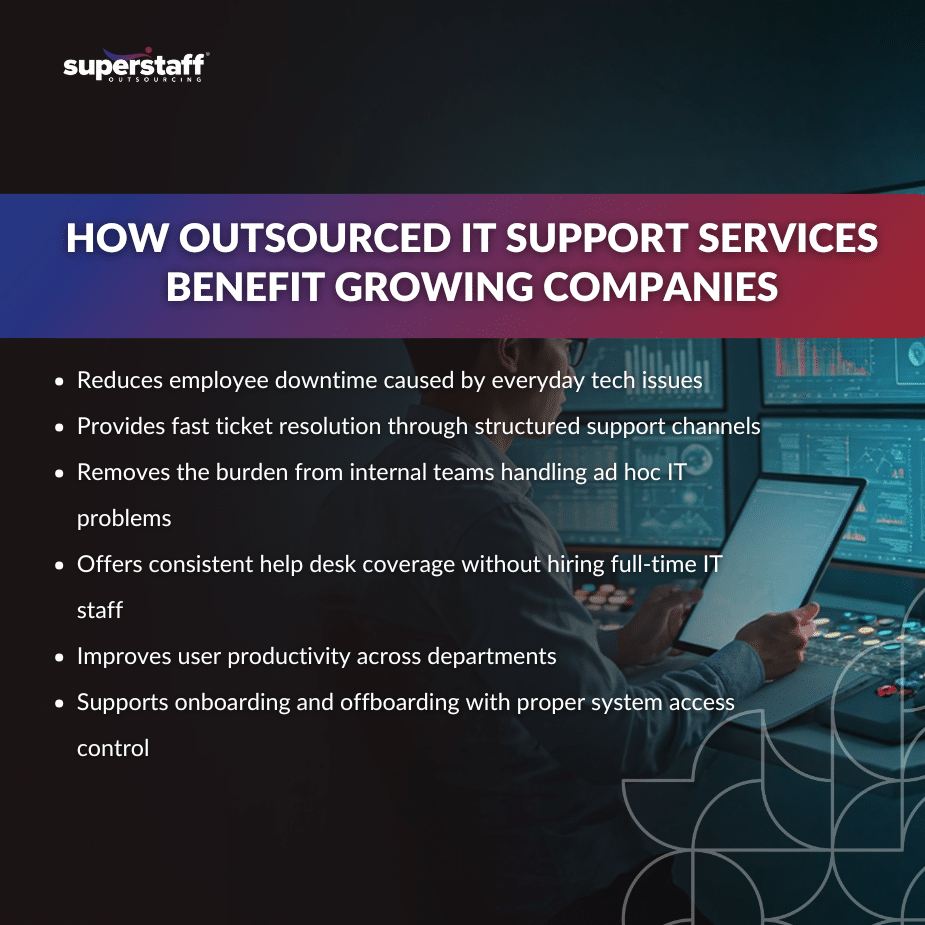
Outsourced IT support services operate through structured ticketing systems where employees submit issues for resolution. Support agents triage tickets, prioritize urgent concerns, and follow standard troubleshooting steps. Resolution times are tracked and reported to ensure accountability.
Additionally, these teams provide live chat, email, or phone assistance depending on the agreed support model. Employees receive immediate guidance instead of waiting for an internal resource to become available. This improves productivity across departments.
What types of issues do outsourced IT teams usually manage?
Most user related technical problems fall within the scope of outsourced IT support services. These include password resets, email issues, software access problems, printer connectivity, VPN setup, and device configuration. Routine system errors and user confusion are addressed quickly.
Moreover, these teams manage onboarding and offboarding from a technical standpoint. New hires receive system access, while departing employees have credentials revoked promptly to maintain security.
How do outsourced IT teams integrate with internal operations?
Integration starts with documentation. The client shares system maps, software lists, user policies, and escalation procedures. IT support agents study this material and receive training before handling live tickets.
When you outsource remote IT support services, communication channels are also defined clearly. Internal managers know when to escalate issues, while support teams know when to involve client leadership. This alignment allows outsourced IT support services to function like an internal help desk.
How does this model improve employee productivity?
Employees lose time whenever technical issues delay their work. Waiting for assistance often leads to frustration and work interruptions. Reliable support removes these bottlenecks and allows staff to focus on their primary responsibilities.
Consistent assistance also reduces repeated issues. Users learn proper system usage through guided support, which lowers the overall volume of recurring tickets over time.
Is data security a concern when outsourcing IT support?
Security remains a valid concern for decision makers. Reputable providers operate under strict access controls, role based permissions, and documented security policies. Support agents access only what is necessary to resolve tickets.
Furthermore, activity logs and audit trails are maintained for transparency. Companies retain full control over systems while benefiting from outsourced IT support services that follow predefined security standards.
How does outsourcing IT support reduce operational costs?
Hiring internal IT staff involves salaries, benefits, equipment, and ongoing training. Many of these costs are fixed regardless of ticket volume. Outsourcing IT support converts this into a predictable service model aligned with actual needs.
Businesses pay for coverage, not idle time. They also avoid the expense of recruiting and retaining hard to find technical talent for routine support work.
What kind of companies benefit the most from this approach?
Small and midmarket companies with growing teams experience the most value from outsourced IT support services. These firms often use multiple SaaS tools, remote work setups, and cloud systems that require consistent user assistance.
Companies expanding into new locations or supporting remote employees also benefit. External IT teams provide coverage across time zones without the need to build local support capacity.
How quickly can a company implement outsourced IT support?
Implementation timelines depend on documentation readiness and system complexity. Many providers complete onboarding within a few weeks after receiving access guidelines and process documentation. Training ensures agents are familiar with tools before going live.
Once operational, support begins immediately through agreed channels. Employees start using the service without major workflow changes.
What should leaders look for in an outsourced IT partner?
Leaders should evaluate process maturity, communication structure, and reporting transparency. If you’re wondering how to choose an outsourced IT support provider, clear service level expectations and ticket tracking are essential. Cultural alignment and responsiveness also matter for smooth collaboration.
Experience with remote support tools and structured onboarding is equally important. A provider that understands business continuity will deliver consistent results.
Partner With SuperStaff for Outsourced IT Support Services That You Can Trust
Technology issues should not distract growing companies from their core mission. Outsourced IT support services offer a practical way to keep employees productive, systems stable, and operations uninterrupted without building a large internal department.
SuperStaff provides dedicated support teams in the Philippines that integrate seamlessly into client operations. If your organization needs reliable technical coverage that scales with growth, explore how outsourced IT support services from SuperStaff can strengthen your day to day operations and support your long term plans.