
Cash flow remains one of the most persistent operational challenges for clinics and hospitals across the United States. Claims sit in queues. Denials accumulate. Patient balances age longer than expected. Meanwhile, internal teams spend valuable time chasing paperwork instead of supporting care delivery.
This is where revenue cycle management outsourcing becomes a practical strategy. Healthcare providers are discovering that delegating complex back-office billing and claims processes to specialized offshore teams can directly improve collections, reduce delays, and stabilize financial performance without increasing headcount.
Why Cash Flow Suffers Inside Healthcare Organizations
Healthcare revenue does not slow down because patients stop coming in. It slows down because administrative bottlenecks interrupt the billing lifecycle.
Several patterns commonly affect providers:
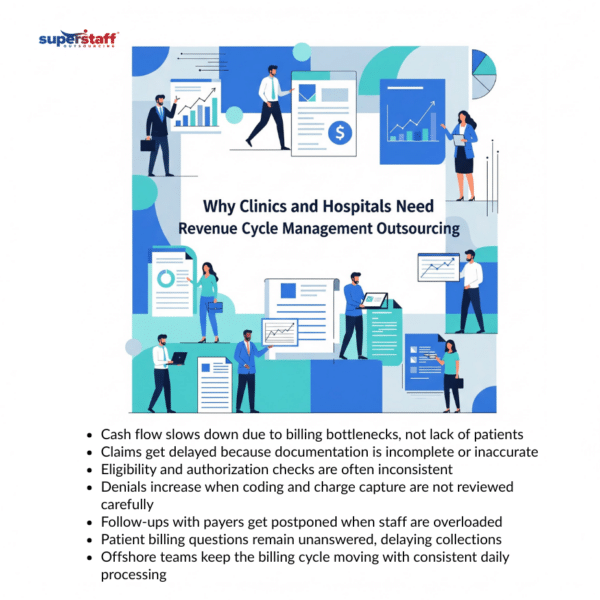
- Claims are submitted with missing or inaccurate documentation
- Eligibility verification happens too late or inconsistently
- Denials are addressed reactively instead of proactively
- Follow-ups with payers take longer due to staffing limits
- Patient statements are delayed or unclear
These issues accumulate over weeks and months. As a result, accounts receivable ages beyond acceptable thresholds. Leadership teams often notice cash strain without fully seeing how daily back-office gaps create the problem.
The Complexity of the Revenue Cycle Today
Healthcare billing is no longer straightforward. Payer rules change frequently. Billing and coding outsourcing requirements grow more detailed. Documentation standards continue to rise. At the same time, staffing shortages make it difficult to keep experienced billing teams fully staffed.
Administrative teams must manage:
- Insurance verification
- Pre-authorization coordination
- Medical coding and charge capture
- Claims submission and tracking
- Denial management
- Payment posting
- Patient billing support
This growing workload makes revenue cycle management outsourcing an operational decision rather than a cost discussion. Providers need consistent capacity to keep the revenue process moving every day.
How Offshore Teams Keep the Billing Cycle Moving
RCM management solutions teams in the Philippines work as an extension of in-house billing departments. They handle repetitive, time-sensitive tasks that directly affect how quickly claims move through the system.
Their daily responsibilities often include:
- Verifying insurance before patient visits
- Reviewing charts for coding completeness
- Submitting claims accurately on first pass
- Monitoring payer portals for status updates
- Initiating timely follow-ups on pending claims
Because these teams focus only on revenue cycle tasks, they create steady workflow momentum that internal teams struggle to maintain during peak periods.
Reducing Denials Before They Happen
Denials are not only a reimbursement issue. They are a time issue. Every denied claim adds another cycle of review, correction, and resubmission.
Specialized offshore staff trained in payer requirements help reduce denials through:
- Pre-claim audits for common error patterns
- Verification of authorization and eligibility details
- Cross-checking diagnosis and procedure codes
- Ensuring required documentation is attached before submission
Through revenue cycle management outsourcing, providers shift from reacting to denials toward preventing them, which shortens the reimbursement timeline.
Faster Follow Ups With Payers and Patients
Timely follow-up is one of the first activities to suffer when in-house teams become overloaded. Calls to payers get postponed. Patient billing questions remain unanswered. Claims remain unresolved longer than necessary.
Outsourced RCM teams dedicate time daily to:
- Calling insurance companies for status clarification
- Escalating aged claims for review
- Responding to patient billing inquiries
- Sending follow-up statements and reminders
This consistent attention helps move aging receivables forward and improves overall collections performance.
Improving Accuracy in Coding and Charge Entry
Small coding mistakes create large payment delays. Missing modifiers. Incorrect code combinations. Uncaptured services. These errors often go unnoticed until payers reject the claim.
With revenue cycle management outsourcing, trained coders and charge entry specialists review documentation carefully before submission. Their role focuses on accuracy, completeness, and compliance with payer guidelines.
As accuracy improves, first-pass acceptance rates improve. Cash flow stabilizes as fewer claims return for correction.
Allowing Internal Staff to Focus on Patient Support
Billing complexity pulls administrative staff away from patient-facing responsibilities. Front desks become overwhelmed. Scheduling slows down. Patient experience suffers.
Outsourcing revenue tasks allows clinics and hospitals to:
- Free up internal staff for patient coordination
- Improve responsiveness at the front desk
- Reduce burnout among administrative teams
- Maintain smoother clinic operations during peak periods
Operational relief often becomes one of the unexpected benefits of revenue cycle management outsourcing.
Handling Volume Without Hiring Pressure
Patient volumes fluctuate. Seasonal surges. Specialty clinics. Expansion into new services. These shifts create billing backlogs quickly when staffing remains fixed.
Offshore teams provide flexible capacity to handle:
- Increased claim volumes during busy months
- Backlogs from system transitions or staffing gaps
- Additional workload during expansions
- Ongoing processing without overtime costs
Providers gain scalability without going through long recruitment and training cycles.
Strengthening Reporting and Visibility
Cash flow issues often stem from limited visibility into where claims are stuck. Leadership may only see high-level aging reports without understanding root causes.
Outsourced teams support better tracking through:
- Daily status updates on pending claims
- Categorization of denial reasons
- Reporting on turnaround times
- Identification of recurring documentation issues
These insights help healthcare leaders make operational improvements beyond billing.
Creating a More Predictable Revenue Process
Consistency matters in healthcare finance. When billing tasks happen irregularly, revenue becomes unpredictable. Providers struggle to forecast collections and plan expenses.
Through revenue cycle management outsourcing, clinics establish a steady rhythm of claim submission, follow-up, and resolution. Predictability improves financial planning and reduces stress on leadership teams.
Why the Philippines Is a Strong Fit for RCM Support
The Philippines has long been a trusted location for healthcare back-office services. Professionals in this market are experienced in U.S. healthcare systems, insurance terminology, and medical documentation standards.
These teams offer:
- Strong English communication skills for payer interaction
- Familiarity with U.S. EHR and billing platforms
- Experience supporting clinics, specialty practices, and hospitals
- Cultural alignment with U.S. work expectations
As a result, integration with internal billing teams becomes smoother and faster.
Building a Financial Backbone That Supports Care Delivery
Revenue cycle efficiency directly supports patient care. When cash flow is stable, providers can invest in staffing, equipment, and service improvements. Administrative strain no longer competes with clinical priorities.
Healthcare leaders increasingly recognize that revenue cycle management outsourcing is not simply a staffing decision. It is a way to build a reliable financial backbone that sustains long-term operations.
Improve Healthcare Cash Flow Through Revenue Cycle Management Outsourcing
Are you wondering how revenue cycle management improves cash flow? These financial challenges in clinics and hospitals rarely come from a lack of patients. They come from delays, errors, and capacity gaps inside the billing process. Revenue cycle management outsourcing provides the daily operational support needed to keep claims moving, reduce denials, and improve collections consistency.
SuperStaff’s experienced healthcare back-office teams in the Philippines work alongside U.S. providers to streamline billing operations and strengthen financial performance. If your organization is looking to improve cash flow without expanding internal headcount, explore how we can support your revenue cycle with dedicated offshore expertise.