As digital operations become more complex, many U.S. SMEs and midmarket companies are rethinking how they support their IT environments. Internal teams are often stretched thin. Hiring locally is expensive. Meanwhile, downtime, security gaps, and slow response times create real business risk.
This is where outsourced IT management in the Philippines has become a practical option. Companies are not looking for basic tech support alone. They want structured coverage, predictable performance, and teams that integrate with how the business already operates.
Below is a clear breakdown of the core functions companies typically include when they move IT responsibilities offshore.
Service Desk and End User Support
At the foundation of most engagements is day to day technical support for employees. This function keeps operations moving and reduces internal disruption.
Teams handle common issues such as password resets, device setup, software access, and basic troubleshooting. Tickets are logged, prioritized, and resolved using established workflows. Clear escalation paths ensure complex issues reach senior technicians quickly.
With outsourced IT management, U.S. companies gain extended coverage without adding overnight shifts internally. Support aligns with business hours or operates around the clock when needed.
Network Monitoring and Infrastructure Support
Stable infrastructure is critical for performance and security. Offshore teams play an active role in monitoring systems before problems escalate.
This includes tracking network health, server performance, and connectivity issues. Alerts are reviewed in real time. Preventive actions are taken to avoid outages or slowdowns.
Many businesses include this function as part of broader managed IT services to reduce the risk of unexpected downtime and internal fire drills.
Cybersecurity Monitoring and Response
Security responsibilities are no longer limited to large enterprises. SMEs face the same threats but often lack internal resources.
Philippine IT teams support cybersecurity by monitoring access logs, managing endpoint protection, and assisting with incident response protocols. They follow client defined security policies rather than imposing generic frameworks.
Within outsourced IT management, this function focuses on execution and vigilance. Strategic decisions remain with the client, while offshore teams handle continuous oversight and first response.
User Access and Identity Management
As organizations scale, controlling who can access what becomes harder to manage internally. Errors increase risk.
Offshore teams manage user provisioning, deprovisioning, and permission updates across systems. Requests are processed through documented approval workflows. Audit trails are maintained to support compliance requirements.
This function is often overlooked early on. Over time, it becomes a core component of stable IT outsourcing services.
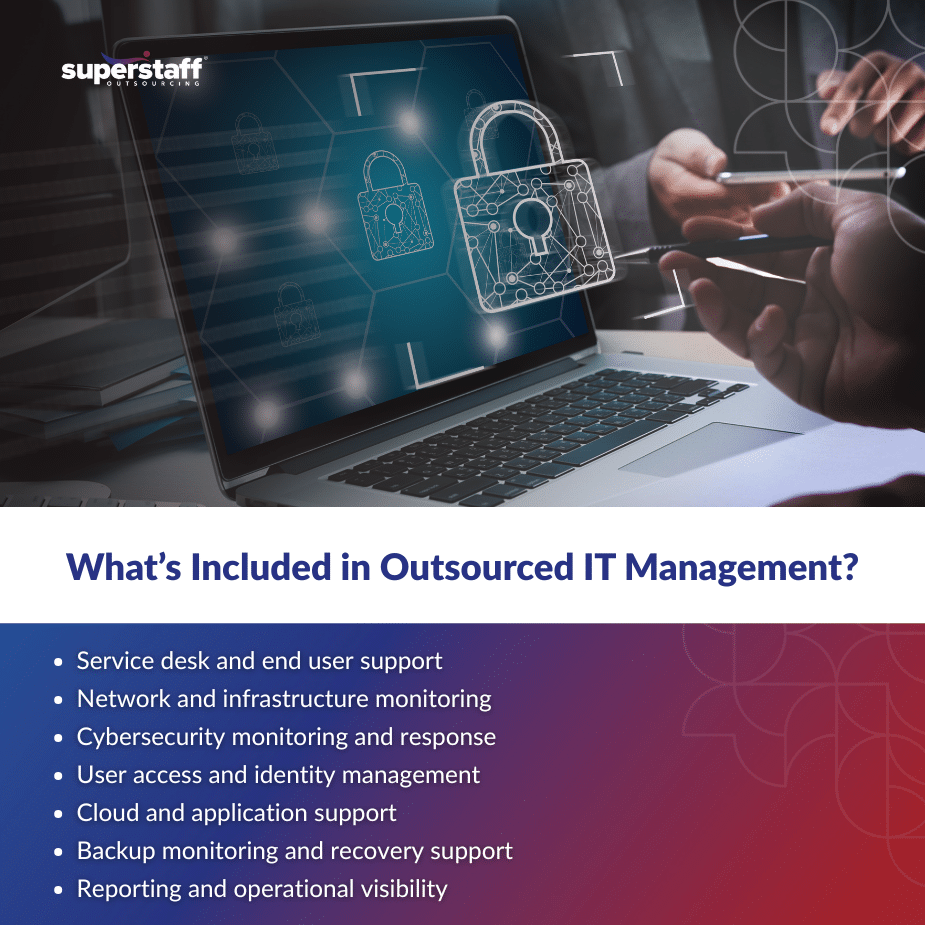
Cloud and Application Support
Most businesses rely on cloud based tools to run daily operations. These platforms require consistent administration.
Teams in the Philippines assist with cloud user management, application configuration, and issue resolution. They coordinate updates and support integrations under client direction.
When companies ask “what is included in managed IT services?”, application support is almost always part of the answer. The goal is continuity, not experimentation.
Patch Management and System Updates
Unpatched systems create security and performance risks. Still, updates are often delayed due to lack of internal bandwidth.
Offshore IT teams schedule, test, and deploy updates across operating systems and applications. Rollouts follow documented procedures to avoid disruption.
This function within outsourced IT management helps businesses stay current without placing extra strain on internal staff.
Backup Monitoring and Recovery Support
Backups only matter when recovery works. Offshore teams focus on making sure systems are protected and restorable.
Responsibilities include monitoring backup jobs, validating success, and assisting during recovery events. When issues occur, teams escalate immediately and follow recovery plans defined by the client.
This operational layer supports business continuity without requiring senior leadership involvement in routine checks.
Asset and Device Lifecycle Management
As remote and hybrid work expand, tracking hardware becomes more complex. Lost visibility leads to waste and security gaps.
Teams manage device inventories, onboarding and offboarding checklists, and replacement workflows. Coordination with vendors and internal stakeholders keeps equipment aligned with user needs.
This function often sits quietly in the background. Over time, it becomes a major efficiency driver.
Vendor and Tool Coordination
IT environments rely on multiple vendors. Managing them consumes time.
Offshore teams assist by coordinating with software providers, telecom partners, and managed platforms. They track tickets, follow up on resolutions, and document outcomes.
Within outsourced IT management, this role protects internal teams from administrative overload while keeping accountability clear.
Reporting and Operational Visibility
Leadership needs clarity, not noise. Offshore teams support reporting that focuses on trends and performance.
Reports typically include ticket volumes, resolution times, recurring issues, and system health summaries. Insights are reviewed with client stakeholders to guide adjustments.
This transparency helps decision makers evaluate the value of managed IT services without digging into technical detail.
Why the Philippines Works for IT Operations
The Philippines offers a mature IT talent pool with strong English proficiency and familiarity with U.S. business environments. Teams are accustomed to following structured processes and collaborating across time zones.
More importantly, the model supports consistency. Offshore teams are trained to operate as extensions of internal IT departments, not detached vendors.
This alignment is what allows outsourced IT management to support growth rather than create friction.
Aligning Scope With Business Priorities
Not every company needs all functions on day one. Many start with service desk support and expand as trust and complexity increase.
Clear role definitions, documented workflows, and governance routines matter more than geography. When expectations are set correctly, IT outsourcing services become predictable and scalable.
Philippine teams succeed when they are given context, not just tasks.
Outsourced IT Management: A Practical Path Forward for Growing Businesses
Outsourcing IT functions is no longer about cost reduction alone. It is about operational resilience, coverage, and focus.
With the right structure, outsourced IT management allows internal leaders to prioritize strategy while execution runs reliably in the background.
At SuperStaff, we build IT support teams in the Philippines that integrate with your systems, policies, and business goals. Our approach emphasizes accountability, clarity, and long term partnership.
If your organization is evaluating how to stabilize and scale IT operations, now is the right time to explore how outsourced IT management through SuperStaff can support your next phase of growth.