

Growth in financial services often comes with pressure. Teams need to launch products faster, meet strict regulations, and deliver seamless customer support. At the same time, hiring skilled talent can be slow and expensive.
That is where fintech outsourcing becomes a practical option. It allows financial firms to access global talent, reduce costs, and scale operations without losing focus on core goals. Instead of building everything in-house, companies can rely on trusted partners to handle key functions.
Clear strategy matters. Smart use of fintech outsourcing helps firms stay competitive while maintaining quality and compliance.
Understanding Fintech Outsourcing
Fintech outsourcing refers to delegating financial technology services and operations to external providers. These providers support tasks that require technical, operational, or compliance expertise.
Companies use fintech outsourcing to handle both customer-facing and back-office functions. This approach supports growth while keeping internal teams focused on strategy and innovation.
Common Functions Outsourced
Financial firms often outsource the following:
- Customer support for banking and fintech apps
- Fraud detection and risk monitoring
- Payment processing support
- Software development and testing
- Data entry and back-office operations
- Regulatory compliance support
Each function plays a role in daily operations. Outsourcing them helps reduce workload and improve efficiency.
Why Growing Financial Firms Choose Fintech Outsourcing
Many firms turn to fintech outsourcing when internal resources reach their limits. Growth creates demand for speed, accuracy, and flexibility.
Key Reasons
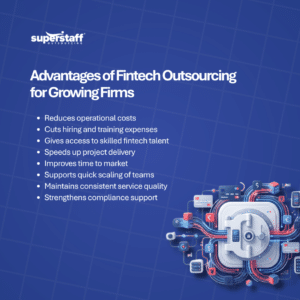
- Cost Control: Hiring in-house teams can be expensive. Fintech outsourcing reduces labor and infrastructure costs.
- Access to Skilled Talent: Specialized roles in fintech require experience. Outsourcing partners already have trained professionals.
- Faster Time to Market: External teams can start quickly. This helps firms launch products and services faster.
- Scalability: Demand can change quickly. Fintech outsourcing allows firms to scale up or down as needed.
- Focus on Core Business: Internal teams can focus on growth, strategy, and customer experience.
As a result, fintech outsourcing supports both operational stability and expansion.
Types of Fintech Outsourcing Services
Different firms have different needs. Fintech outsourcing covers a wide range of services that can be tailored to business goals.
1. Customer Experience Support
Strong customer service is essential in financial services.
Outsourced teams handle:
- Inbound and outbound calls
- Email and chat support
- Account inquiries and issue resolution
This ensures customers receive timely and accurate assistance.
2. Back Office and Administrative Tasks
Back-office work keeps operations running smoothly.
Common outsourced tasks include:
- Data entry and verification
- Transaction processing
- Reporting and documentation
These functions require accuracy and consistency. Fintech outsourcing helps maintain both.
3. Technology and Development Support
Tech drives fintech companies. However, building full in-house teams can be difficult.
Outsourced services include:
- Software development
- Quality assurance testing
- System maintenance
This allows firms to keep systems updated without delays.
4. Compliance and Risk Management
Regulations are strict in financial services. Compliance errors can lead to penalties.
Fintech outsourcing supports:
- Know Your Customer checks
- Anti-money laundering monitoring
- Audit preparation
These services help firms stay aligned with regulatory standards.
Benefits of Fintech Outsourcing for Financial Firms
Fintech outsourcing offers clear advantages when implemented correctly. It supports both efficiency and long-term growth.
Operational Benefits
- Faster processing times
- Improved service availability
- Consistent performance
Financial Benefits
- Lower operating costs
- Reduced hiring expenses
- Better budget control
Strategic Benefits
- Increased flexibility
- Access to global expertise
- Stronger focus on innovation
Each benefit contributes to stronger business performance.
Challenges to Consider
Despite its advantages, fintech outsourcing requires careful planning. Risks can arise without proper management.
Common Challenges
- Data security concerns
- Communication gaps
- Quality control issues
- Regulatory compliance risks
Addressing these challenges early is important. Clear agreements and strong oversight can reduce potential problems.
How to Choose the Right Fintech Outsourcing Partner
Choosing the right provider is a critical step. A strong partner ensures smooth operations and long-term success.
What to Look For
- Industry Experience: Look for providers with fintech or financial services expertise.
- Security Standards: Data protection should be a priority. Check certifications and protocols.
- Scalability: The provider should support growth without delays.
- Communication and Transparency: Clear communication ensures alignment and accountability.
- Performance Metrics: Reliable providers track results and report progress regularly.
A careful selection process leads to better outcomes.
Best Practices for Managing Fintech Outsourcing
Effective management ensures fintech outsourcing delivers value. Strong processes help maintain quality and efficiency.
Recommended Practices
- Set clear goals and expectations
- Define key performance indicators
- Maintain regular communication
- Monitor performance consistently
- Use secure systems for data sharing
These practices create a structured approach to outsourcing.
When Should a Company Consider Fintech Outsourcing?
Timing matters. Fintech outsourcing works best when aligned with business needs.
Signs It Is Time to Outsource
- Rapid business growth
- Increasing operational costs
- Limited access to skilled talent
- Delays in product development
- Rising customer service demands
Recognizing these signs helps firms act early and stay ahead.
The Role of Fintech Outsourcing in Long-Term Growth
Fintech outsourcing is not just a short-term solution. It plays a role in building sustainable operations.
Companies that use fintech outsourcing effectively can:
- Improve service delivery
- Maintain compliance standards
- Adapt to market changes
- Expand into new markets
Over time, outsourcing becomes part of a broader growth strategy.
Build Smarter with SuperStaff’s Fintech Outsourcing Solutions
Fintech outsourcing offers a clear path for financial firms that want to grow without overextending resources. It supports cost control, improves efficiency, and provides access to skilled talent.
With the right partner, fintech outsourcing becomes a reliable extension of your business. It allows your team to focus on strategy while experts handle operational demands.
SuperStaff helps financial firms implement fintech outsourcing with trained teams, strong compliance practices, and scalable solutions.
If your organization is ready to improve efficiency and support long-term growth, connect with us today and explore how fintech outsourcing can work for you.