
Healthcare margins are under constant pressure. Reimbursement complexity continues to increase. Meanwhile, staffing shortages and rising labor costs strain internal billing teams. For finance leaders, healthcare revenue cycle management outsourcing has become a serious strategic consideration rather than a short-term fix.
CFOs today are expected to protect revenue integrity while controlling operating expenses. That balance requires disciplined processes, scalable teams, and measurable accountability. Offshore support from the Philippines offers a structured way to strengthen revenue cycle performance without expanding fixed overhead.
Why CFOs Are Reexamining the Revenue Cycle
Revenue cycle management touches every dollar that enters a healthcare organization. Registration errors delay payment. Coding inconsistencies increase denials. Slow follow-ups weaken cash flow visibility.
Financial leaders are asking direct questions:
- How long does it take to convert services into collected revenue?
- Where do denial patterns originate?
- What percentage of staff time goes to rework?
- How predictable is monthly cash flow?
Healthcare revenue cycle management outsourcing allows CFOs to address these questions through operational redesign. Offshore teams can focus exclusively on defined billing functions while internal leaders concentrate on financial oversight and strategy.
Cost Structure Versus Cost Control
Reducing payroll expenses alone does not improve financial performance. Sustainable improvement requires structural cost control. That distinction matters when evaluating healthcare revenue cycle management outsourcing.
Philippine-based RCM teams operate within a variable cost model. Organizations can scale resources based on patient volume, seasonal shifts, or payer mix changes. Instead of adding full-time domestic staff with long-term obligations, finance leaders gain flexibility.
Predictable labor costs also improve forecasting accuracy. CFOs can align RCM support capacity directly with projected revenue targets.
Strengthening Front-End Accuracy
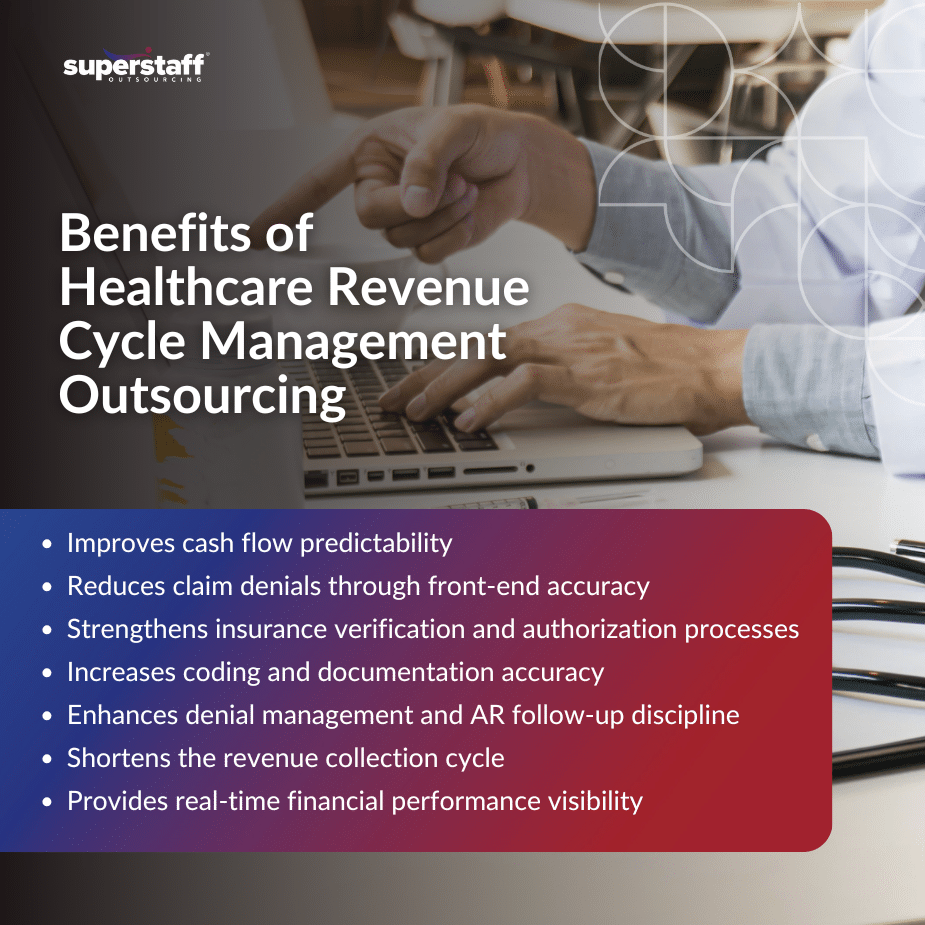
The revenue cycle begins long before a claim is submitted. Patient eligibility checks, benefits verification, and prior authorization processes directly influence reimbursement speed.
Many denials originate at the front end. Healthcare revenue cycle management outsourcing addresses this risk by dedicating trained offshore teams to:
- Insurance verification
- Authorization tracking
- Demographic data validation
- Payment posting preparation
Focused specialization reduces registration errors. Improved data accuracy shortens the revenue timeline and lowers downstream corrections.
Coding and Documentation Support
Clinical documentation must align with payer requirements. Even minor inconsistencies can trigger denials or underpayments.
CFOs evaluating healthcare revenue cycle management outsourcing should examine how offshore teams support coding workflows. Philippine RCM professionals can assist with:
- Medical coding review
- Charge capture validation
- Documentation cross-checking
- Pre-bill audits
Structured quality assurance protocols help maintain compliance standards. Finance leaders retain oversight while benefiting from expanded review capacity.
Denial Management and AR Follow-Up
Denials represent delayed cash. Unresolved accounts receivable erode liquidity. CFOs need disciplined follow-up processes.
Healthcare revenue cycle management outsourcing enables dedicated AR specialists to track payer responses daily. Offshore teams can:
- Identify denial root causes
- Submit corrected claims
- Escalate aging accounts
- Maintain payer communication logs
Continuous monitoring improves recovery rates without expanding domestic administrative headcount. That operational consistency protects revenue stability.
Cash Flow Visibility and Reporting
Finance executives require transparency. Outsourced teams must deliver measurable outputs.
When structured correctly, healthcare revenue cycle management outsourcing integrates reporting dashboards aligned with financial KPIs. CFOs can monitor:
- Clean claim rates
- Denial percentages
- Days in accounts receivable
- Collection cycle timelines
Clear performance metrics allow leadership to evaluate offshore effectiveness objectively. Accountability frameworks replace assumptions.
Compliance and Risk Mitigation
Healthcare billing is highly regulated. Data security and process documentation cannot be compromised.
Philippine outsourcing providers that serve U.S. healthcare organizations typically operate within established compliance frameworks. Secure infrastructure, documented workflows, and defined access controls reduce operational risk.
CFOs should assess vendor governance models, internal audit processes, and escalation protocols before engaging in healthcare revenue cycle management outsourcing. Risk evaluation remains a core financial responsibility.
Workforce Stability and Continuity
Domestic RCM teams often experience turnover. Recruiting experienced billers in competitive U.S. markets can be costly and slow.
Healthcare revenue cycle management outsourcing to the Philippines provides access to a stable talent pool with strong healthcare support experience. Structured onboarding programs ensure process alignment with U.S. payer requirements.
Continuity strengthens institutional knowledge. That consistency reduces training cycles and improves long-term efficiency.
Strategic Alignment With Growth Plans
Healthcare organizations planning expansion face revenue cycle scaling challenges. New clinics, additional specialties, or telehealth growth increase claim volume.
Healthcare revenue cycle management outsourcing offers scalable support. Offshore teams can ramp up capacity without requiring physical office expansion in the United States.
Growth initiatives become financially manageable. CFOs maintain control over cost ratios while enabling operational expansion.
Differentiation Through Process Discipline
Outsourcing should never be transactional. Strategic CFOs evaluate process maturity, communication standards, and continuous improvement frameworks.
Healthcare revenue cycle management outsourcing succeeds when providers implement:
- Clearly documented workflows
- Defined service level agreements
- Structured quality reviews
- Ongoing performance optimization
Executive leaders should expect regular operational reviews. Collaborative governance meetings create transparency between offshore teams and internal finance leadership.
How the Philippines Supports Executive Priorities
The Philippines has developed a strong reputation in healthcare support services. English proficiency, familiarity with U.S. insurance systems, and cultural alignment contribute to operational effectiveness.
Time zone coverage allows extended claim processing windows. That advantage shortens billing cycles without requiring overnight domestic shifts.
Additionally, established BPO infrastructure supports secure data handling and remote workforce management. These factors align directly with CFO concerns around reliability and cost discipline.
Evaluating the Right Partner
Selecting a provider requires more than reviewing pricing models. CFOs should conduct a structured evaluation that includes:
- Process mapping alignment
- Quality assurance methodology
- Data security protocols
- Performance reporting standards
- Escalation and governance procedures
Healthcare revenue cycle management outsourcing delivers results only when integration is deliberate. A well-defined transition plan reduces disruption and maintains claim continuity during onboarding.
Building Financial Strength Through Smart Healthcare Revenue Cycle Management Outsourcing
Revenue cycle performance directly influences organizational stability. Financial leaders cannot afford fragmented billing processes or unpredictable collections. Healthcare revenue cycle management outsourcing offers CFOs a disciplined framework to improve cash flow, enhance accuracy, and manage costs strategically.
The Philippines provides scalable talent, structured processes, and operational continuity that align with executive financial priorities. When implemented thoughtfully, healthcare revenue cycle management outsourcing strengthens revenue integrity while preserving internal leadership focus.
SuperStaff supports U.S. healthcare organizations with dedicated offshore RCM teams built around accountability, compliance, and measurable outcomes. If you are evaluating how to improve financial performance without expanding fixed overhead, explore how SuperStaff can design a tailored outsourcing model aligned with your revenue goals.