Legal teams across the United States are under growing pressure to deliver results faster while managing expanding workloads. Litigation complexity, documentation demands, and regulatory oversight continue to rise.
Many firms are rethinking how legal work is structured to maintain efficiency without overextending internal staff. Legal process outsourcing companies in the Philippines are helping bridge that gap by extending legal teams with specialized offshore talent that supports the entire legal lifecycle.
Growing Operational Pressure on Legal Teams
Modern legal work involves more than courtroom preparation. Attorneys now manage large volumes of documentation, regulatory filings, and digital discovery workflows. These demands stretch internal teams, especially in small and midmarket firms.
Operational strain often appears in early case stages. Discovery timelines tighten while document volumes increase. Administrative tasks begin to consume hours that would otherwise be dedicated to strategy and client work.
Legal leaders are responding by evaluating new workforce models that improve flexibility without compromising quality.
Why Outsourcing Has Become a Strategic Choice
Outsourcing is no longer viewed as a short-term cost response. It has evolved into a long-term operational strategy that supports scalability and resilience. Legal teams are now designing workflows that include both onshore and offshore components.
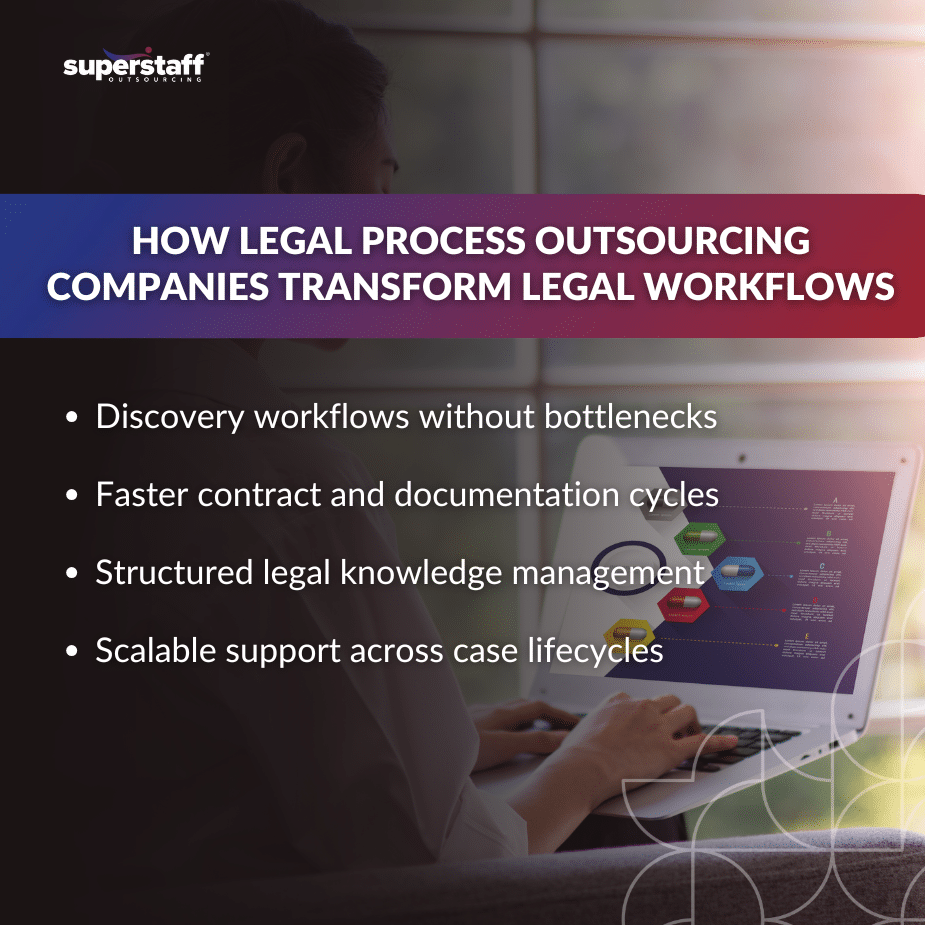
Legal process outsourcing companies help firms stabilize cost structures. Instead of expanding full-time headcount during busy cycles, firms gain access to flexible support layers that expand or contract with demand.
This strategic approach allows legal teams to stay focused on advisory and litigation strategy while offshore teams handle structured workflows.
Why the Philippines Stands Out for Legal Support
The Philippines has developed a strong reputation as a legal outsourcing hub. The country offers a large, English-proficient talent pool familiar with Western legal frameworks. Many professionals possess backgrounds in law, compliance, or legal research.
Cultural alignment also plays a role. Philippine professionals are accustomed to collaborating with U.S. organizations, making communication smoother and more predictable.
Legal process outsourcing companies in the Philippines also offer strong operational maturity. Providers typically implement structured training and quality assurance programs that align with U.S. legal standards.
Discovery Support That Scales with Demand
Discovery is one of the most resource-intensive phases of legal work. Reviewing documents, organizing evidence, and identifying relevant materials require sustained effort and consistency.
Offshore legal teams assist with document review and classification. They help organize digital evidence and support structured workflows that reduce bottlenecks. While attorneys retain decision authority, offshore teams provide essential operational support.
By working with legal process outsourcing companies, firms gain scalable discovery support that reduces burnout while maintaining documentation accuracy.
Contract Review and Legal Analysis Support
High-volume contract environments benefit from standardized review processes. In industries like healthcare, technology, and real estate, legal teams manage large numbers of agreements that require careful review.
Philippine legal professionals can assist with first-level contract analysis. They help identify clauses, flag inconsistencies, and prepare summaries that accelerate attorney review. This layered workflow improves turnaround times without sacrificing oversight.
Legal process outsourcing companies enable firms to handle contract surges without adding permanent staff, making them particularly valuable for growth-stage organizations.
Faster Documentation and Drafting Workflows
Legal documentation often slows internal teams because it requires precision and consistency. Tasks such as deposition summaries, case documentation, and formatting consume valuable time.
Offshore legal teams support documentation workflows by preparing structured drafts and organizing case materials. Attorneys retain final approval while benefiting from faster preparation cycles.
Legal process outsourcing companies provide standardized documentation processes that improve consistency across cases and departments.
Stronger Legal Knowledge Management
Knowledge management is an often overlooked but critical component of legal efficiency. Firms that lack structured document repositories frequently lose time searching for past case materials.
Offshore teams help build centralized document libraries. They organize case files, maintain version control, and standardize indexing systems that make retrieval easier.
Legal process outsourcing companies strengthen institutional knowledge by turning fragmented documents into structured repositories that support long-term productivity.
Compliance and Regulatory Support
Regulatory requirements continue to expand across industries. Legal teams must manage filings, maintain documentation, and track changing compliance frameworks.
Offshore legal support teams assist with regulatory documentation preparation and research. They help organize compliance files and prepare materials for internal audits or external reviews.
Legal process outsourcing companies allow legal departments to manage compliance obligations without overloading internal staff, especially in regulated sectors.
Scalable Support Without Hiring Surges
Hiring additional legal staff can be time-consuming and expensive. Recruitment cycles, onboarding, and training require significant investment, particularly for specialized roles.
Outsourcing provides an alternative model. Firms can access trained professionals without long hiring cycles. Offshore providers typically offer structured onboarding programs that accelerate deployment.
Legal process outsourcing companies enable firms to scale support quickly during litigation spikes or business growth phases while maintaining cost predictability.
Supporting Hybrid Legal Workforce Models
Many legal organizations are adopting hybrid workforce strategies that blend internal expertise with external operational support. This model allows attorneys to focus on high-value tasks while operational workflows are distributed strategically.
Offshore legal teams integrate into existing legal operations frameworks. They collaborate with in-house staff, external counsel, and legal technology platforms.
Legal process outsourcing companies play an important role in enabling this hybrid model by providing structured support that aligns with modern legal operations.
Building a Smarter Legal Support Model
Legal teams are rethinking how work gets done across the legal lifecycle. From discovery to documentation, structured operational support is becoming essential for maintaining efficiency and responsiveness.
Legal process outsourcing companies provide the scalability and process discipline needed to support modern legal workflows. SuperStaff helps U.S. legal teams build reliable offshore extensions that support discovery, documentation, compliance, and knowledge management.
If your organization is exploring smarter ways to scale legal operations, explore how SuperStaff’s outsourcing solutions can strengthen your legal support strategy.