
Business leaders evaluating outsourcing often face a fundamental decision. Should they choose onshore business process outsourcing within the United States, or build offshore support teams in countries like the Philippines? The choice affects cost structure, operational flexibility, talent availability, and long term growth.
Many organizations begin by assuming proximity automatically means efficiency. However, closer analysis often reveals that the right outsourcing model depends on how companies balance workforce costs, scalability, service quality, and strategic priorities.
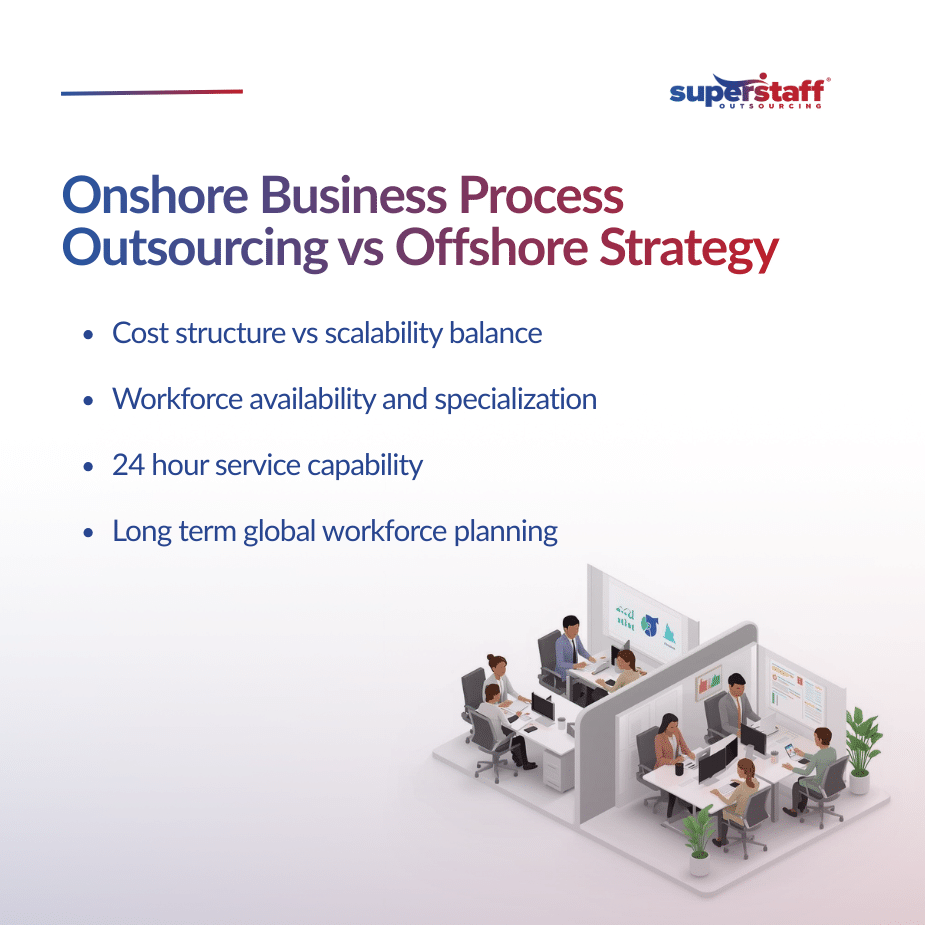
Understanding the Onshore Outsourcing Model
Companies often consider onshore business process outsourcing when they want support teams located in the same country as their headquarters.
This model offers familiarity and geographic proximity. Service providers operate within the same regulatory environment, business culture, and time zones.
Key characteristics of onshore outsourcing include:
- Agents located within the same national labor market
- Shared legal and regulatory frameworks
- Easier in-person collaboration opportunities
However, labor markets in developed economies often face workforce shortages. As a result, companies exploring onshore business process outsourcing frequently encounter higher staffing costs and limited talent availability.
Executives must therefore weigh operational convenience against long term scalability.
The Offshore Philippines Model Explained
Offshore outsourcing shifts operational functions to international locations with strong service talent pools. The Philippines has become one of the most established outsourcing destinations for U.S. companies.
Many firms evaluating onshore business process outsourcing begin comparing it with offshore models once they examine operational costs and hiring challenges.
The Philippines offers several advantages:
- Large English speaking workforce
- Deep experience in customer service operations
- Strong cultural alignment with U.S. business practices
- Mature outsourcing infrastructure
These factors allow companies to build offshore teams that operate as an extension of internal departments rather than external vendors.
Cost Structures Between Onshore and Offshore Teams
Labor economics often drives the outsourcing decision. When companies analyze the financial impact of onshore business process outsourcing, wage levels become a major factor.
Hiring and retaining call center agents in the United States requires significantly higher salaries, benefits packages, and operational overhead.
Organizations evaluating offshore models typically compare:
- Agent salaries
- Training costs
- Infrastructure expenses
- Employee turnover rates
Offshore teams in the Philippines often provide meaningful cost efficiency while maintaining service quality. That cost flexibility allows companies to reinvest savings into technology, growth initiatives, or customer experience improvements.
The financial contrast often becomes clearer as companies scale operations.
Talent Availability and Workforce Depth
Access to talent is another critical difference. Labor shortages across many U.S. service sectors have made onshore business process outsourcing more difficult to scale.
Domestic labor markets face several challenges:
- Competition for experienced customer service agents
- Rising wage expectations
- High turnover rates in support roles
The Philippines developed its outsourcing workforce over two decades. Universities and training institutions often align their programs with business process outsourcing careers.
This pipeline creates a steady supply of agents, supervisors, analysts, and specialists. For companies planning long term support operations, workforce depth becomes a decisive factor.
Operational Flexibility and Scalability
Business demand rarely remains constant. Seasonal spikes, product launches, and customer growth require companies to scale quickly.
Organizations relying on onshore business process outsourcing may find rapid expansion difficult due to hiring timelines and labor market constraints.
Offshore outsourcing models provide greater flexibility. Service providers in the Philippines typically maintain recruiting pipelines and training frameworks designed to support expansion.
Companies can therefore:
- Increase support capacity during peak periods
- Launch new service channels
- Add multilingual capabilities
Operational flexibility becomes particularly important for fast growing businesses.
Service Quality and Customer Experience
Some leaders initially assume domestic agents automatically deliver better service quality. However, companies comparing onshore business process outsourcing with offshore teams often discover that performance depends more on training and management.
Philippine outsourcing providers invest heavily in:
- customer service training
- communication skills development
- quality monitoring systems
Many global brands rely on Philippine teams for complex customer interactions including technical support, billing inquiries, and retention programs.
Quality outcomes depend on strong onboarding processes and continuous coaching rather than geographic location alone.
Time Zone Coverage and 24 Hour Operations
Customer expectations continue to evolve. Many companies now provide support outside standard business hours.
Domestic operations built through onshore business process outsourcing often require overnight shifts or multiple staffing tiers to maintain coverage.
Offshore teams can support extended service hours more naturally. Philippine work schedules frequently align with North American time zones due to the global outsourcing industry.
This arrangement allows companies to:
- maintain 24 hour service availability
- reduce internal overtime costs
- provide consistent customer support across regions
The ability to maintain round the clock operations has become increasingly valuable for digital businesses.
Risk Management and Business Continuity
Outsourcing strategies also affect risk management. Leaders assessing onshore business process outsourcing often prioritize operational stability and regulatory compliance.
Domestic outsourcing may simplify certain compliance processes. However, offshore providers increasingly meet international standards for security and data protection.
Many Philippine outsourcing companies operate with:
- secure facilities
- compliance frameworks aligned with global standards
- structured disaster recovery plans
Diversifying operations geographically can also improve business continuity. Offshore teams provide operational resilience during regional disruptions or workforce shortages.
Strategic Value Beyond Cost Savings
Early outsourcing models focused primarily on reducing labor expenses. Modern outsourcing decisions are more strategic.
Companies considering onshore business process outsourcing now evaluate how support teams contribute to growth, customer retention, and operational efficiency.
Offshore teams often support a broader set of functions including:
- customer experience operations
- technical support
- back office processing
- data management
These capabilities allow companies to build integrated support structures that strengthen customer relationships while improving operational efficiency.
Outsourcing therefore becomes a growth enabler rather than a short term cost strategy.
Choosing the Right Outsourcing Approach
The choice between domestic and offshore outsourcing ultimately depends on business priorities.
Some companies still prefer onshore business process outsourcing for specific regulatory or operational reasons. Others adopt a blended model that combines domestic leadership with offshore execution teams.
Leaders evaluating outsourcing options should consider:
- cost structure and long-term financial impact
- access to specialized talent
- scalability requirements
- customer experience goals
Organizations that approach outsourcing as a strategic workforce decision often achieve stronger long term results.
The Future of Global Outsourcing Strategies
Global workforce strategies continue to evolve. Companies that once relied solely on onshore business process outsourcing increasingly adopt distributed support teams across multiple regions.
Several trends are shaping the future of outsourcing:
- hybrid workforce models
- global talent sourcing
- integrated technology platforms
- increased focus on customer experience
These changes encourage organizations to evaluate outsourcing decisions through a strategic lens rather than a purely operational one.
Businesses that build flexible global support structures often gain a competitive advantage in customer responsiveness and operational efficiency.
Why Offshore Philippines Is a Strategic Advantage
Choosing between onshore business process outsourcing and offshore outsourcing in the Philippines requires thoughtful evaluation of cost, talent access, scalability, and long term strategy. Domestic outsourcing can offer geographic proximity and regulatory familiarity. Offshore teams provide deeper talent pools, greater flexibility, and cost efficiency.
For many U.S. companies, the most effective approach combines strong leadership with global support capabilities. Offshore teams in the Philippines allow organizations to expand customer service operations without compromising quality or operational control.
SuperStaff helps companies build dedicated offshore support teams that operate as a true extension of their business.
If your organization is exploring new ways to scale customer service while managing costs, connect with SuperStaff to learn how Philippine outsourcing teams can support your long term growth.