Growth creates pressure long before it creates clarity. Customer demand increases. Internal teams stretch. Leaders make decisions faster than systems can support. What starts as momentum can quickly turn into operational strain if scale is not managed with intention. That is where a well-designed outsourcing strategy becomes essential.
Many companies outsource to keep up. Fewer outsource to build stability. The difference lies in how the outsourcing strategy is designed, governed, and aligned with long-term business goals rather than short-term relief.
Growth Exposes What Is Already Broken
Scaling rarely introduces new problems. It amplifies existing ones. Gaps in communication widen. Inconsistent workflows surface. Informal decision-making becomes a liability. This is why leaders must consider adopting a scalable outsourcing model.
An outsourcing strategy that works over time acknowledges this reality early. It forces leaders to confront operational weaknesses before extending them to external teams. That discipline prevents chaos as volume increases and complexity grows.
Anchor Outsourcing to Business Objectives
Outsourcing decisions often start with staffing pressure. That approach limits value. Sustainable scale begins with clarity around outcomes.
A strong outsourcing strategy starts with questions that matter to leadership. What must improve for the business to grow responsibly. What risks must be reduced. What customer commitments cannot be compromised. When these answers guide outsourcing design, capacity becomes a strategic tool rather than a reactive fix.
Build for Consistency Before Speed
Speed feels urgent during growth phases. Consistency feels optional. That assumption rarely holds.
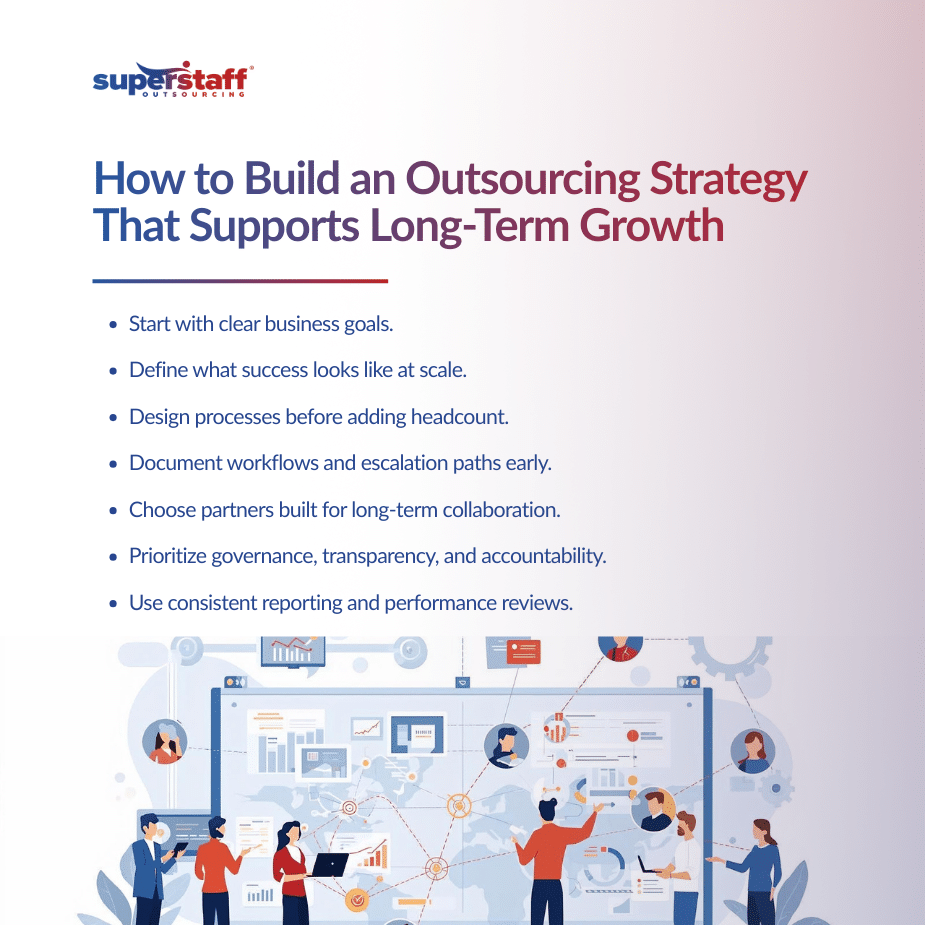
Processes that lack clarity break under scale. Training becomes fragmented. Quality varies by team. A durable outsourcing strategy prioritizes repeatable workflows before rapid expansion. Documentation, role clarity, and escalation paths come first. Speed follows naturally once the foundation is stable.
Design Roles With the Future in Mind
Short-term thinking often leads to narrowly defined outsourced roles. Those roles work until the business evolves.
A forward-looking outsourcing strategy designs roles that can adapt. Agents trained across functions. Supervisors capable of managing complexity. Support teams prepared for changing volumes and customer expectations. This flexibility protects the business as priorities shift.
Governance Is a Growth Enabler
Governance is often misunderstood as overhead. In reality, it creates freedom.
An outsourcing strategy that includes clear governance allows leaders to scale without losing visibility. Regular performance reviews. Defined accountability. Shared problem-solving rhythms. These elements reduce friction and prevent small issues from becoming systemic failures.
Treat Offshore Teams as Part of the Operation
Distance does not have to create disconnect. Isolation does. When offshore teams operate on the margins, performance plateaus and engagement drops. Scale becomes harder to manage because information travels slowly and context gets lost.
A sustainable outsourcing strategy deliberately integrates offshore teams into the core operation. Shared goals anchor daily work to business priorities. Communication standards ensure clarity across time zones. Regular updates provide visibility into shifting objectives, customer expectations, and performance outcomes.
Access to context matters as much as access to tools. Offshore teams need to understand why decisions are made, not just what tasks to complete. When agents see how their work impacts customers and revenue, they make better judgment calls. Quality improves. Escalations decrease. Ownership increases.
Inclusion also strengthens accountability. Offshore leaders who participate in planning discussions can anticipate changes instead of reacting to them. Teams align faster during growth phases. Collaboration replaces dependency, and scale feels coordinated rather than fragmented.
As operations expand, this level of integration keeps execution steady. Offshore teams operate with confidence. Internal teams maintain trust. Growth remains structured, even as complexity rises.
Protect Service Quality During Expansion
Customers experience growth through outcomes, not intentions. They notice delays. They feel inconsistency. They remember when service slips.
By leveraging outsourcing for business growth, companies can enhance and safeguard the customer experience as demand grows. Standardized training. Unified quality metrics. Consistent coaching. These elements ensure customers receive the same level of service regardless of volume or geography.
Plan Capacity Around Predictability and Flexibility
Growth is rarely linear. Peaks and troughs are inevitable.
A resilient outsourcing strategy balances predictability with flexibility. Core staffing supports steady demand. Scalable layers absorb surges. Cross-trained teams provide coverage. This structure prevents burnout and avoids constant rehiring cycles that destabilize operations.
Build Feedback Loops That Scale
Feedback drives improvement. Without structure, it becomes noise.
A mature outsourcing strategy establishes clear feedback loops between internal leaders and offshore teams. Performance insights flow both ways. Process improvements are tested and refined. Teams learn together. This shared learning compounds value over time.
Align Metrics With Strategic Outcomes
Measurement shapes behavior. The wrong metrics create short-term thinking.
A growth-oriented outsourcing strategy focuses on indicators tied to business health. Resolution quality. Customer satisfaction trends. Process adherence. These metrics provide leadership with meaningful insight while guiding teams toward sustainable performance.
Avoid the Trap of Transactional Outsourcing
Transactional outsourcing focuses on tasks. Strategic outsourcing focuses on outcomes.
An outsourcing strategy built for long-term growth treats the partner relationship as collaborative. Challenges are addressed jointly. Capacity planning is proactive. Continuous improvement is expected. This mindset reduces risk as scale increases and complexity deepens.
Technology Supports Strategy, Not the Other Way Around
Tools enable scale, but they do not define it.
A sound outsourcing strategy integrates technology in support of clear processes and roles. Systems are introduced deliberately. Training accompanies deployment. Adoption is monitored. This approach prevents technology from becoming another source of fragmentation during growth.
Leadership Alignment Sustains Momentum
Outsourcing decisions impact multiple functions. Misalignment at the leadership level creates friction downstream.
A cohesive outsourcing strategy requires alignment across operations, finance, and customer experience leadership. Shared priorities reduce conflict. Decisions move faster. Teams receive consistent direction. Growth becomes coordinated rather than chaotic.
Scaling Without Losing Control
The goal of outsourcing is not delegation alone. It is controlled expansion.
Companies that scale successfully invest time upfront in designing an outsourcing strategy that anticipates growth rather than reacts to it. They build systems that absorb complexity. They create partnerships that mature alongside the business. They preserve clarity even as operations expand.
Build Your Ideal Outsourcing Strategy With SuperStaff
Long-term growth demands structure, foresight, and discipline. An outsourcing strategy designed for scale allows companies to grow without sacrificing control, service quality, or operational clarity.
SuperStaff works with U.S. SMEs and midmarket companies to design and execute operating models that support scalability. Trust our team to guide you through how to build an outsourcing strategy for long-term growth.
Contact us to learn how we can help you scale confidently, protect your customer experience, and build an operation that grows with purpose rather than pressure.