
Money moves in two directions inside every company. Cash goes out to suppliers, and cash comes in from customers. Both flows must be accurate and timely. If one side slows down, the whole business feels the impact.
That is why leaders often examine accounts payable vs receivable as a priority. These two functions shape cash flow, vendor trust, and customer satisfaction. While some firms manage them in house, many now turn to offshore teams. As a result, the Philippines has become a strong location for finance support.
A clear understanding of accounts payable vs receivable helps decision makers see why outsourcing both functions can create stability and cost control.
Understanding Accounts Payable vs Receivable
Accounts payable vs receivable refers to two core finance processes:
- Accounts Payable handles money going out.
- Accounts Receivable manages money coming in.
Although both sit under the finance team, they serve different purposes. However, they are closely connected through cash flow management.
1. What Is Accounts Payable?
Accounts payable includes:
- Processing supplier invoices
- Verifying purchase orders
- Scheduling payments
- Managing vendor records
- Reconciling statements
When accounts payable is delayed, vendors may charge penalties. Therefore, accuracy and timing are critical.
2. What Is Accounts Receivable?
Accounts receivable focuses on:
- Issuing invoices
- Tracking customer payments
- Following up on overdue balances
- Applying payments to accounts
- Preparing aging reports
If receivables are not monitored, revenue may be delayed. Consequently, working capital can shrink.
When comparing accounts payable vs receivable, one protects outgoing payments while the other secures incoming revenue. Together, they protect financial health.
Why Companies Struggle With Both Functions
Many SMEs and midmarket companies face similar challenges with accounts payable vs receivable.
- Manual data entry increases errors.
- High invoice volumes strain small teams.
- Delayed collections affect liquidity.
- Staff turnover disrupts continuity.
- Compliance requirements add pressure.
Additionally, hiring experienced finance professionals in the U.S. can be expensive. Salary, benefits, and overhead costs rise quickly. Because of this, leaders look for alternatives that maintain quality without raising expenses.
Outsourcing accounts payable vs receivable becomes a practical solution.
Why the Philippines Is a Strong Choice
The Philippines has built a strong reputation in finance and accounting outsourcing. Several factors explain why companies trust offshore teams in this location.
1. Skilled Finance Professionals
The country produces thousands of accounting graduates each year. Many professionals are trained in international accounting standards. As a result, offshore teams can handle accounts payable vs receivable tasks with precision.
Moreover, English proficiency supports clear communication with U.S. vendors and clients.
2. Cost Efficiency Without Compromising Quality
Labor costs in the Philippines are lower than in many Western countries. However, lower cost does not mean lower standards.
Businesses that outsource accounts payable vs receivable often report:
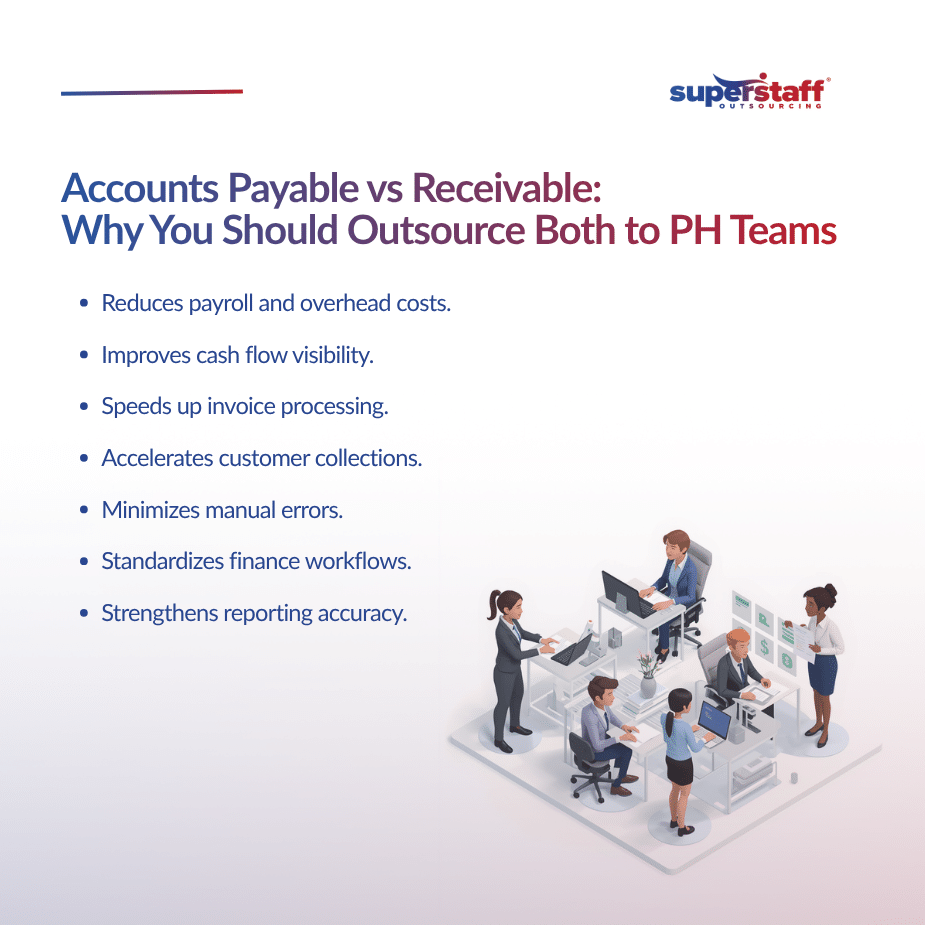
- Reduced payroll expenses
- Lower overhead costs
- Flexible staffing options
- Predictable monthly billing
Therefore, finance leaders gain cost control while maintaining service levels.
3. Time Zone Coverage and Faster Processing
Offshore teams can work during U.S. off hours. Consequently, invoices are processed overnight. Payment follow ups can also begin early in the day.
This extended coverage improves turnaround times for both accounts payable vs receivable workflows.
Benefits of Outsourcing Both Payables and Receivables
Some firms outsource only one function. However, outsourcing both accounts payable vs receivable often delivers stronger results.
1. Better Cash Flow Management
When one offshore team manages outgoing and incoming transactions, visibility improves. Reports become consistent. Leadership can monitor:
- Days payable outstanding
- Days sales outstanding
- Cash flow forecasts
- Vendor balances
- Customer aging
Because both sides are aligned, financial planning becomes easier.
2. Standardized Processes
Outsourcing providers implement structured workflows. These include:
- Invoice approval protocols
- Payment scheduling systems
- Automated reminders
- Reconciliation checkpoints
As a result, accounts payable vs receivable processes follow clear steps. This reduces confusion and improves audit readiness.
3. Reduced Errors and Rework
Manual mistakes can damage vendor relationships. Incorrect invoices can frustrate customers. However, trained offshore specialists focus on detail and documentation.
Quality checks and reporting systems strengthen accounts payable vs receivable accuracy.
4. Scalability During Growth
Growth increases transaction volume. More vendors mean more invoices. More customers mean more billing cycles.
Instead of hiring quickly, companies can scale offshore teams. Therefore, accounts payable vs receivable operations expand without long recruitment cycles.
Common Tasks Outsourced to the Philippines
Companies that outsource accounts payable vs receivable often delegate specific functions.
Accounts Payable Tasks
- Invoice data entry
- Three way matching
- Vendor communication
- Payment preparation
- Expense report review
- Monthly reconciliation
Accounts Receivable Tasks
- Invoice generation
- Customer billing support
- Payment posting
- Collections follow up
- Credit memo processing
- Reporting and aging analysis
Each task follows defined service level agreements. Consequently, expectations remain clear.
Risk Management and Compliance
Finance leaders often worry about control when outsourcing accounts payable vs receivable. That concern is valid. However, reputable providers use:
- Secure cloud based systems
- Role based access controls
- Data protection protocols
- Regular reporting dashboards
- Audit trails
Furthermore, contracts outline confidentiality and performance metrics. Therefore, oversight remains strong.
With proper onboarding and documentation, offshore teams integrate smoothly into existing systems.
Strategic Impact Beyond Cost Savings
Although cost reduction is important, the value of outsourcing accounts payable vs receivable extends further.
Finance leaders gain time to focus on:
- Financial analysis
- Budget planning
- Investor reporting
- Risk assessment
- Strategic forecasting
Instead of handling routine data entry, internal teams concentrate on higher level responsibilities.
This shift strengthens long term growth planning.
Signs It Is Time to Outsource
Not every company needs outsourcing immediately. However, certain signals suggest it may be the right step.
- Invoices are consistently delayed
- Vendor complaints are increasing
- Collections are falling behind
- Finance staff are overloaded
- Cash flow reports lack clarity
When these patterns appear, reviewing accounts payable vs receivable workflows can uncover improvement opportunities.
Why Partner With SuperStaff
Outsourcing works best with the right partner. SuperStaff provides trained finance professionals in the Philippines who understand accounts payable vs receivable processes.
Our teams support:
- Structured onboarding
- Clear reporting systems
- Scalable staffing models
- Secure data handling
- Dedicated account management
Additionally, we align service levels with your internal standards. As a result, integration feels seamless.
If your organization is evaluating accounts payable vs receivable outsourcing, now is the time to explore practical options.
Move Forward With Confidence
Accounts payable vs receivable functions influence every business decision. Payment delays affect vendor trust. Slow collections weaken liquidity. However, structured offshore support can stabilize both sides.
Companies that outsource accounts payable vs receivable to the Philippines gain cost control, skilled talent, and improved processing speed. At the same time, leadership can focus on strategy instead of transaction volume.
SuperStaff is ready to help you build a reliable offshore finance team. Contact us today to discuss how outsourcing accounts payable vs receivable can support your growth plans and protect your cash flow.