
Companies across the United States are reassessing how their operations are structured. Rising costs, talent shortages, and increased operational complexity have pushed leaders to reconsider where and how support functions should be managed.
Many organizations are now turning to business operations outsourcing to stabilize workflows and maintain efficiency while focusing their internal teams on strategic priorities.
Back office teams handle essential functions such as finance support, data processing, compliance checks, and customer administration. These activities rarely generate direct revenue, yet they keep organizations running. As companies scale, the need to manage these functions effectively becomes even more important.
This shift has led to a broader operations reset. Instead of maintaining large internal administrative teams, many firms are rebuilding their back office through offshore partnerships that offer structure, flexibility, and operational continuity.
The operational pressures forcing companies to rethink their back office
Many organizations are experiencing growing pressure on their internal operations. Administrative teams are often asked to support expanding workloads while budgets remain fixed.
Leadership teams increasingly recognize that traditional staffing models can struggle to keep pace with business growth.
Key operational pressures include
- Difficulty hiring skilled administrative talent
• Rising labor costs in major U.S. markets
• Increasing compliance requirements
• Higher expectations for operational speed and accuracy
Business operations outsourcing helps organizations address these pressures by expanding their support capacity without increasing internal complexity. Offshore teams allow companies to maintain consistent service levels while their internal teams focus on core priorities.
Why back office work is well suited for offshore teams
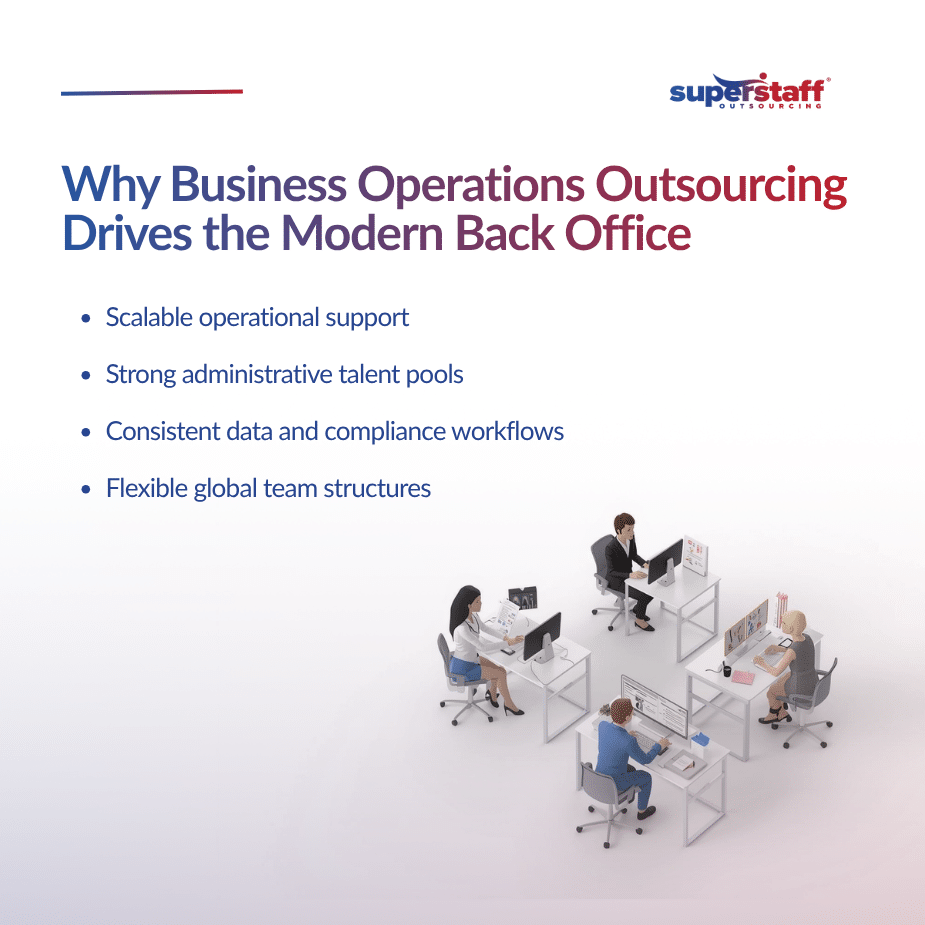
Back office functions follow structured processes and standardized workflows. These characteristics make them ideal for distributed teams that can operate efficiently from remote locations.
Many tasks rely on digital systems rather than physical proximity. As a result, offshore professionals can perform the same work with the same systems used by onshore teams.
Common back office functions that companies outsource include
- Data entry and data validation
• Billing and invoice processing
• Document management
• Customer account administration
• Reporting support
Business operations outsourcing allows companies to scale these processes without building large internal departments.
The financial logic behind offshore operational models
Financial discipline remains a major factor in operational decisions. Maintaining a large internal administrative workforce can place significant pressure on operating budgets.
Office space, benefits, training programs, and recruitment costs add to the overall expense of maintaining in-house teams.
Offshore staffing models reduce many of these overhead costs while maintaining operational quality.
Business operations outsourcing helps organizations
- Optimize operational spending
• Convert fixed labor costs into flexible operating expenses
• Scale teams according to demand
• Improve cost predictability
These advantages allow leadership teams to allocate resources more effectively while maintaining operational stability.
How offshore teams improve operational resilience
Operational resilience has become a key concern for many companies. Disruptions such as supply chain issues, workforce shortages, and unexpected workload spikes can quickly strain internal teams.
Distributed operational models help companies maintain continuity during these challenges.
Business operations outsourcing strengthens resilience in several ways
- Offshore teams provide additional capacity during peak workloads
• Multiple team locations reduce operational risk
• Workflows can continue across time zones
• Internal teams avoid burnout from sudden demand increases
Organizations that adopt offshore operational models often find they can respond to change more quickly.
Why the Philippines has become a leading offshore destination
The Philippines has built a strong reputation as a global outsourcing hub. Its workforce combines strong English communication skills with extensive experience supporting international companies.
Universities across the country produce graduates in business administration, finance, information technology, and communications. Many professionals pursue careers in the outsourcing sector because it offers stable employment and career growth.
Business operations outsourcing to the Philippines provides companies with
- Highly trained administrative professionals
• Strong cultural alignment with U.S. companies
• Established outsourcing infrastructure
• Reliable telecommunications and digital connectivity
These factors make the Philippines a practical location for organizations rebuilding their back office operations.
The growing role of offshore teams in data management
Modern businesses rely heavily on accurate data. Administrative teams are responsible for maintaining the integrity of this information.
However, large volumes of data can overwhelm internal teams if processes are not structured properly.
Offshore professionals play a critical role in supporting data management activities such as
- Database maintenance
• Customer record updates
• Data verification
• Document indexing
• Information reconciliation
Business operations outsourcing ensures that data management tasks are handled consistently while internal teams focus on analysis and decision making.
Strengthening compliance through structured offshore workflows
Regulatory compliance has become more complex across many industries. Companies must follow strict documentation standards and maintain detailed operational records.
Back office teams play an important role in supporting these compliance requirements.
Offshore professionals can assist with
- Documentation review
• Record management
• Audit preparation support
• Regulatory reporting assistance
Business operations outsourcing allows organizations to maintain disciplined documentation practices without placing additional strain on their internal teams.
Supporting customer operations behind the scenes
Customer service does not happen only in call centers. Many customer interactions rely on administrative processes that take place behind the scenes.
Account updates, billing corrections, service activation, and documentation requests all depend on back office support.
Offshore teams help maintain these processes by handling tasks such as
- Customer record updates
• Order processing support
• Payment reconciliation
• Service documentation management
Business operations outsourcing ensures that these activities remain accurate and efficient while front line teams focus on customer engagement.
How offshore teams improve operational scalability
Growth often creates new operational challenges. As companies add customers, expand services, or enter new markets, administrative workloads increase quickly.
Internal teams can struggle to keep pace with these changes.
Offshore teams provide a flexible solution that allows companies to expand support capacity without lengthy recruitment cycles.
Business operations outsourcing supports scalability through
- Rapid team expansion
• Structured onboarding programs
• Consistent operational procedures
• Flexible staffing models
This approach allows companies to align operational capacity with business growth.
Building integrated teams between onshore and offshore staff
Successful outsourcing strategies depend on strong collaboration between internal and external teams. Companies that treat offshore professionals as integrated team members often achieve the best results.
Clear communication channels, shared workflows, and defined performance standards help ensure alignment across locations.
Organizations that implement business operations outsourcing effectively focus on
- Standardized training processes
• Clear reporting structures
• Collaborative project management systems
• Continuous performance monitoring
When offshore teams operate as an extension of internal departments, operational efficiency improves significantly.
What the future holds for global operational models
Operational structures continue to evolve as companies adopt new technologies and distributed workforce strategies. Many organizations are now building hybrid models that combine internal teams with offshore support.
This structure allows businesses to balance strategic control with operational flexibility.
Business operations outsourcing will likely remain a core element of these models because it allows companies to adapt quickly as business conditions change.
Leadership teams that adopt flexible operational frameworks are better prepared to manage growth, cost pressures, and workforce challenges.
A smarter approach to rebuilding the modern back office
The shift toward distributed operational models reflects a broader change in how companies structure their organizations. Businesses are moving away from rigid internal structures toward more flexible systems that allow them to scale and adapt.
Business operations outsourcing helps organizations rebuild their back office with greater efficiency, stability, and operational control. Offshore teams handle essential administrative functions while internal staff focus on strategy, innovation, and customer relationships.
SuperStaff supports companies that want to strengthen their operational foundation through experienced offshore teams in the Philippines. If your organization is exploring ways to improve efficiency and expand operational capacity, now is the time to learn how an offshore partnership can support your next phase of growth.
Connect with SuperStaff today to explore how the right offshore team can help rebuild your operations for long term success.