Growth puts pressure on operations. Orders increase. Customers expect faster delivery. Costs also rise. Many companies struggle to balance all of these at once. That is where outsourcing becomes a practical move.
The benefits of global supply chain outsourcing are becoming clear across industries. Businesses are no longer handling everything in-house. Instead, they rely on offshore and nearshore teams to manage logistics tasks with speed and accuracy. This shift helps companies stay competitive while keeping operations stable.
Outsourcing is not only about saving money. It is also about building a smarter and more flexible supply chain.
Understanding the Benefits of Global Supply Chain Outsourcing
The benefits of global supply chain outsourcing go beyond cost reduction. It gives companies access to skills, systems, and processes that improve daily operations.
Outsourcing partners take care of tasks such as:
- Order processing
- Shipment tracking
- Inventory updates
- Documentation and compliance
Because of this, internal teams can focus on strategy and growth.
As a result, businesses gain better control over operations without increasing internal workload.
1. Cost Efficiency Without Sacrificing Quality
One of the most visible benefits of global supply chain outsourcing is cost efficiency.
Operating logistics internally requires:
- Hiring staff
- Training teams
- Investing in systems
- Managing overhead costs
Outsourcing reduces these expenses.
Instead of building large in-house teams, companies can:
- Pay only for the services they need
- Scale resources based on demand
- Avoid long-term fixed costs
At the same time, quality remains high because outsourcing providers specialize in logistics support.
This balance between cost and quality is a key reason businesses shift to outsourcing.
2. Access to Skilled Logistics Professionals
Finding experienced logistics staff can be difficult. Training also takes time.
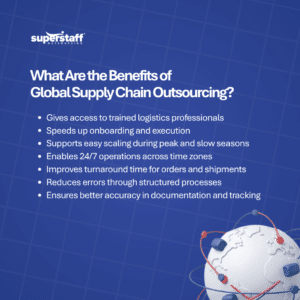
Another strong advantage tied to the benefits of global supply chain outsourcing is access to trained professionals.
Offshore and nearshore teams already have:
- Experience in supply chain systems
- Knowledge of global shipping processes
- Familiarity with documentation and compliance
Because of this, companies can onboard faster.
In addition, outsourcing partners often provide continuous training. This ensures teams stay updated with industry changes.
As a result, businesses benefit from expertise without long hiring cycles.
3. Scalability Based on Business Demand
Demand does not stay constant. Some months are busy. Others are slower.
The benefits of global supply chain outsourcing include the ability to scale operations quickly.
Companies can:
- Add more agents during peak seasons
- Reduce support during slow periods
- Adjust workflows without disruption
This flexibility prevents overstaffing and understaffing.
For example:
- E-commerce companies can scale during holidays
- Logistics firms can handle sudden shipment spikes
- Manufacturers can adjust based on production cycles
Therefore, outsourcing supports both growth and stability.
4. Faster Turnaround and 24/7 Operations
Speed matters in logistics. Delays can lead to lost revenue and unhappy customers.
One of the practical benefits of global supply chain outsourcing is round-the-clock support.
Offshore teams allow businesses to operate across time zones.
This leads to:
- Faster order processing
- Real-time shipment tracking
- Immediate issue resolution
Nearshore teams also help by providing time zone alignment with key markets.
Because of this setup, operations continue even after local business hours.
This improves service levels and customer satisfaction.
5. Improved Accuracy and Reduced Errors
Manual processes often lead to mistakes. Errors in logistics can be costly.
The benefits of global supply chain outsourcing include better accuracy through standardized processes.
Outsourcing providers use:
- Structured workflows
- Quality checks
- Performance tracking systems
These reduce risks such as:
- Incorrect data entry
- Missing documentation
- Shipment delays due to errors
Consistency becomes easier to maintain.
As a result, businesses experience smoother operations and fewer disruptions.
6. Better Use of Internal Resources
Internal teams should focus on growth and decision-making. However, routine logistics tasks often consume time.
Another advantage tied to the benefits of global supply chain outsourcing is resource optimization.
By outsourcing repetitive tasks, companies can:
- Free up internal teams
- Focus on strategy and expansion
- Improve productivity across departments
For example:
- Leadership can focus on partnerships
- Sales teams can focus on revenue growth
- Operations can focus on process improvements
This shift leads to stronger business performance.
7. Enhanced Technology and Tools
Logistics requires systems for tracking, reporting, and coordination.
Investing in these tools can be expensive.
The benefits of global supply chain outsourcing include access to advanced technology without large investments.
Outsourcing partners already use:
- Tracking systems
- Reporting dashboards
- Workflow management tools
Businesses gain access to these tools as part of the service.
This improves visibility across the supply chain.
In addition, reporting becomes more accurate and timely.
8. Risk Management and Business Continuity
Supply chains face many risks. These include delays, system failures, and unexpected demand changes.
The benefits of global supply chain outsourcing include better risk management.
Outsourcing providers often have:
- Backup teams
- Established processes
- Contingency plans
This ensures operations continue even during disruptions.
For example:
- If one team is unavailable, another team can take over
- If demand increases suddenly, resources can be added quickly
Because of this, businesses maintain continuity even in uncertain situations.
9. Stronger Customer Experience
Customers expect timely updates and fast delivery.
The benefits of global supply chain outsourcing directly impact customer satisfaction.
Outsourced teams handle:
- Order inquiries
- Delivery updates
- Issue resolution
This leads to:
- Faster response times
- Clear communication
- Better service consistency
As a result, customers feel more confident in the brand.
Satisfied customers are more likely to return and recommend the business.
Offshore vs Nearshore: Choosing the Right Model
Both offshore and nearshore outsourcing offer unique advantages.
Businesses often combine both to maximize the benefits of global supply chain outsourcing.
Offshore outsourcing offers:
- Lower labor costs
- Access to large talent pools
- 24/7 support across time zones
Nearshore outsourcing provides:
- Closer time zone alignment
- Cultural compatibility
- Easier collaboration
Choosing the right model depends on:
- Business goals
- Budget
- Operational needs
A hybrid approach often delivers the best results.
Why More Businesses Are Making the Shift
Companies are rethinking how they manage logistics.
The benefits of global supply chain outsourcing make it easier to:
- Stay competitive
- Manage costs
- Improve efficiency
At the same time, outsourcing supports long-term growth.
Businesses can expand without building large internal teams.
This approach is practical and scalable.
Reap the Benefits of Global Supply Chain Outsourcing With SuperStaff’s Offshore and Nearshore Solutions
The benefits of global supply chain outsourcing are clear. Companies gain flexibility, efficiency, and access to skilled talent. Operations become faster and more reliable. Costs stay manageable while service quality improves.
However, success depends on choosing the right partner.
SuperStaff helps businesses build strong logistics support teams through offshore and nearshore solutions. Our teams handle back-office logistics, track and trace, customer support, and coordination tasks with accuracy and consistency.
If you want to improve your operations and unlock the full benefits of global supply chain outsourcing, now is the time to act.
Contact SuperStaff today and discover how outsourcing can support your growth.