
Companies often look beyond their home markets when rising labor and operating expenses put pressure on budgets. Low cost country outsourcing gives businesses access to skilled professionals in markets with lower operating costs while allowing internal teams to focus on higher-priority work. It can also give companies more flexibility to expand teams, access specialized skills, and manage growing workloads without significantly increasing overhead.
However, lower costs should not come at the expense of performance, security, or customer experience. Companies need clear standards, reliable partners, regular communication, and strong quality controls to get the expected value from an offshore operation. By monitoring results and setting clear expectations from the start, businesses can control spending while maintaining consistent service and productivity.
Why Companies Consider Lower-Cost Outsourcing Markets
Businesses choose offshore locations for several reasons beyond labor savings. In particular, established outsourcing markets can provide skilled talent, flexible staffing, specialized services, and extended operating hours.
1. Access to Skilled Professionals
Countries such as the Philippines and India have large service sectors with professionals working in customer support, finance, IT, healthcare administration, and back-office functions. Therefore, companies can access skills that may cost more or prove difficult to recruit locally.
However, businesses should evaluate talent based on qualifications and experience rather than location alone. A strong provider should show how it recruits, trains, and manages professionals for specific roles.
2. Lower Operating Expenses
Differences in wages, office expenses, and other operating costs can make offshore delivery more affordable than building the same team in higher-cost markets. As a result, companies can redirect part of their budget toward technology, product development, marketing, or expansion.
Still, businesses should calculate the total cost rather than comparing salaries alone. Training, technology, management, security, and employee retention can all affect the final outsourcing cost.
3. Flexible Staffing
Business demand can change throughout the year, especially during seasonal peaks, product launches, and expansion periods. Outsourcing gives companies another way to increase or reduce team capacity based on operational requirements.
For example, businesses can add customer support or back-office staff as workloads increase. They can then adjust the team as requirements change instead of repeatedly building new internal departments.
4. Extended Operating Hours
Working across time zones can allow companies to extend business coverage beyond their local working hours. Offshore teams may handle customer inquiries, process transactions, or complete administrative work while the client’s local office operates on another schedule.
However, companies should plan schedules carefully rather than assuming offshore teams automatically provide 24/7 coverage. Providers need the right staffing model, shift structure, and management resources to support extended operations.
5. Access to Global Talent Markets
Offshore outsourcing allows companies to recruit beyond their immediate location. Consequently, businesses can consider a broader talent pool when local hiring markets cannot provide enough qualified professionals.
This approach can also support expansion into new markets. Teams with regional knowledge and language skills may provide additional support as companies serve customers in different locations.
How Cost-Effective Outsourcing Creates Business Value
Cost savings can make outsourcing attractive, but businesses gain more value when they connect savings with operational improvements. Low cost country outsourcing works best when companies measure quality, productivity, and business results alongside expenses.
1. Better Control of Operating Costs
Companies that build large internal teams must account for salaries, recruitment, training, equipment, software, office space, and management. Outsourcing can move many of these responsibilities to a service provider.
Therefore, businesses can structure spending around the services and staffing levels they need. They should still review contracts carefully to identify setup costs, technology fees, and other expenses.
2. More Efficient Workflows
Experienced outsourcing providers use documented processes, performance standards, and quality controls to manage recurring work. These systems can make tasks easier to track and reduce inconsistencies between team members.
Moreover, companies can work with providers to improve workflows over time. Regular performance reviews can identify unnecessary steps, delays, and opportunities for process improvement.
3. Faster Turnaround
Companies can assign specific workflows to dedicated offshore teams instead of adding them to the workload of already busy internal employees. As a result, tasks can move through clearly assigned processes with defined deadlines.
Time zone differences may also support faster completion for certain activities. However, companies need clear handoff procedures so work moves smoothly between internal and offshore teams.
4. More Focus on Core Priorities
Administrative and repetitive work can take time away from strategic projects. Therefore, companies may outsource selected processes so internal employees can focus on customers, products, revenue, and other business priorities.
For example, businesses can use outsourced back-office services for reporting, documentation, order processing, and data-related work while maintaining internal oversight of important decisions.
5. Greater Operational Flexibility
Companies need the ability to respond when workloads, customer expectations, or market conditions change. Outsourcing can provide additional capacity without requiring the business to restructure its internal workforce every time demand changes.
Furthermore, different outsourcing workforce models allow businesses to adjust team structures around changing requirements.
Maintaining Quality Through Strong Outsourcing Governance
Lower costs only create value when the offshore team consistently meets performance expectations. Therefore, companies need a governance structure that defines responsibilities, measures results, and addresses problems quickly.
1. Establish Clear Service-Level Agreements
Companies should define measurable expectations before work begins. Service-level agreements can cover response times, accuracy, turnaround times, availability, resolution targets, and other relevant performance measures.
Additionally, both parties should agree on how they will calculate and report each metric. Clear definitions reduce confusion when managers review performance.
2. Review Quality Regularly
Managers should review work quality throughout the engagement rather than waiting until problems become serious. Depending on the service, they can examine accuracy rates, customer feedback, call quality, turnaround times, or error rates.
Regular reviews also create opportunities for improvement. When teams identify a performance gap, managers can adjust training, workflows, staffing, or technology.
3. Keep Communication Consistent
Internal and offshore teams need regular communication to stay aligned. Weekly meetings, shared dashboards, written updates, and defined escalation channels can keep everyone informed about priorities and problems.
However, companies should avoid unnecessary meetings that slow down work. Each communication channel should have a clear purpose and owner.
4. Provide Continuous Training
Products, policies, technology, and customer expectations change over time. Therefore, companies should give offshore teams updated information and training instead of relying only on initial onboarding.
Ongoing training can also address quality issues identified through performance reviews. This approach keeps employees familiar with current processes and service expectations.
5. Use Performance Data
Companies should use relevant KPIs to measure whether outsourcing delivers the expected results. Metrics may include productivity, accuracy, customer satisfaction, resolution rates, turnaround time, or other measures based on the outsourced function.
Managers can then use these results to make informed changes. Data also gives both parties a common reference point when discussing performance.
What to Look for in an Outsourcing Partner
Choosing a provider based mainly on the lowest quote can create problems later. Instead, companies should evaluate whether a provider can deliver reliable service, protect business information, and support changing requirements.
1. Relevant Industry Experience
Businesses should look for providers with experience in the type of work they plan to outsource. Relevant experience can reduce training requirements and give teams a stronger understanding of common workflows and industry expectations.
However, companies should verify experience through case studies, client references, certifications, or other supporting information. Marketing claims alone do not show whether a provider can meet specific requirements.
2. Transparent Operations
A reliable outsourcing partner should clearly explain how it recruits employees, manages teams, tracks performance, and reports results. This visibility gives clients more control over outsourced operations.
Furthermore, providers should communicate problems rather than hiding them. Early reporting allows both sides to resolve issues before they affect customers or larger business processes.
3. Reliable Technology and Security
Providers need suitable systems, equipment, connectivity, and security controls for the services they deliver. Businesses should therefore evaluate technology and security requirements during provider selection.
Companies can also use established guidance such as the NIST Cybersecurity Framework when reviewing their broader approach to cybersecurity risk. The specific controls required will depend on the work, systems, data, and applicable regulations.
4. Ability to Scale
A provider should have a clear process for adding employees when workloads increase. At the same time, businesses should understand how quickly the provider can change staffing levels and whether contract terms limit adjustments.
Scalability also requires strong recruitment and management. Rapid growth can reduce service quality if the provider adds employees faster than it can train and supervise them.
5. Strong Quality Management
Businesses should ask providers how they train employees, monitor work, handle errors, and improve performance. A strong quality process should include measurable standards and clear responsibilities.
Additionally, companies should review how providers respond when performance falls below expectations. Corrective action plans can show whether the provider takes accountability seriously.
Popular Locations for Offshore Outsourcing
Companies have several established and emerging outsourcing markets to consider. The right location depends on required skills, language, time zone, cost, infrastructure, regulations, and service type.
The Philippines has a mature BPO sector with professionals supporting customer service, back-office work, finance, healthcare, and IT functions. India also has a large outsourcing sector, particularly across technology and professional services, while countries such as Mexico can support nearshore requirements for North American companies.
Meanwhile, markets such as Vietnam and Poland have developed capabilities across technology and business services. Businesses should compare countries based on their actual requirements rather than assuming one location fits every outsourced function.
How to Maintain Quality Without Overspending
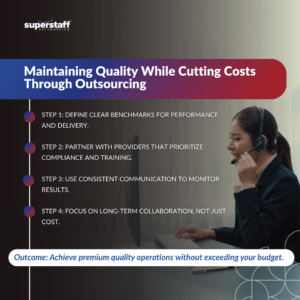
Companies can control low cost country outsourcing expenses without reducing standards when they focus on total value. First, they should define measurable expectations, choose experienced providers, and clarify what each party will manage.
Next, managers should review results regularly and address performance gaps early. They can also use automation and workflow tools for suitable repetitive tasks while keeping people responsible for decisions that require judgment or specialized knowledge.
Finally, companies should invest in communication and employee development. Stable teams that understand the client’s processes can become more efficient over time, which may reduce retraining and repeated errors.
Build a Cost-Effective Outsourcing Strategy With SuperStaff
Successful outsourcing requires more than finding the lowest labor rate. Businesses need skilled professionals, clear processes, strong management, appropriate technology, and regular performance reviews to protect quality while controlling expenses.
SuperStaff provides offshore outsourcing solutions for companies that need scalable teams across customer experience, back-office, healthcare, IT, and other business functions. Our teams work within defined processes and performance requirements based on each client’s operational needs.
Considering low cost country outsourcing for your business? Contact SuperStaff to discuss your staffing requirements, operational goals, and outsourcing options.