
A startup can grow fast after landing new clients, entering a new market, or launching a new product. However, growth also brings hiring pressure. Many startups struggle to recruit skilled employees quickly while staying within budget. At the same time, they need to manage payroll, labor laws, onboarding, and employee support across different countries.
Because of these challenges, many companies now use global employment outsourcing to support expansion plans. This setup helps startups hire international talent without building a full legal entity in every country. As a result, businesses can expand faster while keeping operations organized and costs under control.
Startups also want flexibility. They need teams that can scale based on project demand, customer needs, and market changes. Therefore, global employment outsourcing gives them a practical way to grow without adding unnecessary risks or delays.
Why Startups Need Flexible Hiring Solutions
Expanding into global markets requires careful planning. However, startups often work with limited time, smaller teams, and strict budgets. Because of this, they need hiring solutions that support fast growth without creating operational problems.
1. Faster Access to Skilled Talent
Many startups cannot wait months to fill important roles. Instead, they need quick access to customer support staff, IT professionals, finance specialists, and administrative teams. Recruitment process outsourcing can give companies additional sourcing, screening, and onboarding support.
In addition, outsourcing providers already have recruitment systems and local market knowledge. Therefore, startups can shorten hiring timelines and reduce delays during expansion.
2. Lower Hiring and Operational Costs
Opening offices in different countries requires significant investment. Businesses may need local HR systems, payroll processes, administrative staff, and infrastructure. For startups, these costs can limit growth opportunities.
Through global employment outsourcing, companies can use existing workforce systems instead of building every process from the beginning.
3. Easier Compliance Management
Labor laws, payroll requirements, and statutory benefits differ across markets. Startups entering an unfamiliar country may not have internal employees who understand every local requirement.
An Employer of Record can legally employ workers on a company’s behalf while managing local employment contracts, payroll, statutory benefits, and related compliance responsibilities.
4. Better Workforce Scalability
Startup growth often changes quickly. A company may suddenly need ten new support agents or additional back-office staff after winning a major client. However, scaling an internal HR department takes time.
Outsourcing allows startups to adjust team size based on business demand. Because of this flexibility, businesses can respond faster to new projects and market opportunities.
5. Reduced Administrative Work
Hiring employees across multiple countries creates ongoing administrative work. Teams must handle contracts, payroll, onboarding, employee records, and other employment processes.
By using global employment services, startups can shift many of these responsibilities to a dedicated provider. Leadership teams can then spend more time on product development, customer growth, and business strategy.
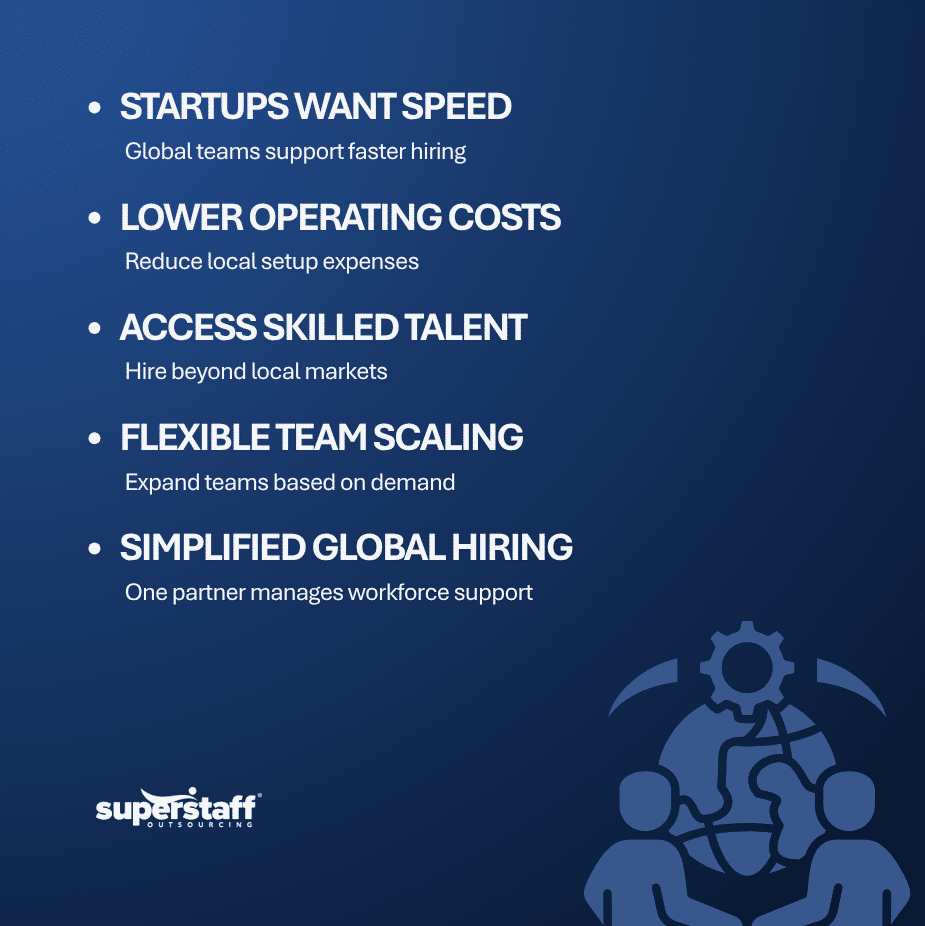
How Global Employment Outsourcing Supports Expansion
Many startups choose international hiring solutions because they simplify workforce expansion. Instead of managing every process internally, companies can rely on experienced providers for employment and operational support.
1. Entering New Markets Faster
Expanding into another country can require legal, payroll, tax, and HR preparation before employees can be hired directly.
An EOR for hiring abroad provides another option by allowing businesses to hire in markets where they do not have their own legal entity.
2. Building Remote Teams Efficiently
Remote hiring allows startups to recruit based on skills instead of limiting searches to one local market. However, companies still need clear processes for onboarding, communication, performance management, and team integration.
A structured offshore team onboarding process can give remote employees clearer expectations about their roles, workflows, and company standards.
3. Supporting Customer Service Growth
Customer expectations increase as startups gain more users and enter additional markets. Businesses may need larger teams or extended service hours to manage growing inquiry volumes.
Customer service outsourcing can provide dedicated teams across phone, chat, email, and other channels while giving startups additional capacity as demand increases.
4. Strengthening Business Continuity
Unexpected staffing shortages can slow operations. Startups may also face recruitment challenges when they need specialized skills or additional capacity within a short period.
Working with a provider that maintains recruitment and workforce processes can make it easier to add or replace employees when operational needs change.
5. Improving Focus on Core Operations
Startup founders already manage product launches, investor relations, sales, customer acquisition, and other priorities. Handling every part of international recruitment and workforce administration can add unnecessary pressure.
Outsourcing non-core business functions allows leadership teams to assign suitable operational work to dedicated teams while maintaining their focus on priority business functions.
Key Factors Startups Consider Before Outsourcing
Although outsourcing offers many benefits, startups still need the right strategy and provider. Careful planning helps businesses build an outsourcing model that supports their current operations and future goals.
1. Industry Experience Matters
Not all outsourcing providers support the same industries or functions. Some focus on customer experience, while others provide finance, healthcare, recruitment, IT, or back-office services.
Startups should review a provider’s experience with the roles they plan to outsource. This makes it easier to determine whether the provider understands the required workflows and service standards.
2. Communication and Transparency
Clear communication supports stronger outsourcing partnerships. Startups should look for providers that offer regular updates, performance reporting, and clear points of contact.
A structured outsourcing partnership should also provide measurable performance standards so companies can track service quality and operational results.
3. Data Security Standards
Startups may share customer information, employee records, financial data, and confidential business information with an outsourcing provider. Therefore, information security should be reviewed carefully before work begins.
Businesses should examine security controls, access policies, employee training, and relevant certifications. SuperStaff, for example, states that its operations use enterprise-grade security and that its Manila headquarters holds ISO/IEC 27001:2022 certification.
4. Workforce Quality and Training
A growing startup depends heavily on employee performance. Poor hiring and unclear onboarding can affect productivity, customer experience, and team stability.
Businesses should ask how providers recruit, screen, train, and monitor outsourced employees. Clear processes make it easier to maintain service standards as teams grow.
5. Long-Term Scalability
Expansion plans often change over time. A startup may begin with only a few outsourced roles before adding entire teams or entering additional markets.
Providers offering scalable outsourcing solutions can allow businesses to add or reduce team members as their needs change.
Global Hiring Support Helps Startups Grow
Startups need practical hiring solutions that support speed, flexibility, and operational efficiency. As businesses expand, they may need different approaches for recruitment, employment, payroll, customer service, and back-office operations. For many companies, global employment outsourcing provides a structured way to access international talent without managing every workforce process internally.
SuperStaff supports companies through nearshore and offshore teams across customer service, accounting, recruitment, technical support, healthcare operations, and other business functions. Its global workforce services can also support companies that need different employment models as they enter new markets.
Expand Smarter With Global Workforce Support
Growth becomes easier to manage when companies have the right people and workforce processes in place. SuperEOR Staffing provides Employer of Record support for businesses that want to hire internationally without establishing their own local entities, including payroll, employment contracts, statutory benefits, and ongoing labor law support.
Reach out to SuperStaff today to discuss how global employment outsourcing can support your hiring needs and international expansion plans.