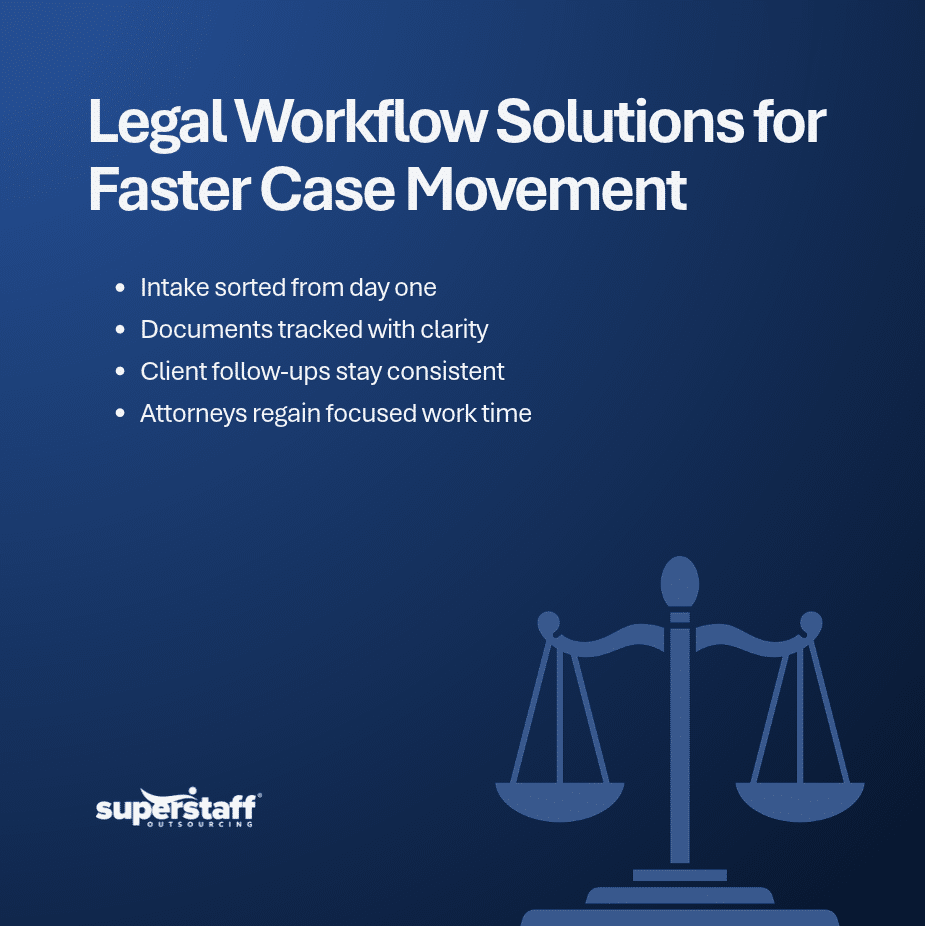
Legal work moves fast, but legal teams often operate under constant pressure. Attorneys must manage client expectations, review documents, meet deadlines, coordinate filings, and protect case quality at every step. When administrative tasks pile up, even the most capable firms can lose time to manual processes. Legal workflow solutions help law firms bring order to daily operations, reduce bottlenecks, and give attorneys more space to focus on legal strategy.
For U.S. small and midmarket law firms, the issue is not always staffing alone. It is often structure. A firm may have talented people, but if intake notes sit in different inboxes, documents move without a clear system, or follow-ups depend on memory, the entire operation becomes harder to manage.
That is why many firms are looking at outsourcing as a practical way to support legal operations. With the right offshore team in the Philippines, law firms can build more consistent processes without overloading their in-house staff.
Why legal workflows break as firms grow
A small firm can often manage work through informal coordination. Someone remembers to follow up. Someone checks the calendar. Someone updates the client. Someone tracks the missing document.
But growth changes the equation.
More cases mean more calls, more forms, more deadlines, more client questions, and more administrative touchpoints. Without strong legal workflow solutions, small delays can spread across the entire client journey.
A missed intake note can slow down consultation scheduling. A delayed document request can affect case preparation. A forgotten follow-up can frustrate a client who already feels uncertain.
These problems do not always come from poor performance. They often come from overworked teams trying to manage too many moving parts without enough operational support.
The hidden cost of manual legal work
Manual legal administration can look harmless at first. It may seem like a few minutes spent updating a file, sending a reminder, checking a calendar, or organizing client documents.
But those small tasks add up quickly.
When attorneys handle routine administrative work, they lose time that should go toward legal analysis, strategy, and client counsel. When paralegals and legal assistants are stretched thin, important details can take longer to process.
Legal workflow solutions help reduce this friction by giving firms a clearer way to manage recurring tasks.
These tasks may include:
- Client intake coordination
- Appointment scheduling
- Document collection
- Case file organization
- Billing support
- Client follow-ups
- Records management
- Calendar reminders
- Data entry and case updates
- Administrative reporting
These functions may not require legal judgment, but they require discipline, accuracy, and consistency. That makes them strong candidates for offshore support.
What law firms should outsource first
Law firms do not need to outsource every process at once. A smarter approach is to identify repetitive tasks that slow down the team but do not require attorney-level decision-making.
For example, a personal injury firm may need support with intake calls, client updates, medical record follow-ups, and appointment reminders. An immigration firm may need help tracking document checklists, forms, deadlines, and applicant communication. A family law firm may need assistance with consultation scheduling, file organization, and billing inquiries.
These are not minor tasks. They shape how clients experience the firm.
Legal workflow solutions become more effective when firms separate legal judgment from legal administration. Attorneys should focus on strategy and counsel. In-house legal staff should focus on higher-level case support. Outsourced teams can manage structured processes under clear direction.
This gives the firm more capacity without weakening control.
Why offshore legal support makes sense
The Philippines has become a trusted outsourcing destination because of its strong service culture, English proficiency, and deep experience in customer support and back-office operations. For law firms, those qualities matter.
Legal support requires clear communication, patience, accuracy, and respect for confidentiality. It also requires people who can follow process carefully and escalate issues when needed.
With the right partner, offshore teams can help strengthen legal workflow solutions by supporting the administrative side of legal operations. They can help keep tasks moving while the firm maintains oversight.
This model is especially useful for small and midmarket firms that need more support but may not be ready to hire several full-time local employees.
An offshore team can help law firms:
- Respond to client inquiries faster
- Reduce administrative backlogs
- Organize case information
- Track routine follow-ups
- Support document collection
- Improve calendar coordination
- Free attorneys from repetitive tasks
- Maintain more consistent client communication
The goal is not to replace the legal team. The goal is to support it with reliable operational capacity.
How better workflows improve the client experience
Clients often contact law firms during stressful moments. They may be dealing with a claim, a dispute, a family issue, a contract concern, or an immigration matter. They want clear guidance, quick acknowledgment, and confidence that their case is being handled properly.
Legal workflow solutions help firms create that experience.
When intake is organized, clients do not have to repeat the same information multiple times. When document requests are tracked properly, fewer items fall through the cracks. When follow-ups are scheduled, clients feel informed instead of ignored.
This matters because client experience is part of the firm’s reputation.
A law firm can provide strong legal counsel, but if clients struggle to get updates or understand the next step, trust can weaken. Smooth operations help protect that trust.
Outsourced legal support teams can handle routine communication, appointment reminders, administrative updates, and file coordination. This allows attorneys and senior legal staff to step in when legal expertise is required.
What strong legal workflow support should include
Effective outsourcing starts with clear structure. Law firms should never treat offshore support as a loose handoff. The best results happen when processes are documented and expectations are defined early.
Legal workflow solutions should include clear guidelines for what the outsourced team can handle, what must be escalated, and how sensitive information should be managed.
A strong support model should include:
- Defined task responsibilities
- Approved client communication templates
- Matter-specific intake forms
- Escalation procedures
- Secure document handling rules
- Quality checks
- Reporting schedules
- Performance expectations
- Clear points of contact
This structure gives the firm control while giving the offshore team the direction needed to perform consistently.
It also helps reduce confusion. Everyone knows who owns each step, when updates are required, and how issues should move through the workflow.
Why SuperStaff is a strong partner for legal operations
SuperStaff helps SMEs and midmarket companies build offshore teams in the Philippines that support real business needs. For law firms, that can mean legal administrative support, intake coordination, client communication, document follow-up, calendar management, billing support, and back-office assistance.
The value is not only lower labor cost. The deeper value is operational focus.
SuperStaff can help firms design support around daily workflow pain points. Instead of adding staff without a plan, firms can build support roles around the tasks that slow them down the most.
That is how legal workflow solutions become more than internal process improvements. They become a practical growth strategy.
A law firm with better support can respond faster, manage higher case volume, improve client experience, and protect attorney productivity. It can grow with more control and less pressure on the in-house team.
Build legal operations that can scale
Law firms do not need more scattered processes. They need dependable systems, capable support, and better follow-through across every stage of the client journey.
Legal workflow solutions give firms a clearer way to manage intake, documents, scheduling, client communication, and administrative tasks. When supported by SuperStaff’s offshore teams in the Philippines, these workflows can become more consistent, more efficient, and easier to scale.
SuperStaff helps law firms strengthen operations without losing control of quality or client service. Explore SuperStaff’s legal support and back-office outsourcing services to see how the right offshore team can help your firm work better, serve clients faster, and grow with confidence.