For U.S. SMEs and midmarket companies, outsourcing to Colombia offers a strong mix of nearshore access, cultural alignment, and real-time collaboration. But the success of any outsourcing partnership depends on more than staffing. It depends on structure, accountability, and decision-making discipline. This is where an outsourcing governance framework becomes essential.
A strong model helps companies move from vendor management to performance partnership. It defines who owns what, how work gets reviewed, how risks are handled, and how both teams improve over time. For growing companies, especially those outsourcing customer service, back office support, document processing, or specialized workflows, governance can make the difference between smooth expansion and operational confusion.
Why governance matters before scale
Many companies outsource because they need capacity. They may need more agents, faster response times, better coverage, or lower operating pressure on internal teams. These are valid reasons. However, capacity without control can create inconsistent results.
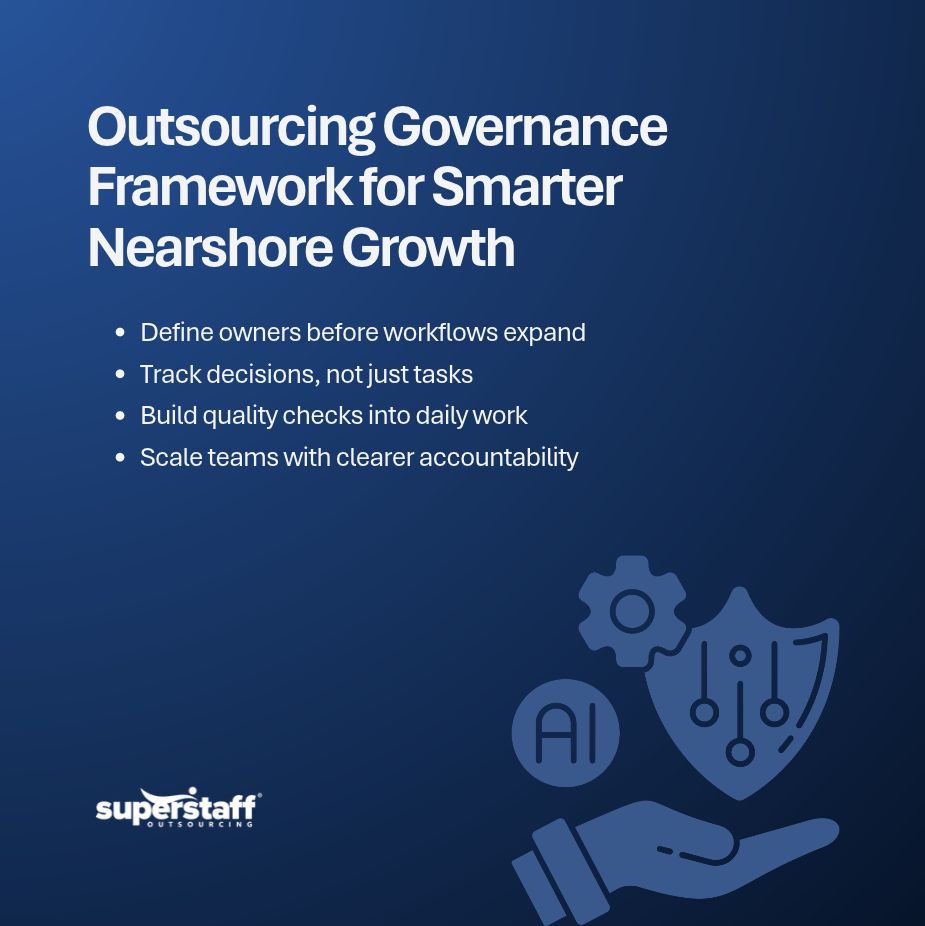
An outsourcing governance framework gives leaders a clear operating model before the work expands. It prevents the common problems that happen when expectations stay verbal, reports become inconsistent, and escalations depend on individual relationships instead of documented processes.
For U.S. companies working with a Colombia office, this matters even more because nearshore operations often support fast-moving teams. Similar time zones create better collaboration, but collaboration still needs rules. Governance ensures that meetings, reporting, quality checks, and performance reviews serve a business purpose.
What an effective governance model should clarify
A practical outsourcing governance framework should answer direct business questions. Who approves process changes? Who reviews quality? Who handles exceptions? Who owns training updates? Who decides whether a workflow is ready to scale?
These questions may seem basic, but they protect both the client and the outsourcing partner. Clear answers reduce delays and prevent duplicated work.
The framework should define:
- The decision-makers on both sides
- The reporting cadence and review format
- The escalation path for urgent issues
- The quality assurance process
- The service level expectations
- The change management process
- The compliance and data handling requirements
This structure creates alignment before pressure builds. It also gives leadership a reliable way to evaluate whether the partnership is improving business outcomes.
Building accountability into daily operations
An outsourcing governance framework should not live only in a kickoff document. It should show up in daily operations.
For example, a customer support team may need clear rules for handling refund requests, billing concerns, complex complaints, or technical issues. A back office team may need approval rules for document validation, claims support, account updates, or order processing. A document-heavy operation may also need clear controls for outsourced document management services.
Accountability works best when teams know the scope of their role. Agents and specialists should understand what they can resolve, what they should escalate, and what must remain with the client’s internal team.
This protects quality. It also builds trust because the client sees that the outsourced team follows an agreed process instead of improvising under pressure.
Why Colombia strengthens governance for U.S. teams
A Colombia office can strengthen an outsourcing governance framework because real-time communication is easier for U.S. companies. Leaders can review performance during the same business day. Managers can join meetings without extreme schedule gaps. Training updates can move faster because feedback cycles are shorter.
This matters for teams that handle active customer conversations, sales support, recruitment coordination, document review, and business document processing outsourcing. When work depends on quick clarification, nearshore alignment reduces friction.
The benefit is not only geographic. Colombia also gives companies access to bilingual and customer-facing talent that can support U.S. markets while staying close to the client’s operating rhythm. With the right governance model, that proximity becomes a management advantage.
Governance should connect performance to business goals
Many outsourcing relationships track activity but miss the bigger point. They monitor call volume, tickets closed, documents processed, or average handling time. These metrics matter, but they should not be the only view.
An outsourcing governance framework should connect operational performance to business priorities. For a healthcare company, that may mean faster patient coordination and fewer administrative delays. For a logistics provider, it may mean better shipment visibility and cleaner documentation. For a retail business, it may mean more consistent customer support during peak demand.
The goal is to make performance reviews useful for leaders. Reports should show what is working, what needs attention, and what decisions are required.
This keeps outsourcing from becoming a task handoff. It turns the partnership into a managed operating system.
How governance supports document workflows
Many companies exploring how to outsource document management for businesses already know the pain points. Files pile up. Teams use different naming rules. Approvals slow down. Internal staff spend too much time checking, sorting, and validating information.
An outsourcing governance framework gives document workflows the structure they need. It defines intake rules, quality checks, turnaround expectations, access controls, and escalation points.
For example, a business may outsource invoice processing, claims documentation, customer records, compliance files, or onboarding paperwork. Each workflow needs accuracy. Each workflow also needs transparency.
When governance is clear, the outsourced team can process work faster without losing control. The client can also review output with confidence because the rules are documented and repeatable.
What U.S. leaders should expect from their outsourcing partner
A strong partner should help design the outsourcing governance framework, not leave the client to build it alone. This is where provider maturity becomes visible.
The right outsourcing partner should be able to explain:
- How performance will be reported
- How supervisors manage quality
- How training updates are handled
- How risks are flagged
- How process changes are approved
- How the team improves after launch
These details matter because outsourcing success depends on ongoing management. A provider should not only supply people. It should help build a dependable operating structure around those people.
For SMEs and midmarket companies, this support is especially valuable. Many do not have large internal transformation teams. They need a partner that can bring operational discipline without creating unnecessary complexity.
Common governance gaps to avoid
An outsourcing governance framework can fail when it becomes too vague or too heavy. Vague governance creates confusion. Overbuilt governance slows down work.
The best model stays practical. It gives teams enough structure to perform well without burying them in meetings and approvals.
Common gaps include unclear escalation rules, weak quality calibration, inconsistent reporting, limited client involvement, and no formal review of process changes. These issues often appear slowly. A client may only notice them when errors increase, customers complain, or managers spend too much time correcting preventable problems.
A healthy governance model catches these issues early. It gives both sides a shared language for solving them.
Governance creates room for smarter growth
Companies often begin outsourcing with one function. They may start with customer support, then expand into back office work. They may begin with document processing, then add data management, scheduling, intake, or finance support.
An outsourcing governance framework makes this expansion safer. It gives leaders a clear way to decide what should move next, what should stay internal, and what must be improved before scaling.
For a Colombia office, this is especially useful because nearshore teams can support more collaborative workflows. With the right management structure, companies can test, refine, and expand functions without losing visibility.
Growth becomes more controlled. Leaders can see where outsourcing adds value and where the operating model needs adjustment.
Partner with SuperStaff for governed growth
An outsourcing governance framework helps U.S. companies protect quality, manage risk, and scale with more confidence. It brings discipline to daily work and gives leaders a clearer view of performance.
SuperStaff supports SMEs and midmarket companies through offshore and nearshore outsourcing solutions, including Colombia-based support for teams that need closer time zone alignment and stronger collaboration. Whether you need customer service, back office support, or document-driven workflows, SuperStaff can help you build the structure behind the team.
Explore SuperStaff services today and see how the right outsourcing partner can help you scale with clarity, control, and measurable operational value.