Customer support leaders are under pressure to reduce costs, improve service speed, and keep customers satisfied without adding unnecessary headcount. That is why many U.S. companies are looking at automated call center solutions as a practical way to modernize operations while keeping the human side of service intact.
For growing businesses, automation should not mean removing people from the customer experience. It should mean giving agents better tools, cleaner workflows, and faster access to the information they need to solve problems.
This is especially important for companies serving customers across different time zones, channels, and service expectations. When automation works together with a trained offshore or nearshore support team, the result is a more efficient customer operation that can scale without losing control.
SuperStaff’s Colombia office helps U.S. businesses build this kind of support model. It combines bilingual talent, cultural alignment, and smart process design to help companies improve service quality while managing labor costs more strategically.
Why Automated Call Center Solutions Matter Now
Many customer service teams are dealing with the same problem. Call volumes rise, customer expectations increase, and internal teams are expected to do more with the same budget.
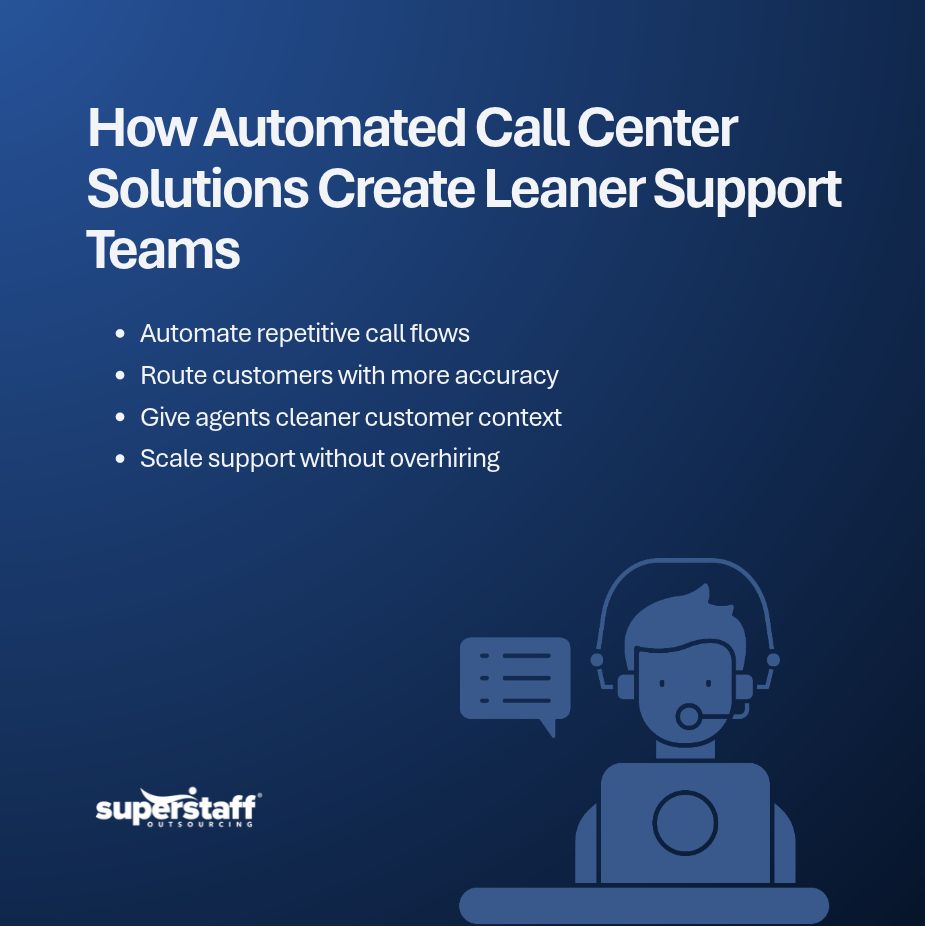
Automated call center solutions help solve this by reducing repetitive work. They can route calls, organize tickets, update customer records, trigger follow-ups, and support agents with faster access to account information.
This matters because agents should not spend their time searching through systems, repeating basic answers, or manually logging every small detail. Their time is better spent handling complex concerns, calming frustrated customers, and protecting the customer relationship.
For SMEs and midmarket companies, this is where the business case becomes clear. Automation helps remove operational waste, while outsourced support teams bring the people needed to manage conversations with care.
Automation Works Best When People Stay Involved
Some companies hesitate to use automated call center solutions because they worry customers will feel ignored or forced through a rigid system. That can happen when automation is used without a clear service strategy.
The better approach is to use automation as a support layer, not a replacement for human judgment. For example, a chatbot can answer basic questions about order status. An IVR system can guide customers to the right department. A CRM workflow can remind agents when follow-up is needed.
But when a customer has a billing concern, a complicated account issue, or a sensitive service complaint, they still need a skilled person who can listen, assess, and respond appropriately.
This is why the best customer operations are not fully automated. They are intelligently supported. The technology handles predictable tasks, while trained agents manage the moments that require empathy, problem-solving, and accountability.
Where Automation Reduces Call Center Costs
Automated call center solutions can lower costs in several practical ways. They reduce manual work, shorten handle times, improve call routing, and help agents avoid repetitive administrative tasks.
A company does not need to replace its entire support operation to see value. Often, the strongest improvements begin with a few focused areas:
- Call routing that sends customers to the right team faster
- Self-service tools for common questions
- CRM integrations that reduce duplicate data entry
- Automated reminders for follow-ups and escalations
- Reporting dashboards that help managers spot service gaps
These improvements can make a support team more productive without forcing the business to hire faster than revenue growth allows.
For U.S. companies, pairing automation with SuperStaff’s Colombia-based agents can strengthen the cost advantage. Colombia offers strong time zone alignment with the U.S., bilingual support capabilities, and access to skilled customer service professionals who can work as an extension of the client’s team.
The Strategic Role of Colombia in Customer Support
When U.S. companies evaluate automated call center solutions, location still matters. Technology can improve workflows, but the support team behind the system still shapes the customer experience.
SuperStaff’s Colombia office gives U.S. companies a nearshore option that supports real-time collaboration. This is valuable for businesses that want faster communication, easier schedule alignment, and bilingual coverage for English and Spanish-speaking customers.
For industries such as healthcare, e-commerce, logistics, financial services, and technology, this alignment can be a major advantage. Teams can work during U.S. business hours, join client meetings more easily, and respond to operational updates without long delays.
Automation improves the system. Nearshore talent improves the execution. Together, they create a support model that is easier to manage and easier to scale.
What Businesses Should Automate First
Not every support process should be automated right away. The smartest use of automated call center solutions starts with high-volume, low-complexity tasks.
These are the activities that slow agents down but do not always require deep judgment. Common examples include account verification, appointment reminders, order updates, simple troubleshooting steps, and post-call surveys.
Once those workflows are stable, companies can expand automation into more advanced areas. This may include predictive call routing, quality monitoring, agent assist tools, and performance analytics.
The key is to avoid automating broken processes. If a workflow is already confusing, automation may only make the confusion faster. Companies should first review how calls move through the system, where customers get stuck, and where agents lose time.
SuperStaff helps clients identify these operational gaps before building support teams around them. This allows automation and staffing to work together instead of operating as separate initiatives.
How Automation Improves the Agent Experience
Customer experience often improves when the agent experience improves. Agents who have better tools can respond faster, stay more organized, and focus more fully on the customer.
Automated call center solutions help reduce the pressure of repetitive work. Agents no longer need to switch between too many screens, manually record every detail, or search for basic information while the customer waits.
This can also support better training and quality control. Managers can review call trends, identify recurring issues, and coach agents using clearer data. Instead of relying only on random call reviews, leaders can see patterns across the operation.
For outsourced teams, this is especially useful. Clients gain better visibility into performance, while agents get the structure they need to meet service expectations consistently.
Why Human Support Still Protects the Brand
Automation can make service faster, but speed alone does not build customer loyalty. Customers remember how they were treated when a problem mattered to them.
Automated call center solutions should guide customers efficiently, but they should also make it easy to reach a person when needed. Long automated menus, dead-end chat flows, and poor escalation paths can damage trust.
A strong outsourced support model solves this by balancing efficiency with accessibility. Simple requests can move through self-service. More complex conversations can move to trained agents who understand the client’s tone, policies, and customer expectations.
This is where SuperStaff’s approach becomes valuable. The company does not position automation as a shortcut. It uses automation to help support teams deliver more consistent, responsive, and cost-effective service.
What U.S. Leaders Should Look For in a Partner
Choosing a partner for automated call center solutions is not only a technology decision. It is an operating model decision.
Business leaders should look for a partner that understands staffing, process design, quality assurance, and customer experience management. A tool alone will not fix poor training, unclear escalation rules, or weak reporting.
The right partner should be able to help answer important questions. Which tasks should be automated first? Which calls still require live support? How should success be measured? What should be handled in-house, outsourced, or supported through a blended model?
SuperStaff works with clients to build support teams that match the business need. For companies that need bilingual coverage, nearshore alignment, and scalable customer service operations, the Colombia office offers a strong option.
Building a Smarter Call Center Without Losing Control
Some leaders worry that outsourcing and automation will reduce visibility. In reality, the right model can improve control.
Automated call center solutions can give managers better reporting, clearer service metrics, and more consistent workflows. Outsourced teams can then execute those workflows with defined expectations, regular coaching, and structured accountability.
This creates a more disciplined operation. Leaders can see what is happening across call volume, resolution times, escalation trends, and customer feedback. They can also adjust staffing levels based on demand without carrying the full burden of direct hiring.
For SMEs and midmarket companies, this flexibility matters. It allows them to compete with larger companies without building an expensive in-house call center from the ground up.
A Practical Next Step for Growing Companies
Customer support does not need to be fully manual or fully automated. Most growing companies need a balanced model that uses technology to remove friction and people to manage the moments that require care.
Automated call center solutions give companies a smarter way to control costs, improve response times, and support agents with better systems. When combined with SuperStaff’s Colombia-based customer support teams, they become part of a practical growth strategy for U.S. businesses that want efficiency without sacrificing service quality.
If your company is ready to modernize customer support, reduce operational strain, and build a more scalable service model, explore SuperStaff’s outsourcing solutions today.