For U.S. companies exploring offshore hiring, Philippine work culture is more than a workplace topic. It shapes how teams communicate, serve customers, handle pressure, and stay committed to business goals. For SMEs and midmarket companies, understanding this culture can help turn offshore staffing from a cost decision into a stronger operating model.
The Philippines has become a trusted location for customer support, back-office operations, and specialized business services because its workforce brings a practical mix of English fluency, service orientation, adaptability, and strong team values. When paired with the right Employer of Record partner, these traits can help U.S. companies build reliable teams without opening a local entity.
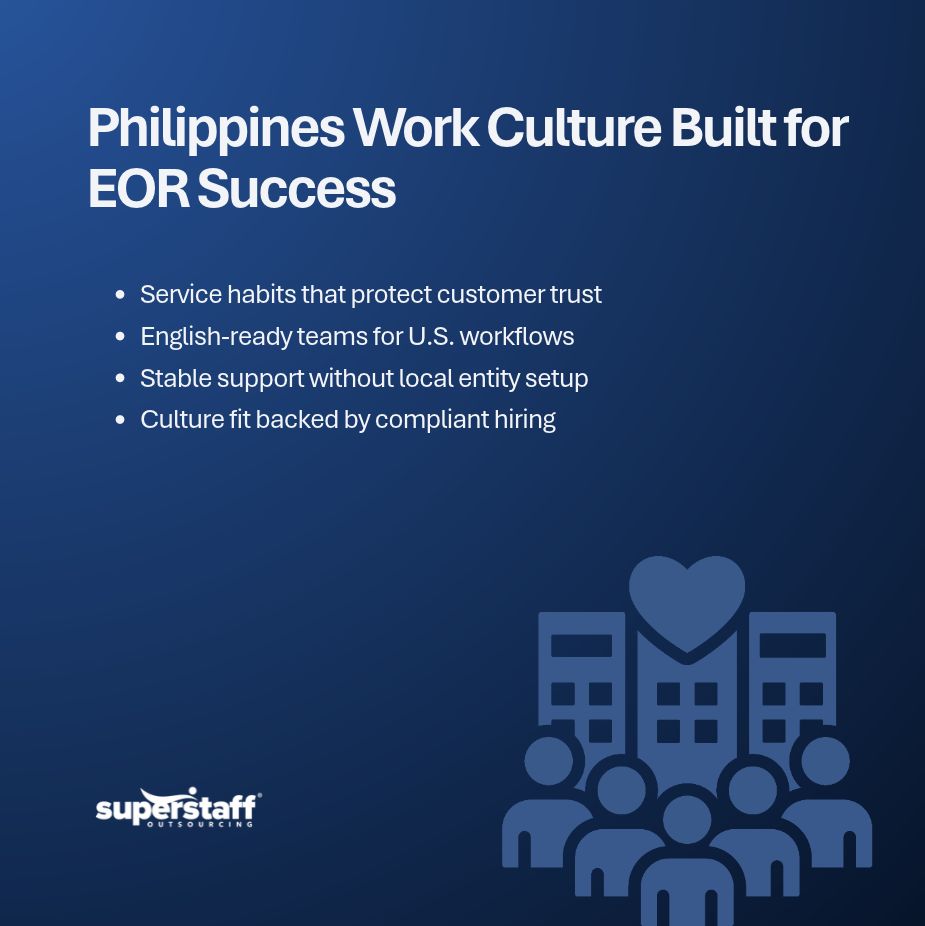
Why Culture Matters in Offshore Hiring
Hiring in another country is not only about labor availability. It is also about how people work, how managers lead, and how teams respond to customers.
Philippines work culture gives U.S. companies a strong foundation because Filipino professionals are used to working with international clients, especially in customer-facing roles. Many have experience supporting American consumers, using U.S. business tools, and adjusting to client-specific service standards.
This makes the onboarding curve more manageable. It also helps companies maintain continuity when they expand customer service, sales support, technical support, healthcare administration, or back-office functions offshore.
For companies using an EOR model, culture becomes even more important. The Employer of Record handles compliance, employment administration, payroll, and HR support, while the client focuses on performance and business outcomes.
A Service Mindset That Fits Customer Support
One of the strongest traits of Philippine work culture is its service-first approach. Filipino professionals are often trained to listen carefully, stay respectful, and manage conversations with patience.
This is valuable for U.S. companies that need agents who can handle everyday support issues without making the customer feel rushed or dismissed. It also matters in sensitive industries such as healthcare, legal intake, finance, e-commerce, and logistics, where accuracy and empathy must work together.
A customer may be calling about a delayed shipment, a billing concern, a missed appointment, or a product issue. In each case, the agent must solve the problem while protecting the brand relationship. Filipino support teams are well suited for this type of work because the culture values courtesy, cooperation, and accountability.
Communication That Supports U.S. Customers
English proficiency is a key reason companies choose the Philippines, but communication is not only about language. It is also about tone, clarity, listening, and judgment.
Philippine work culture often aligns well with U.S. customer expectations because many professionals are familiar with American media, business communication, and service standards. This helps agents understand context, not only scripts.
For example, an agent supporting a U.S. e-commerce brand must know when to follow process and when to escalate. A healthcare support representative must speak clearly while handling patient information with care. A logistics coordinator must update customers in a way that is direct but professional.
These details affect customer experience. They also affect retention, escalation volume, and the overall quality of support delivery.
Team Loyalty and Day-to-Day Reliability
U.S. companies want offshore teams that can perform consistently, not just fill seats. This is where the Philippines’ work culture offers a practical advantage.
Filipino employees often value stable work, supportive leadership, and team connection. These factors help create a stronger sense of ownership when the offshore team is properly managed.
That does not mean performance happens automatically. It still requires clear KPIs, structured onboarding, coaching, quality assurance, and good workforce planning. But when the right systems are in place, Filipino teams can become long-term contributors instead of short-term capacity.
For SMEs and midmarket companies, this matters. Hiring replacements, retraining staff, and correcting service gaps take time. A stable offshore team can reduce operational friction and help internal leaders focus on growth.
Adaptability Across Time Zones and Workflows
Many U.S. businesses need coverage beyond regular office hours. Some need evening support, overnight assistance, weekend coverage, or blended shifts across multiple teams.
Philippines work culture has developed around global service delivery, especially in the BPO sector. Many Filipino professionals understand what it means to support international schedules and follow client-specific workflows.
This adaptability helps companies extend service hours without overloading their U.S. team. It can also improve responsiveness when customer demand rises during seasonal peaks, product launches, claims cycles, enrollment periods, or logistics disruptions.
An EOR partner can make this easier by managing local employment requirements, HR administration, and workforce support. That gives U.S. leaders more room to focus on training, service design, and operational performance.
Where U.S. Companies Need the Right Partner
Culture is an advantage, but it still needs structure. U.S. companies should avoid assuming that a talented offshore workforce can succeed without clear leadership and compliance support.
Philippines work culture works best for business outcomes when expectations are clear from the start. Teams need defined roles, documented processes, performance standards, escalation paths, and regular coaching.
This is especially important under an EOR model. The client may manage daily work, but the EOR partner handles local employment responsibilities. That split must be clean, compliant, and well coordinated.
A strong EOR partner helps with:
- Local employment compliance
• Payroll and benefits administration
• HR support and employee relations
• Recruitment and onboarding coordination
• Workforce continuity and local management guidance
These functions protect the company while giving employees a better work experience. That combination supports stronger performance.
The Human Side of Offshore Scaling
Companies often begin offshore hiring because they need cost relief. That is valid. Labor pressure, hiring delays, and customer demand can make local-only staffing difficult.
But the stronger reason to build in the Philippines is operational resilience. Philippines work culture supports teams that can integrate with U.S. companies, manage customer interactions professionally, and stay aligned with business processes.
For example, a growing healthcare company may need patient support staff who can schedule appointments, handle documentation, and route calls correctly. A logistics provider may need coordinators who can track shipments and communicate with customers. A software company may need support agents who can troubleshoot basic concerns and escalate technical issues.
In each case, the offshore team is not separate from the business. It becomes part of how the business delivers service.
What Leaders Should Look For Before Hiring
Before building a Philippine team through EOR, U.S. companies should review the type of work they want to offshore and the level of customer impact involved.
Philippines work culture is a strong match for roles that require communication, patience, process discipline, and service quality. These include customer support, virtual assistance, billing support, intake support, logistics coordination, data processing, appointment setting, and back-office administration.
Leaders should also define success early. A vague offshore plan can create confusion. A clear plan helps the team understand priorities from day one.
Useful questions include:
- Which tasks should stay with the U.S. team?
• Which tasks can be handled offshore?
• What tools and systems will the offshore team use?
• What customer issues require escalation?
• How will quality be measured?
These questions help transform offshore hiring into a real operating model.
How SuperStaff Helps U.S. Companies Build Philippine Teams
SuperStaff helps U.S. SMEs and midmarket companies build reliable offshore teams in the Philippines through flexible staffing and EOR support. The goal is not only to provide talent. It is to help companies create a team structure that fits their workflow, compliance needs, and customer expectations.
With SuperStaff, companies can access Filipino professionals while receiving support for recruitment, onboarding, HR coordination, and day-to-day workforce management. This helps reduce the complexity of hiring in another country.
Philippines work culture becomes more valuable when it is supported by the right systems. SuperStaff helps connect that cultural strength with practical business execution.
Build a Team That Works the Way Your Business Works
Offshore hiring works best when companies understand both the people and the process. Philippine work culture offers U.S. companies a strong advantage because it supports service quality, adaptability, communication, and team commitment.
For business leaders, the opportunity is clear. The right Philippine team can help improve coverage, support customers better, and give internal teams more room to focus on higher-value work.
SuperStaff helps you build that team with the structure, compliance support, and operational guidance needed to scale with confidence.
Explore SuperStaff’s EOR and outsourcing services today and see how a Philippine-based team can support your next stage of growth.