For years, large enterprises used the global capability center model to centralize specialized work, improve governance, and support global operations. Today, SMEs and midmarket companies are looking at the same model for a practical reason. They need reliable capacity, stronger process control, and skilled teams that can support growth without adding unnecessary pressure to local hiring.
Why Growth Now Requires Better Operating Capacity
Growth can expose weaknesses that were easy to manage at a smaller size. Customer inquiries increase. Back-office queues get longer. Support teams carry more tasks. Managers spend more time solving staffing gaps than improving service quality.
A global capability center helps companies move beyond reactive hiring. It creates a structured offshore team that handles defined business functions with clear workflows, performance standards, and management oversight.
For U.S. companies, this matters because labor markets remain competitive and customer expectations continue to rise. Leaders need more than extra hands. They need a smarter way to build capacity that supports consistency.
What a Global Capability Center Really Does
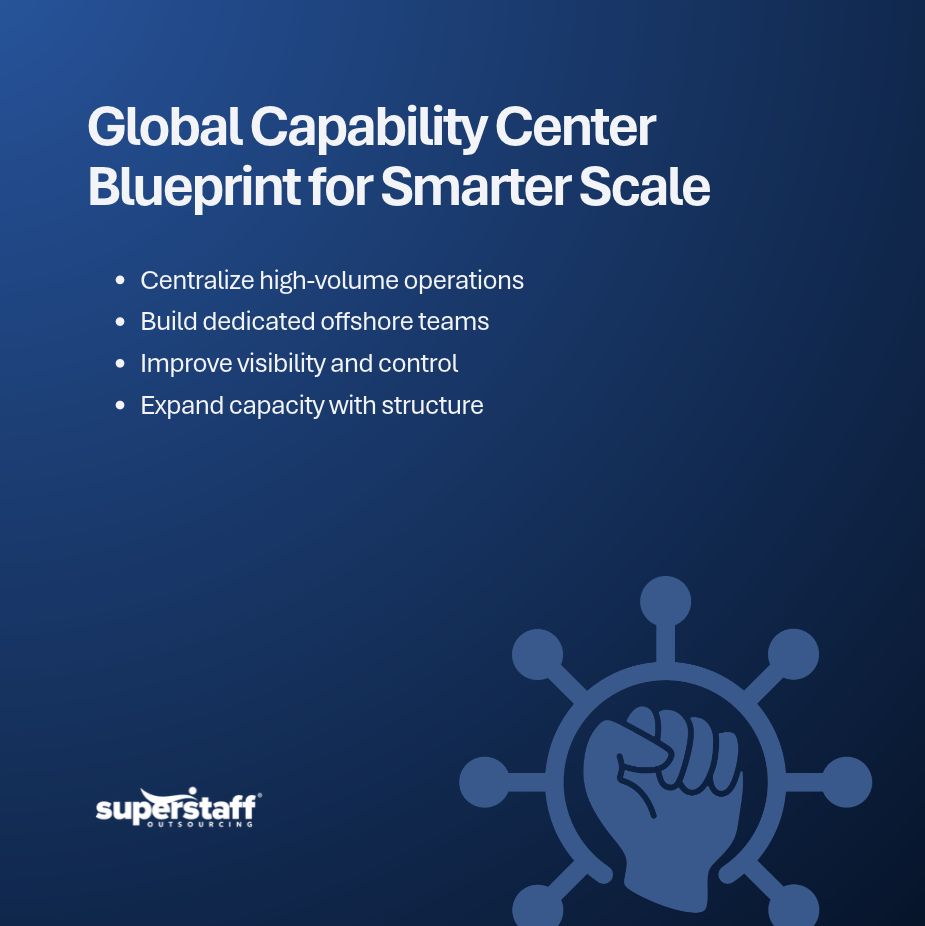
A global capability center is a dedicated offshore operating unit that supports core and non-core business functions. It can cover customer service, technical support, finance support, data processing, sales support, recruitment, healthcare administration, and other specialized roles.
The key difference is structure. A global capability center is built around repeatable processes, trained teams, reporting standards, and long-term business goals. It gives companies a dependable extension of their operations rather than a short-term staffing fix.
This model works best when leaders want to improve service delivery while maintaining visibility. They can define how the team works, what tools they use, what outcomes matter, and how success gets measured.
Why SMEs Are Paying Attention
SMEs often face the same operational pressures as larger companies, but with fewer resources. They need to serve customers faster, keep internal teams productive, and manage costs carefully.
A global capability center gives these businesses access to a wider talent pool without forcing them to build a large internal department from scratch. It also allows them to scale specific functions based on demand.
For example, an e-commerce company may need customer support agents, order management staff, and returns specialists before peak season. A healthcare company may need patient support, claims assistance, or appointment coordination. A logistics provider may need tracking support, dispatch coordination, and documentation teams.
Each of these functions can be supported through a global capability center with the right staffing plan and operating rhythm.
Why the Philippines Fits the Model
The Philippines remains one of the most trusted outsourcing destinations for U.S. companies because of its strong English proficiency, service culture, and experience in customer-facing work. Filipino teams are familiar with U.S. business communication standards and are highly adaptable across industries.
For companies building a global capability center, this creates a strong foundation. The Philippines offers talent that can support both voice and non-voice operations, from customer service to administrative processing.
This is especially valuable for businesses that want offshore support but still care deeply about quality, empathy, and brand representation. Cost savings matter, but service quality keeps customers loyal.
The Real Value Is Management Discipline
A global capability center should not operate like a loose collection of outsourced roles. It needs clear leadership, documentation, training, quality assurance, and reporting.
Without those elements, offshore teams can become disconnected from business goals. With them, they can improve speed, reduce bottlenecks, and help internal teams focus on higher-value work.
Strong management discipline includes defined service levels, escalation paths, onboarding plans, coaching routines, and performance reviews. It also includes ongoing communication between the offshore team and the client’s internal stakeholders.
This is where the right outsourcing partner makes a major difference. The staffing model matters, but the operating model determines the outcome.
What Functions Can Move First
Companies do not need to move everything offshore at once. A practical global capability center often starts with one or two functions that are process-heavy, volume-driven, or difficult to staff locally.
Customer support is a common starting point because it affects response time and customer satisfaction. Back-office support is another strong candidate because it often consumes internal bandwidth without requiring local presence.
Sales support, lead management, data entry, document processing, appointment setting, order support, and recruitment coordination can also fit well. The best starting point depends on the company’s current pain points and growth plans.
A careful rollout helps leaders test workflows, refine training, and prove value before expanding the team.
How This Supports Better Business Planning
A global capability center can also improve planning. Instead of reacting to hiring delays or seasonal demand, companies can build a flexible operating base that supports future growth.
This is useful during annual planning, budget reviews, market expansion, or new product launches. Leaders can look at where work is piling up and decide which functions need dedicated offshore support.
The result is a more balanced workforce. Local teams can focus on strategy, client relationships, product development, and leadership priorities. Offshore teams can handle the operational work that keeps the business moving.
What Decision Makers Should Look For
Choosing a partner for a global capability center requires more than checking seat capacity or hourly rates. Leaders should evaluate whether the provider understands process design, talent matching, compliance, training, and performance management.
The right partner should be able to explain how teams are recruited, trained, supervised, and improved over time. They should also provide transparency into reporting, quality checks, and communication routines.
For U.S. SMEs and midmarket companies, cultural fit also matters. The offshore team must understand customer expectations, brand tone, and business priorities. That alignment turns outsourcing into a true operating advantage.
Where SuperStaff Comes In
SuperStaff helps companies build offshore teams in the Philippines that are structured, managed, and aligned with business goals. With around 400 agents, SuperStaff combines the flexibility SMEs need with the operational discipline required for long-term success.
Our teams support customer experience, back-office operations, knowledge process outsourcing, recruitment process outsourcing, and industry-specific functions across sectors such as healthcare, logistics, e-commerce, finance, and technology.
For companies exploring a global capability center, SuperStaff offers a practical path forward. We help define the roles, build the team, train for quality, and manage performance so your operations can scale with confidence and control.
Build Capacity That Works Like Part of Your Business
A global capability center gives growing companies a way to expand capacity, improve service delivery, and protect internal teams from operational overload. It works best when it is planned carefully, managed consistently, and supported by a partner that understands both people and process.
SuperStaff can help you build the offshore team your next stage of growth requires. Explore SuperStaff services today and see how a dedicated Philippine-based team can support your business with the right talent, structure, and accountability.