Data now sits at the center of almost every business decision. Customer records, contracts, invoices, claims, service tickets, employee files, and operational documents all carry signals that can improve speed, accuracy, and customer experience. Yet many SMEs and midmarket companies still manage these assets across disconnected systems, shared folders, inboxes, and manual workflows. That is where ai data management and document management outsourcing become practical business strategies, not abstract technology initiatives.
For U.S. companies trying to scale, the challenge is clear. AI tools can only perform well when the underlying data is clean, structured, searchable, and consistently updated. If documents are incomplete, mislabeled, duplicated, or difficult to retrieve, automation becomes unreliable. Leaders do not need more digital clutter. They need organized information that supports better decisions, smoother operations, and faster service delivery.
Why document management outsourcing now supports AI readiness
Document management outsourcing gives companies a structured way to manage information before it becomes a bigger operational problem. It helps teams convert scattered files into organized, validated, and usable business data.
This matters because ai data management depends on discipline. AI systems need accurate inputs. They need consistent naming, proper tagging, clean records, and clear workflows. Without those foundations, even the most advanced platform will struggle to produce dependable results.
Many internal teams already understand the value of better data. The issue is capacity. Employees who should focus on customers, finance, compliance, sales, or strategy often spend hours searching for documents, checking file versions, entering data, or correcting avoidable errors.
Document management outsourcing helps remove that burden. It allows trained offshore teams to handle repetitive but business-critical documentation work while in-house employees focus on higher-value responsibilities.
The hidden cost of unorganized business data
Unorganized documents create delays that leaders may not immediately see on a spreadsheet. A missing form can slow down onboarding. A poorly tagged invoice can delay payment. An incomplete customer file can affect service quality. A duplicated record can create confusion across departments.
These issues become more serious when companies introduce ai data management. AI can accelerate workflows, but it can also amplify existing problems if the data behind those workflows is weak. Bad inputs can lead to inconsistent outputs, manual rework, and low trust in automation.
Document management outsourcing addresses the operational layer behind AI adoption. It supports the human work required to prepare, maintain, and improve business information before it feeds into digital systems.
This is especially useful for companies with high document volume. Healthcare providers, logistics firms, legal teams, finance departments, e-commerce brands, and professional services firms all depend on accurate records. When documents move slowly, the business moves slowly.
What outsourced teams can handle
Outsourced document management services can support a wide range of back-office functions. The goal is not only to store documents but to make them easier to use across the business.
A trained offshore team can assist with:
- Document indexing and tagging
- Data entry and validation
- File organization and naming
- Invoice and receipt processing
- Contract and form management
- Customer record updates
- Claims and application documentation
- Digital archiving and retrieval support
- Quality checks and exception handling
- Workflow coordination across departments
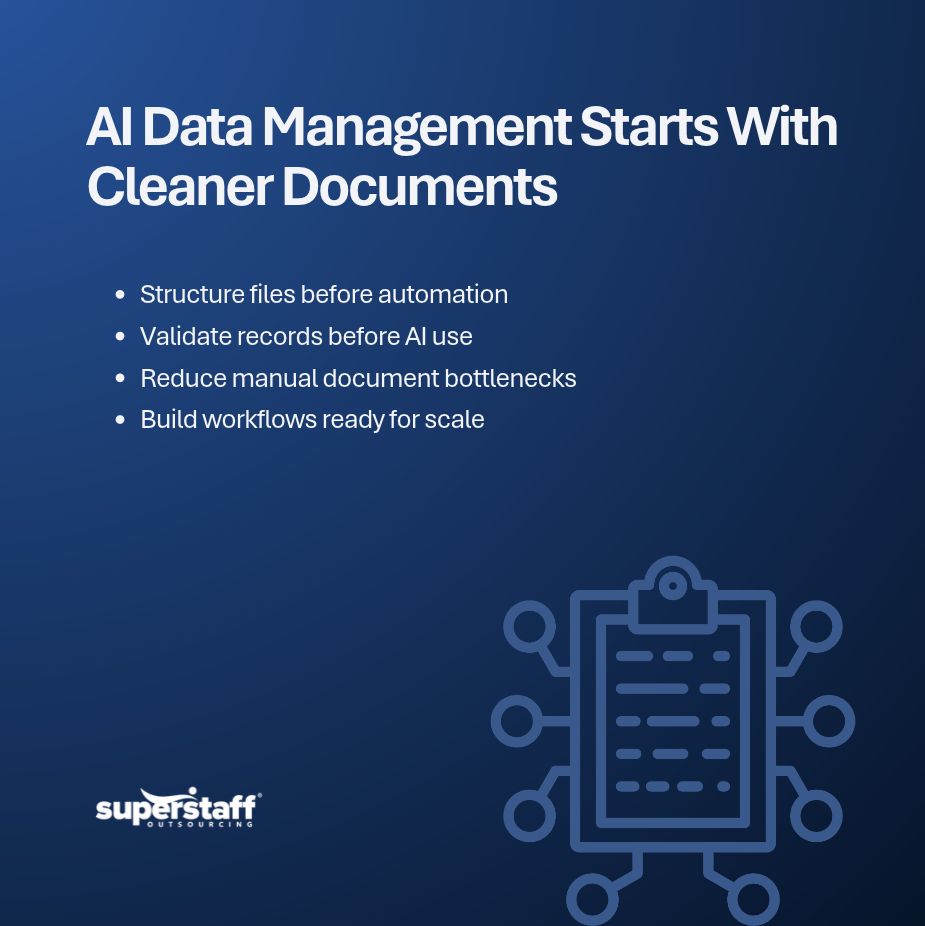
These tasks may look basic, but they have a direct impact on ai data management. Clean files and structured records make it easier for companies to use automation, analytics, search tools, and AI-assisted workflows.
Document management outsourcing also creates process consistency. Instead of relying on different employees to organize information in different ways, companies can build standard workflows. This improves accuracy and reduces confusion.
Why offshore support works for document-heavy teams
Many U.S. SMEs and midmarket companies want to modernize their operations but cannot always justify expanding local administrative teams. Hiring in-house support can be costly, time-consuming, and difficult to scale.
Document management outsourcing gives companies access to trained talent in the Philippines without adding unnecessary pressure to internal departments. For document-heavy operations, this model works because many tasks require focus, accuracy, accountability, and process discipline.
The Philippines has a strong BPO workforce with experience supporting U.S. businesses across customer service, healthcare, finance, logistics, legal support, and back-office operations. This makes Filipino offshore teams well-positioned to support ai data management initiatives that require reliable human oversight.
AI may automate parts of the workflow, but people still play a key role in reviewing exceptions, checking accuracy, preparing records, and maintaining process quality. Offshore teams help bridge that gap.
Business document processing outsourcing for better control
Business document processing outsourcing is especially valuable when companies deal with recurring documents every day. Examples include purchase orders, claims forms, patient records, loan documents, shipping documents, invoices, contracts, and customer applications.
These documents often follow predictable patterns. That makes them ideal for structured offshore support. A dedicated team can receive documents, classify them, extract needed information, check for missing fields, route exceptions, and update systems.
This creates stronger operational control. It also supports ai data management because information enters the system in a more consistent format.
When business leaders evaluate outsourcing, they should look beyond labor savings. The stronger value is process reliability. A good offshore team helps create repeatable workflows, clear ownership, and measurable accountability.
Document management outsourcing gives leaders a practical way to clean up daily operations while preparing the business for more advanced digital tools.
How to outsource document management for businesses
Companies exploring how to outsource document management for businesses should start with the workflows that cause the most friction. These are often tasks that are repetitive, document-heavy, and important enough to affect customers, revenue, compliance, or internal speed.
The first step is to identify where documents slow the team down. This may include billing, onboarding, claims review, customer support, vendor management, or compliance reporting.
The next step is to define the process clearly. What documents arrive? Where do they come from? What information must be captured? Which systems need updates? What errors happen most often? Which exceptions require escalation?
This process map helps the outsourcing partner build the right support model. It also prevents ai data management from becoming too broad or vague. Leaders need practical workflows that can be improved step by step.
Document management outsourcing works best when expectations are clear. Companies should define turnaround times, quality standards, escalation rules, access controls, and reporting needs before launching the partnership.
Where AI and human support work together
AI can help classify documents, extract text, detect patterns, and speed up search. However, AI still needs human review when documents are unclear, incomplete, sensitive, or unusual.
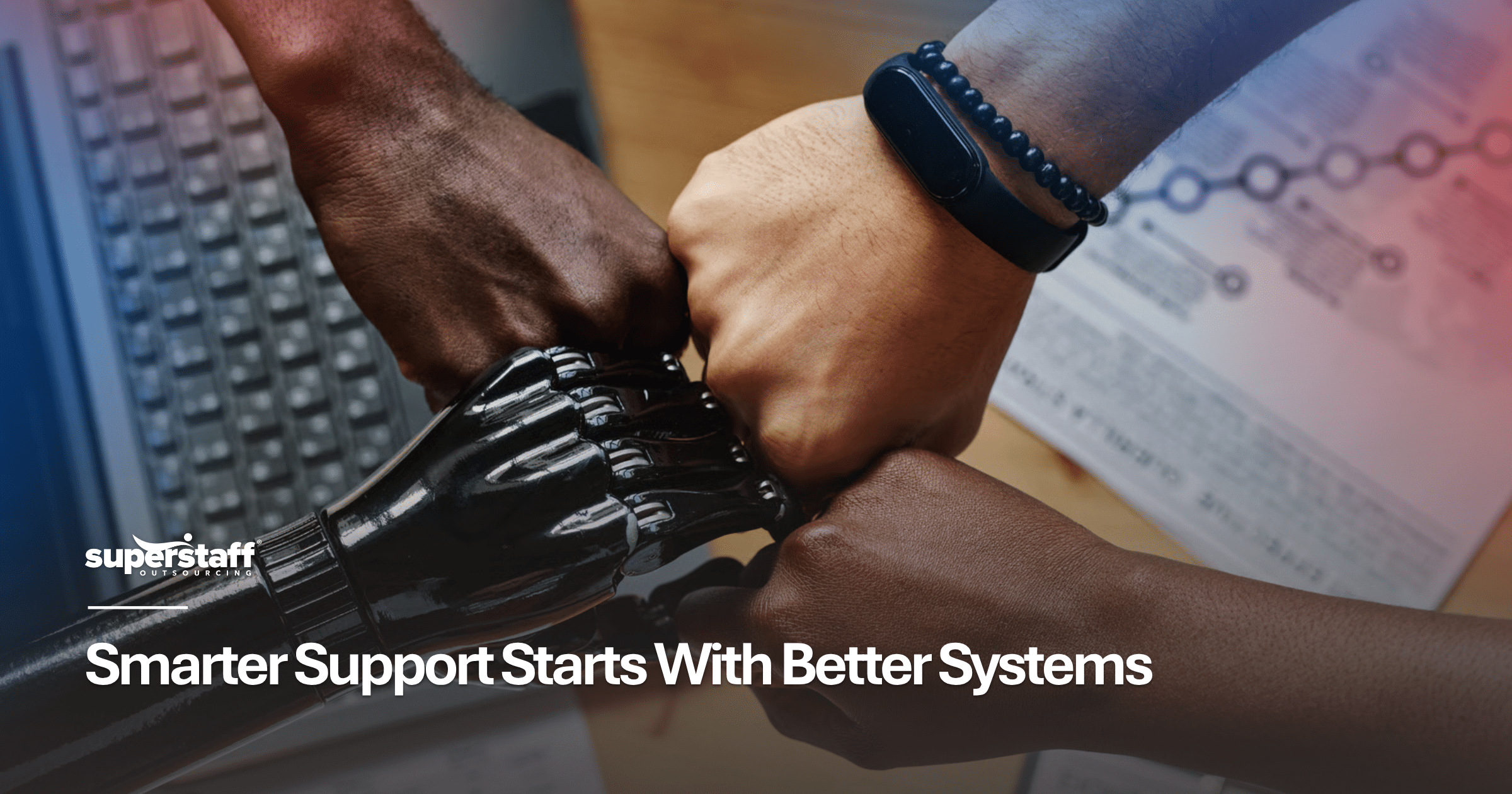
That is why ai data management should combine technology with trained support teams. Offshore specialists can verify outputs, correct errors, handle exceptions, and keep records aligned with business rules.
This human-in-the-loop model is especially important for regulated or detail-heavy industries. Healthcare, finance, insurance, logistics, and legal operations cannot rely on automation alone. They need accuracy, documentation discipline, and clear accountability.
Document management outsourcing helps companies build that balance. It gives internal leaders more confidence that their AI tools are working from organized, reviewed, and properly maintained information.
What decision-makers should look for
The right outsourcing partner should understand both process execution and business context. A low-cost provider that only moves files from one folder to another will not create enough value.
Leaders should look for a partner that can support:
- Clear workflow design
- Data accuracy and quality control
- Secure document handling
- Scalable staffing
- Process reporting
- System familiarity
- Exception management
- Continuous improvement
These capabilities make document management outsourcing more strategic. They also strengthen ai data management by giving companies a dependable operating layer behind their digital tools.
For SMEs and midmarket companies, this matters because AI adoption should not create more complexity. It should make work easier, faster, and more reliable. That outcome starts with better data discipline.
Building a stronger data foundation with SuperStaff
AI can help companies work faster, but it cannot fix messy operations on its own. Businesses need clean records, structured workflows, organized documents, and trained people who can manage the details consistently.
That is why ai data management and document management outsourcing now belong in the same conversation. One prepares the business for smarter technology. The other gives leaders the operational support needed to keep information accurate and usable every day.
SuperStaff helps U.S. SMEs and midmarket companies build reliable offshore teams in the Philippines for back-office support, customer experience, healthcare operations, finance support, and document-heavy workflows. With the right team in place, businesses can reduce manual strain, improve process consistency, and prepare their data for smarter systems.
Explore SuperStaff services today and see how an offshore team can help you manage documents, strengthen operations, and build a cleaner foundation for AI-enabled growth.