Customer expectations have changed. Buyers want fast answers, smooth handoffs, and support teams that understand context without making every conversation feel scripted. For many U.S. SMEs and midmarket companies, a Filipino call center offers a practical way to improve customer service without overextending internal teams.
The appeal is clear. The Philippines has long been one of the strongest destinations for outsourced customer support because of its English proficiency, service mindset, and familiarity with U.S. business culture. But choosing the right partner is no longer only about lowering labor costs.
Today, the smarter question is this. Can your outsourcing partner help you protect customer relationships, support growth, and improve how service is delivered every day?
Why a Filipino call center still stands out
A Filipino call center gives U.S. companies access to customer support professionals who are known for clear communication, patience, and adaptability. These traits matter in voice support, live chat, email support, appointment setting, order management, and technical help desk roles.
For growing companies, this can solve a common problem. Your internal team may be strong, but they may not have the bandwidth to handle every customer request, every after-hours inquiry, or every seasonal surge. When response times slip, customer trust can slip with them.
Outsourcing helps companies add capacity without rushing local hiring or stretching managers too thin.
A Filipino call center can support several business needs, including:
- Customer service and inbound support
- Outbound calling and lead qualification
- Technical support and troubleshooting
- Appointment scheduling and order processing
- Billing inquiries and account updates
- Back-office support connected to customer care
For SMEs, the value is not just having more agents. It is having the right operating model to keep customers supported while the core team focuses on growth.
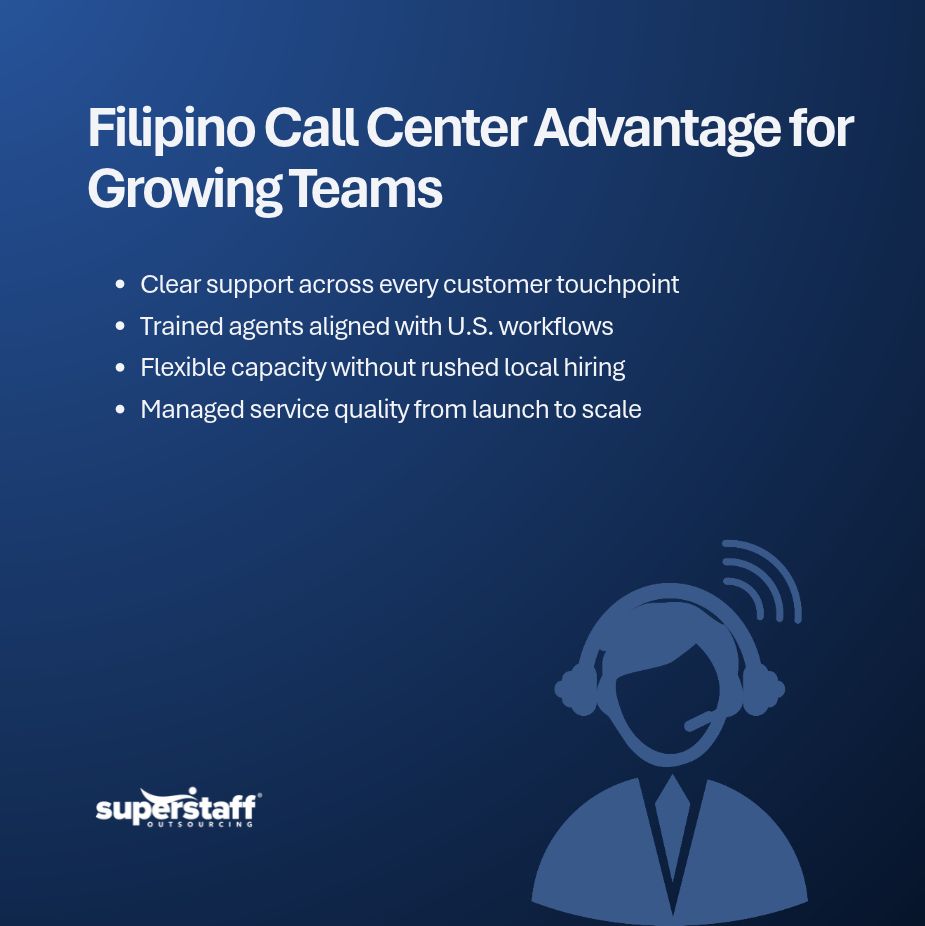
The real business case is consistency
Many companies look at outsourcing when call volume becomes difficult to manage. That is a valid starting point, but the bigger value comes from consistency.
A Filipino call center can help standardize how customers are greeted, how issues are documented, how escalations are handled, and how follow-ups are completed. This is especially important for businesses that are growing across multiple regions, adding new products, or managing higher customer expectations.
When support becomes inconsistent, leaders often see the same patterns:
- Customers repeat their concerns across channels.
- Agents lack full context during calls.
- Follow-ups are delayed or missed.
- Internal teams spend too much time fixing service gaps.
- Managers struggle to identify where the process breaks down.
A reliable outsourcing partner helps reduce those gaps by building clear workflows, training agents on account-specific needs, and managing performance with structure.
For U.S. companies, this means support can become more predictable. Customers get clearer answers. Internal teams get fewer avoidable escalations. Leaders get better visibility into what is happening on the front line.
Why Filipino agents connect well with U.S. customers
A strong Filipino call center is effective because communication is one of its biggest strengths. Filipino agents are widely recognized for their English fluency, neutral communication style, and ability to adjust tone based on the customer’s situation.
This matters because customer service is rarely just about answering a question. Agents often need to calm frustration, clarify details, explain next steps, and make the customer feel heard without extending the call unnecessarily.
That balance matters in industries where every interaction affects trust. Healthcare providers need patient-friendly support. E-commerce brands need quick order assistance. Logistics companies need proactive updates. Legal and financial service firms need professional, detail-focused communication.
A Filipino call center can help support these needs while keeping conversations clear, respectful, and aligned with the brand.
Cost savings should not be the only reason
Cost efficiency is one reason U.S. companies consider offshore support, but it shouldn’t be the only strategy. A lower-cost team that lacks training, accountability, or process discipline can create more problems than it solves.
The better approach is to look at cost and quality together.
A Filipino call center should help you reduce hiring pressure while improving service structure. That means your partner should understand more than seat count. They should know how to recruit for the right communication skills, train for your workflows, monitor performance, and improve agent coaching over time.
The right partner should also help you answer key questions before launch:
- What support channels need coverage?
- Which tasks should stay in-house?
- What issues require escalation?
- What systems will agents use?
- How will quality be measured?
- What does a successful first 30 to 90 days look like?
These questions help prevent outsourcing from becoming a rushed staffing decision. They turn it into a service delivery strategy.
How the right partner supports growth
A Filipino call center can be especially valuable for companies that are entering a new growth stage. When sales increase, customer support demand often rises quickly. Orders increase. Tickets increase. Billing questions increase. Technical issues become more visible.
If the company does not prepare for that growth, customer experience can become the first weak point.
Outsourcing gives leaders more flexibility. Teams can be built around current demand and adjusted as needs change. This helps companies avoid two common risks. One is under-hiring and overwhelming the internal team. The other is over-hiring locally before demand becomes stable.
With the right structure, outsourced support can help companies scale more responsibly. It gives leadership room to test new markets, extend service hours, manage seasonal volume, and support customers without adding too much fixed overhead.
A Filipino call center also gives companies access to talent that can handle both front-line conversations and support-related administrative tasks. This matters because customer service doesn’t end when the call ends. Notes must be updated. Orders must be checked. Tickets must be routed. Follow-ups must happen.
When those tasks are handled well, the entire customer journey runs more smoothly.
What U.S. companies should look for
Not every outsourcing provider will fit every business. A strong Filipino call center partner should match talent, process, technology, and management support to your goals.
Before choosing a provider, companies should assess:
- Experience supporting U.S. customers
- Recruitment and training standards
- Quality assurance process
- Data security practices
- Reporting and performance visibility
- Ability to support voice and non-voice channels
- Flexibility for ramp-up or seasonal needs
- Management support after launch
The best fit is usually a partner that can act as an extension of your team, not just a vendor that fills seats.
This is where operational discipline matters. Customer support requires more than polite agents. It requires workforce planning, coaching, quality monitoring, escalation paths, and communication between the client and the outsourcing team.
A Filipino call center with strong management can help protect the customer experience while giving your company the flexibility to grow.
Where SuperStaff fits in
SuperStaff helps U.S. businesses build customer support teams in the Philippines with the structure, training, and management needed for long-term success.
For SMEs and midmarket companies, this means you can access skilled Filipino support professionals without managing every part of offshore hiring yourself. SuperStaff recruits, trains, equips, and manages teams that align with your service goals, customer expectations, and operating standards.
A Filipino call center partnership with SuperStaff can support customer service, technical support, back-office support, inbound calls, outbound outreach, and other customer-facing functions. The goal is simple. Help your business serve customers better while giving your internal team more room to focus on revenue, product, and strategy.
SuperStaff also understands that outsourcing is a business decision, not just a staffing decision. That is why every engagement should begin with the right questions. What are your customer pain points? Where does your team need support? What tasks can be delegated? What level of reporting does leadership need? What does success look like after launch?
Answering these questions early makes outsourcing clearer, more controlled, and more valuable.
Build support that can grow with you
A Filipino call center can give U.S. companies the customer support capacity, communication quality, and operational flexibility they need to grow without overwhelming internal teams. The strongest results come when the partner understands both people and process.
SuperStaff helps companies build support teams that are trained, managed, and aligned with real business goals. If your team needs reliable customer service capacity, stronger coverage, or a more scalable support model, explore SuperStaff’s outsourcing services and see how the right Philippine-based team can help you serve customers with confidence.