For U.S. companies expanding support teams across borders, talent retention offshore is no longer a concern that starts after hiring. It begins much earlier, during workforce planning, role design, sourcing, screening, onboarding, and candidate communication. When companies rush recruitment, they often fill seats quickly but lose people just as fast.
This is where Recruitment Process Outsourcing becomes more strategic. A strong RPO partner does more than find candidates. It helps build a hiring system that attracts people who understand the role, fit the culture, and see a future with the company.
For SMEs and midmarket businesses, this matters even more. A single vacant role can affect customer response times, team morale, and service consistency. When the position supports call center operations, healthcare coordination, logistics support, or back-office workflows, every hiring decision has a direct impact on performance.
SuperStaff’s Colombia office helps companies approach recruitment with retention in mind from day one. Instead of treating hiring as a one-time transaction, RPO creates a stronger talent pipeline built for long-term success.
Why Talent Retention Offshore Requires Better Hiring Design
Many companies think retention depends only on compensation, benefits, or management style. These factors matter, but they are only part of the picture. Talent retention offshore also depends on whether the right person was hired for the right role under the right expectations.
When job descriptions are vague, candidates enter the process with incomplete information. When screening is rushed, hiring teams may overlook communication style, schedule fit, work preferences, and motivation. When onboarding feels disconnected, new hires may struggle to settle into the role.
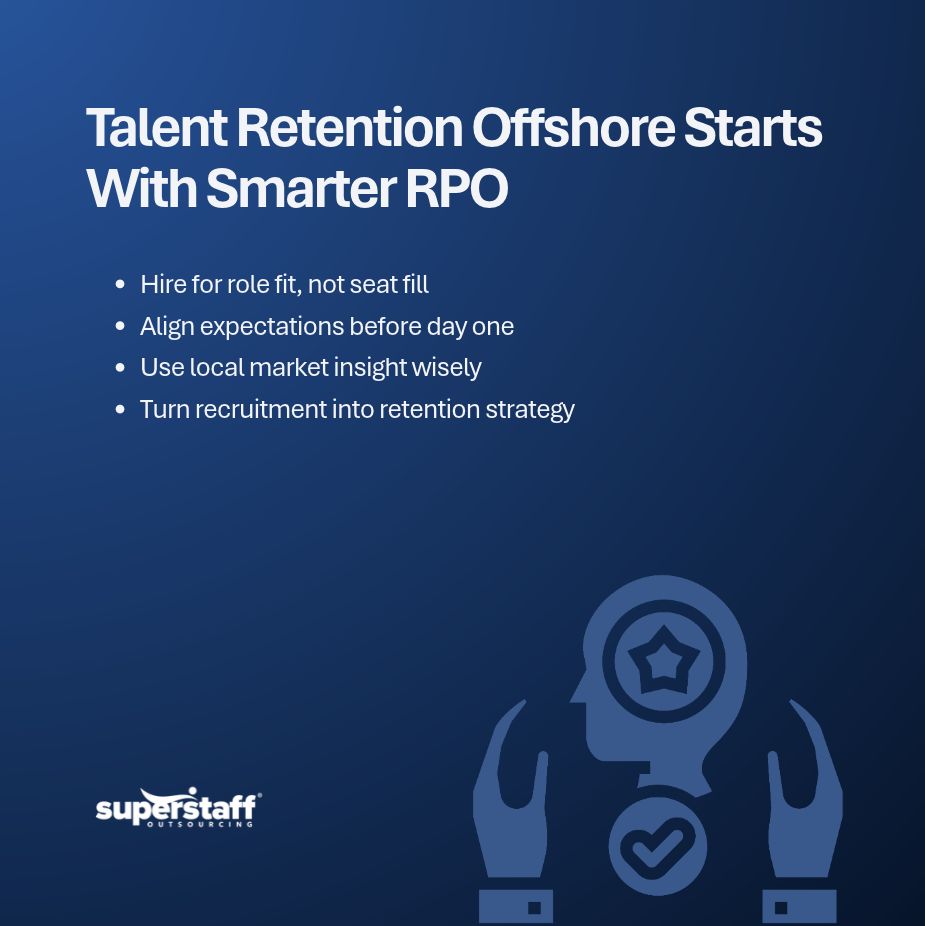
An RPO partner helps close these gaps. It brings structure to every step of recruitment, including:
- Clear role profiling
• Candidate market mapping
• Screening aligned with actual work conditions
• Faster communication with applicants
• Better interview coordination
• Stronger onboarding handoff
For U.S. businesses hiring in Colombia or other offshore locations, this level of structure can make the difference between filling a role and building a stable team.
Recruitment Should Support Retention, Not Just Hiring Volume
High-volume recruitment can solve urgent staffing needs, but volume alone does not guarantee quality. Nearshore talent retention improves when companies stop measuring recruitment only by speed and start measuring it by fit, readiness, and long-term performance.
For example, a call center role may require excellent English communication, patience, comfort with repetitive tasks, and the ability to handle difficult customer conversations. A candidate may look qualified on paper but may not be prepared for the schedule, metrics, or emotional demands of the work.
RPO adds discipline to this process. Recruiters can evaluate not only skills but also role expectations, career goals, availability, and cultural alignment. This helps reduce mismatches before they become attrition problems.
For midmarket companies, this is especially important. They need teams that can scale without constant rehiring. A strong RPO model helps protect continuity by improving the quality of each hiring decision.
The Colombia Advantage in RPO and Offshore Workforce Planning
SuperStaff’s Colombia office gives U.S. companies access to a nearshore talent market that supports both recruitment speed and workforce stability. Colombia offers geographic proximity, strong English-speaking talent, and time zone alignment with many U.S. teams.
For RPO, these advantages are practical. Recruiters can communicate with candidates during overlapping business hours. Hiring managers can interview faster. New hires can integrate more easily with U.S.-based operations. These details support talent retention offshore because they reduce friction across the employee experience.
A Colombia-based recruitment team also understands local candidate behavior. That includes how professionals evaluate opportunities, what questions they ask before accepting an offer, and what factors influence whether they stay.
This local insight helps employers avoid common mistakes, such as underexplaining the role, overlooking schedule preferences, or creating a hiring process that feels too slow or unclear.
Better Candidate Communication Builds Stronger Commitment
Candidates remember how they are treated before they are hired. Slow updates, unclear expectations, and inconsistent messaging can weaken trust early. Talent retention offshore improves when candidates experience professionalism from the first interaction.
An RPO partner helps maintain this consistency. Recruiters can keep candidates informed, explain the role clearly, prepare them for interviews, and answer questions about schedules, training, performance expectations, and work setup.
This creates a more transparent hiring experience. It also helps candidates make informed decisions. When people accept a role with a clear understanding of what the job involves, they are more likely to stay.
For U.S. companies, this also protects employer reputation. Offshore candidates often compare several opportunities at once. A thoughtful recruitment process can help an employer stand out without relying only on salary.
Role Fit Matters More Than Fast Hiring
Fast hiring can be useful, but poor role fit creates future costs. Talent retention offshore depends on matching candidates to the realities of the job, not only to a list of qualifications.
For customer support roles, recruiters should assess communication skills, empathy, problem-solving ability, and comfort with performance metrics. For back-office roles, attention to detail, process discipline, and reliability may matter more. For recruitment support roles, persistence, responsiveness, and candidate management skills are critical.
RPO helps define these differences before sourcing begins. This prevents recruiters from using one generic hiring approach for every role.
A strategic RPO partner also works with hiring managers to refine expectations. Sometimes, the challenge is not the talent market. It is an unclear profile. When the role is better defined, sourcing becomes sharper, interviews become more useful, and hiring outcomes improve.
Onboarding Starts Before Day One
Retention does not begin after training. It begins before the new hire reports to work. Talent retention offshore improves when onboarding is connected to recruitment instead of treated as a separate stage.
This means recruiters should pass along important candidate context to operations and HR. What motivated the candidate to accept the role? What concerns did they raise? What support might they need during the first few weeks? These details help managers create a smoother transition.
A good RPO process also prepares candidates for what comes next. New hires should know what to expect during training, who they will report to, what tools they will use, and how success will be measured.
This reduces uncertainty. It also helps new employees feel that the company is organized and ready for them.
How RPO Helps Reduce Early Attrition
Early attrition often happens when there is a gap between what candidates expected and what they experience. Talent retention offshore improves when companies reduce that gap before the offer is accepted.
RPO can help by strengthening:
- Realistic job previews
• Clear compensation and schedule discussions
• Skills-based screening
• Culture-fit evaluation
• Interview feedback loops
• Offer management
• Preboarding communication
These steps may seem basic, but many companies skip or rush them when hiring demand rises. RPO brings consistency when internal teams are busy, understaffed, or managing multiple roles at once.
For SMEs, this can be a major advantage. They may not have a large internal recruitment team, but they still need hiring processes that can compete with larger employers.
Building a Retention-Focused Offshore Recruitment Strategy
Companies that want stronger offshore teams should treat recruitment as part of workforce strategy. Talent retention offshore requires alignment between hiring goals, business needs, employee expectations, and operational support.
A retention-focused RPO strategy should answer several practical questions.
What roles are hardest to keep filled? Which skills are essential from day one? Which skills can be trained? What schedule requirements affect candidate availability? What traits predict success in the role? What feedback do new hires give during their first 30 to 60 days?
These questions help improve future hiring cycles. Over time, the recruitment process becomes smarter because it learns from actual employee outcomes.
This is where RPO becomes more than an external hiring function. It becomes a source of workforce intelligence.
Why SuperStaff’s RPO Model Supports Long-Term Growth
SuperStaff understands that U.S. companies do not only need more applicants. They need reliable people who can support customers, protect service quality, and grow with the business.
Through its Philippine office, SuperStaff helps companies design RPO programs that support hiring speed without losing sight of retention. The approach combines recruitment expertise, local market knowledge, and operational understanding of outsourced support teams.
This is valuable for companies that need to scale but cannot afford constant turnover. It also helps businesses entering new markets, launching new support functions, or building bilingual and nearshore teams.
For leaders asking how to improve offshore talent retention with RPO, the answer starts with better recruitment foundations. Clear roles. Better screening. Stronger communication. Faster coordination. More informed hiring decisions.
Stronger Recruitment Creates Stronger Offshore Teams
Talent retention offshore is not a single HR initiative. It is the result of many connected decisions, starting with how a company attracts, evaluates, selects, and prepares its people.
SuperStaff helps U.S. businesses build offshore and nearshore teams with retention in mind from the very beginning. With RPO support from its Colombia office, companies can create a smarter hiring engine that strengthens workforce stability, improves team continuity, and supports long-term growth.
Explore SuperStaff’s RPO services to build a recruitment strategy that helps you hire better, retain stronger talent, and scale with confidence across borders.