AI is reshaping how customer support teams are built, managed, and scaled. Across Latin America, Colombia is emerging as a hub for AI-enabled roles that blend automation oversight with human judgment.
These changes are driving the growth of AI customer service jobs that sit between technology and frontline support. For U.S. companies, this shift is not about replacing teams.
It is about redesigning how support operates, where work happens, and how customer experience is protected as automation expands.
How Customer Support Roles Are Changing
Customer service has moved beyond scripted responses and ticket handling. Automation now resolves basic inquiries, routes requests, and surfaces insights in real time. As a result, AI customer service jobs focus on supervising systems, managing exceptions, and maintaining service quality.
These roles require analytical thinking and communication skills. Agents monitor automated interactions and intervene when needed. This structure allows companies to scale customer service and support automation without sacrificing accountability or customer trust.
Why Colombia Is Producing AI Customer Service Jobs
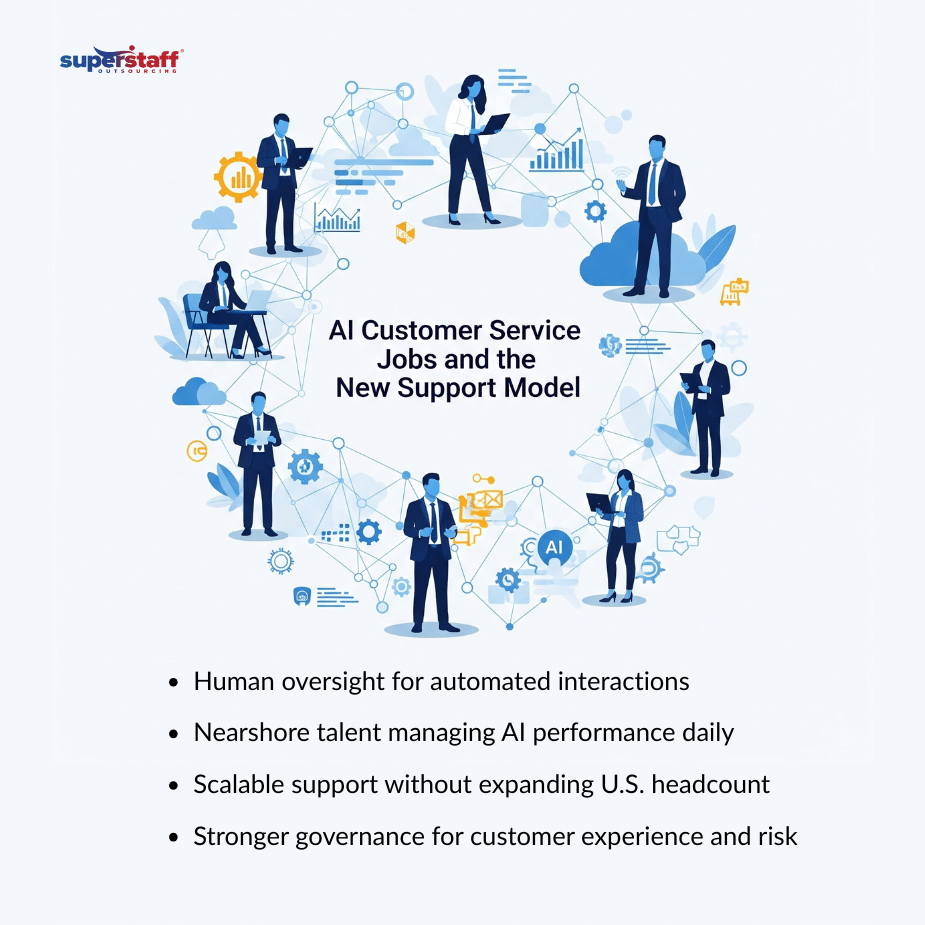
Colombia has developed a workforce that combines customer service experience with growing digital fluency. Many professionals already support North American businesses and understand U.S. service expectations. As AI tools enter support workflows, these workers are transitioning into AI customer service jobs that oversee platforms rather than replace them.
Education programs and employer-led training emphasize data interpretation, process compliance, and customer context. This prepares teams to manage customer experience and AI in tandem. The result is a workforce capable of supporting more complex service models.
Cost and Operational Efficiency for U.S. Companies
Cost structure plays a significant role in where AI customer service jobs are deployed. Colombia allows companies to staff specialized oversight roles at a lower operational cost than comparable U.S. positions. This matters as automation increases the need for monitoring, tuning, and quality assurance.
Savings do not come from cutting corners. They come from aligning labor costs with task complexity. U.S. companies can reinvest these savings into platform improvements and CX design while maintaining service standards.
Time Zone Alignment Improves Control
Time zone alignment strengthens how AI-enabled teams operate. Colombian teams work during overlapping U.S. business hours. This supports faster issue resolution and real-time collaboration.
Leaders can review AI performance daily. Escalations receive immediate attention. AI customer service jobs benefit from this proximity because oversight requires constant feedback loops. Distance creates risk. Alignment reduces it.
Governance and Risk Management
Automation introduces governance challenges. AI systems require oversight to ensure compliance, fairness, and accuracy. AI customer service jobs exist largely to manage this responsibility.
Teams review outputs, flag inconsistencies, and ensure brand guidelines are followed. They also manage handoffs between automated systems and human agents. This governance layer protects customer experience and reduces operational risk.
How U.S. Support Teams Are Evolving
As AI customer service jobs expand offshore, U.S. support teams shift toward higher-level responsibilities. Domestic teams focus on service strategy, platform selection, and performance metrics.
Execution moves closer to the systems. Oversight stays with leadership. This division allows U.S. teams to remain lean while increasing service capacity. It also improves decision-making by separating strategy from day-to-day task management.
Scaling Support Without Disruption
Demand volatility is a constant challenge. AI customer service jobs support scalability by allowing automation to absorb volume while humans manage exceptions. This balance prevents service degradation during spikes.
Colombian teams can scale faster than domestic hiring cycles allow. Training focuses on system logic and escalation rules rather than rote responses. This flexibility supports growth without operational stress.
Maintaining Customer Experience Standards
Customer experience depends on consistency. Poorly managed automation creates fragmented interactions. AI customer service jobs exist to prevent that outcome.
Teams ensure that automated responses align with brand tone. They manage transitions between systems and agents. This coordination keeps customer experience and AI aligned, even as automation expands across channels.
Workforce Sustainability and Retention
AI customer service jobs offer clearer career paths than traditional call center roles. Workers develop skills in analytics, quality management, and process optimization.
This improves retention and performance. Stable teams deliver more consistent service. For U.S. companies, workforce sustainability reduces retraining costs and operational churn.
What This Means for Outsourcing Strategy
The rise of AI customer service jobs signals a shift toward hybrid support models. Automation handles volume. Nearshore teams manage oversight. U.S. leaders retain strategic control.
This model reduces dependency on a single labor market. It also supports long-term resilience as technology and customer expectations evolve. An effective AI customer service workforce strategy for U.S. companies balances automation with human accountability.
What the Rise of AI Customer Service Jobs Signals for Support Leaders
The growth of AI customer service jobs in Colombia reflects how customer support is being redesigned around automation, governance, and scalability.
These roles allow U.S. companies to expand customer service and support automation while protecting service quality and operational control. As customer experience and AI become inseparable, support leaders must rethink workforce design, not just technology investment.
SuperStaff helps U.S. businesses build support models that combine human expertise with automation readiness. If your organization is evaluating how AI-enabled teams fit into your customer support strategy, explore how SuperStaff can help you design a scalable, disciplined, and future-ready operation.