From Labor Arbitrage to Intelligence Arbitrage: The New Era of AI in BPO
For years, outsourcing decisions focused on cost reduction. Labor arbitrage defined how companies scaled support functions and improved margins.
Today, that model is evolving. AI in business process outsourcing is shifting the conversation from cost to capability. Leaders are now evaluating how outsourced teams can drive faster decisions, improve service quality, and support growth through intelligent workflows.
This shift is shaping a new outsourcing model that prioritizes insight, execution, and long-term value.
The Shift From Cost Focus to Capability Focus
Outsourcing used to be measured by savings. That approach is no longer enough.
Organizations now expect partners to contribute to outcomes. They want faster turnaround times, better customer interactions, and stronger operational visibility. AI in business process outsourcing enables this shift by combining automation with human expertise.
Companies are no longer asking, “How much can we save?”
They are asking, “How much better can we perform?”
This change sets the stage for intelligence arbitrage.
What Intelligence Arbitrage Means for Business Leaders
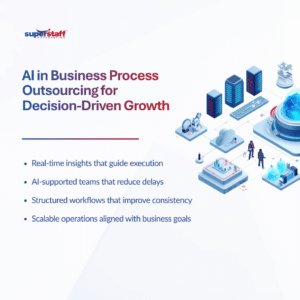
Intelligence arbitrage refers to accessing better decision-making capability through a combination of talent and technology.
Instead of relying only on lower-cost labor, companies tap into:
- AI-supported insights
- Process optimization
- Skilled offshore teams trained to interpret data
AI in BPO industry environments allows organizations to act on information faster. It reduces delays between data collection and execution.
As a result, outsourcing becomes a strategic function, not just an operational one.
How AI Is Reshaping Outsourced Operations
Executives often ask “how is AI used in business process outsourcing?” in practical terms.
The answer lies in workflow transformation.
AI supports:
- Automated ticket routing and prioritization
- Real-time sentiment analysis in customer support
- Predictive analytics for demand planning
- Intelligent document processing in back-office tasks
AI in business process outsourcing improves both speed and accuracy. It reduces manual workload while allowing teams to focus on higher-value activities.
This creates more consistent outcomes across functions.
The Role of Human Expertise in AI-Driven BPO
AI does not replace people. It enhances how they work.
Offshore teams remain critical because they:
- Interpret AI-generated insights
- Handle exceptions and complex cases
- Maintain quality control
- Deliver personalized customer interactions
AI in business process outsourcing works best when paired with trained professionals. Human input ensures that decisions remain aligned with business goals.
This balance strengthens both efficiency and accountability.
Why SMEs and Midmarket Firms Are Adopting This Model
Large enterprises have invested in AI for years. Smaller firms are now catching up.
AI outsourcing services make advanced capabilities accessible without heavy upfront investment. This is especially relevant for SMEs and midmarket companies that need to scale quickly.
Key drivers include:
- Limited internal resources
- Pressure to improve customer experience
- Need for faster decision cycles
AI in business process outsourcing allows these companies to compete with larger players while maintaining operational control.
Operational Benefits That Go Beyond Cost Savings
Cost efficiency still matters. However, it is no longer the primary value.
Organizations adopting AI in business process outsourcing see improvements in:
- Response times
- Process consistency
- Error reduction
- Workforce productivity
These benefits compound over time. Faster workflows lead to better customer satisfaction. Improved accuracy reduces rework.
The result is a more stable and scalable operation.
Real Business Scenarios Where Intelligence Arbitrage Delivers Value
Consider a healthcare support team handling patient inquiries.
AI can:
- Categorize requests
- Flag urgent cases
- Suggest next actions
Agents then step in to resolve issues with context already available.
In e-commerce, AI can:
- Predict order volumes
- Optimize staffing schedules
- Identify common customer concerns
AI in business process outsourcing ensures that teams are prepared before demand spikes.
These scenarios highlight how intelligence arbitrage improves both planning and execution.
Integration Challenges and How to Address Them
Adopting AI within outsourcing requires careful planning.
Common challenges include:
- Misalignment between tools and workflows
- Lack of training for offshore teams
- Poor data quality
To address these issues, companies should:
- Align AI tools with specific business objectives
- Invest in training and onboarding
- Establish clear performance metrics
AI in BPO industry environments succeeds when technology and operations are tightly integrated.
This requires collaboration between internal teams and outsourcing partners.
Choosing the Right Outsourcing Partner in the AI Era
Not all providers are equipped to support intelligence arbitrage.
Decision-makers should evaluate:
- Experience with AI-enabled workflows
- Ability to train and manage skilled teams
- Flexibility in scaling operations
- Understanding of industry-specific requirements
AI outsourcing services should not be treated as standalone solutions. They must be embedded into daily operations.
A strong partner ensures that AI delivers measurable results.
The Strategic Advantage of the Philippines in AI-Enabled BPO
The Philippines remains a leading destination for outsourcing.
Its strengths include:
- A highly skilled, English-proficient workforce
- Strong cultural alignment with U.S. businesses
- Established training systems for customer service and back-office roles
When combined with AI in business process outsourcing, these advantages become even more valuable.
Philippine teams are well-positioned to manage AI-supported workflows while maintaining high service standards.
This makes the country a strategic choice for companies transitioning to intelligence arbitrage.
Building a Future-Ready Outsourcing Strategy
Organizations need to rethink how they approach outsourcing.
A future-ready strategy should focus on:
- Integrating AI into core workflows
- Upskilling offshore teams
- Aligning outsourcing with business goals
AI in business process outsourcing is not a one-time implementation. It is an ongoing process that evolves with business needs.
Leaders who adopt this mindset are better positioned to handle change and maintain competitiveness.
Driving Value Through Intelligence Arbitrage
The shift from labor arbitrage to intelligence arbitrage reflects a broader change in how businesses operate. AI in business process outsourcing enables companies to move faster, make better decisions, and deliver more consistent outcomes. It combines the strengths of technology and human expertise to create a more effective outsourcing model.
SuperStaff supports this approach by integrating AI into its workflows while maintaining strong human oversight. This ensures that every process remains aligned with real business needs. Clients benefit from both efficiency and thoughtful execution.
If your organization is looking to improve performance, scale operations, and strengthen decision-making, now is the time to explore outsourcing solutions. Connect with SuperStaff to learn how AI-enabled teams can support your growth and help you stay competitive.