Search Without Friction: Building an AI Search Optimization Workflow That Converts Intent Into Action
Search behavior has changed. Buyers now expect answers that are fast, relevant, and easy to act on. This shift is forcing companies to rethink how they structure content, support journeys, and guide decisions.
An AI search optimization workflow helps organizations align search results with real user intent, turning discovery into measurable action.
For business leaders, this means building systems that do more than rank content. It means designing search experiences that move prospects forward with clarity and speed.
Why Search Friction Hurts Conversion
Search friction slows down decision-making. It creates gaps between what users want and what they find.
When results are unclear or irrelevant, users leave. They do not wait for better answers. They move to competitors who can provide faster clarity.
- Poor keyword alignment leads to mismatched content
- Long navigation paths reduce engagement
- Inconsistent messaging breaks trust
An AI search optimization workflow reduces these issues by mapping intent directly to outcomes. It ensures that every search interaction leads somewhere meaningful.
Transitioning from understanding friction to solving it requires a structured approach to intent.
Understanding User Intent at a Deeper Level
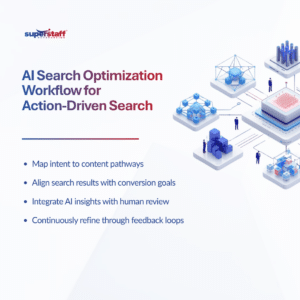
Intent is not just about keywords. It reflects what the user is trying to achieve at a specific moment.
Some users want information. Others want solutions. Many are ready to act but need validation.
An effective AI search optimization workflow identifies:
- Informational intent for early-stage research
- Comparative intent for evaluation
- Transactional intent for decision-making
Each intent type requires different content and support. Without this alignment, even strong content fails to convert.
Once intent is clear, the next step is structuring content around it.
Structuring Content Around Intent Signals
Content should follow the user’s decision path. It should not exist as isolated pieces.
An AI search optimization workflow organizes content into logical clusters. Each cluster supports a specific stage in the buyer journey.
- Awareness content introduces challenges and context
- Consideration content explains options and approaches
- Decision content provides clear next steps
This structure allows users to move forward without confusion. It also improves how search engines interpret relevance.
With structure in place, AI can enhance how content is delivered.
How AI Improves Search Relevance
AI analyzes patterns that manual processes cannot handle at scale. It studies behavior, context, and engagement signals.
Through an AI search optimization workflow, companies can:
- Adjust content ranking based on real-time behavior
- Personalize results based on user profiles
- Identify gaps where intent is not being met
These capabilities improve relevance. They ensure that users see what matters most to them.
However, relevance alone is not enough. Execution matters.
Connecting Search to Business Outcomes
Search should lead to action. It should not stop at information.
An AI search optimization workflow connects search results to business goals such as lead generation, conversion, and retention.
This requires:
- Clear calls to action aligned with intent
- Seamless transitions from content to engagement
- Consistent messaging across touchpoints
When search is tied to outcomes, it becomes a revenue driver rather than a support function.
To achieve this, internal alignment is critical.
Aligning Teams Around Search Strategy
Search optimization is not just a marketing task. It involves multiple teams.
Content, operations, customer support, and sales all play a role in delivering a consistent experience.
An AI search optimization workflow supports alignment by:
- Standardizing how content is created and updated
- Sharing insights across departments
- Defining clear ownership of search-related tasks
This alignment reduces duplication. It ensures that every team contributes to a unified experience.
Next, the workflow must be designed for continuous improvement.
Building a Feedback-Driven Workflow
Search behavior evolves. A static approach will not keep up.
An AI search optimization workflow should include feedback loops that track performance and adjust strategies.
Key areas to monitor include:
- Search queries and click patterns
- Content engagement and drop-off points
- Conversion paths and bottlenecks
These insights help refine content and improve outcomes over time.
With feedback in place, automation can scale the process.
Scaling Search Optimization Through Automation
Manual optimization cannot handle large volumes of content and data.
Automation allows businesses to maintain consistency while increasing efficiency.
An AI search optimization workflow uses automation to:
- Update metadata and content structures
- Recommend content improvements
- Route user queries to the right resources
This reduces operational load. It also ensures that updates happen quickly.
Still, automation must be balanced with human oversight.
Balancing AI with Human Expertise
AI provides speed and scale. Human teams provide context and judgment.
An effective AI search optimization workflow combines both.
- AI identifies patterns and opportunities
- Human teams validate insights and refine messaging
- Collaboration ensures accuracy and relevance
This balance is critical for maintaining quality. It also builds trust with users.
To sustain this approach, businesses need the right support structure.
Why Outsourcing Strengthens Search Workflows
Managing search optimization internally can stretch resources. It requires ongoing analysis, content updates, and technical adjustments.
Outsourcing provides access to specialized teams who can manage these tasks efficiently.
With the right partner, an AI search optimization workflow becomes easier to execute.
- Dedicated teams handle content updates and optimization
- Support teams ensure consistent user experience across channels
- Scalable resources adapt to changing demand
This approach allows internal teams to focus on strategy while execution is handled by experts.
Applying Search Optimization to Customer Experience
Search is part of the broader customer experience. It influences how users perceive a brand.
An AI search optimization workflow improves CX by:
- Reducing time to find answers
- Providing consistent information across channels
- Supporting faster decision-making
These improvements lead to higher satisfaction and stronger engagement.
As expectations continue to rise, companies must act with precision.
Turning Search Into a Strategic Advantage
Search optimization is no longer optional. It is a core part of how businesses compete.
An AI search optimization workflow enables companies to:
- Deliver relevant experiences at scale
- Align content with real business goals
- Convert intent into measurable outcomes
This approach shifts search from a technical function to a strategic asset.
Driving Action Through Smarter Search
Search is where many customer journeys begin. It shapes how users understand options and make decisions. An AI search optimization workflow ensures that these journeys are clear, efficient, and aligned with business goals.
Companies that invest in structured workflows can reduce friction, improve engagement, and increase conversions. They create experiences that guide users forward instead of leaving them to navigate alone.
SuperStaff supports this transformation by combining AI-driven processes with skilled human teams. While AI enables speed and insight, human input ensures accuracy, clarity, and consistency across every interaction.
If your organization is looking to improve search performance and convert intent into action, now is the time to explore how outsourcing can support your goals. Connect with SuperStaff to learn how tailored solutions can help you build and execute an effective AI search optimization workflow.