
Customer expectations have shifted. Speed matters, clarity matters, and language matters more than many leaders realize. As U.S. companies expand into new markets or serve more diverse customer bases, communication gaps become operational risks. That reality is pushing more decision makers to rethink how they structure help desk outsourcing solutions.
Colombia has emerged as a strong nearshore option, not just because of location or cost, but because of its bilingual workforce. Spanish and English fluency is no longer a nice-to-have. It is becoming a baseline requirement for reliable support delivery.
For U.S. SMEs and midmarket firms, this shift creates an opportunity to scale smarter without adding friction.
Why Language Capability Now Shapes Help Desk Performance
Every help desk interaction is a moment of truth. Customers contact support when something is not working, not clear, or not resolved. If language slows that interaction, resolution time increases and satisfaction drops.
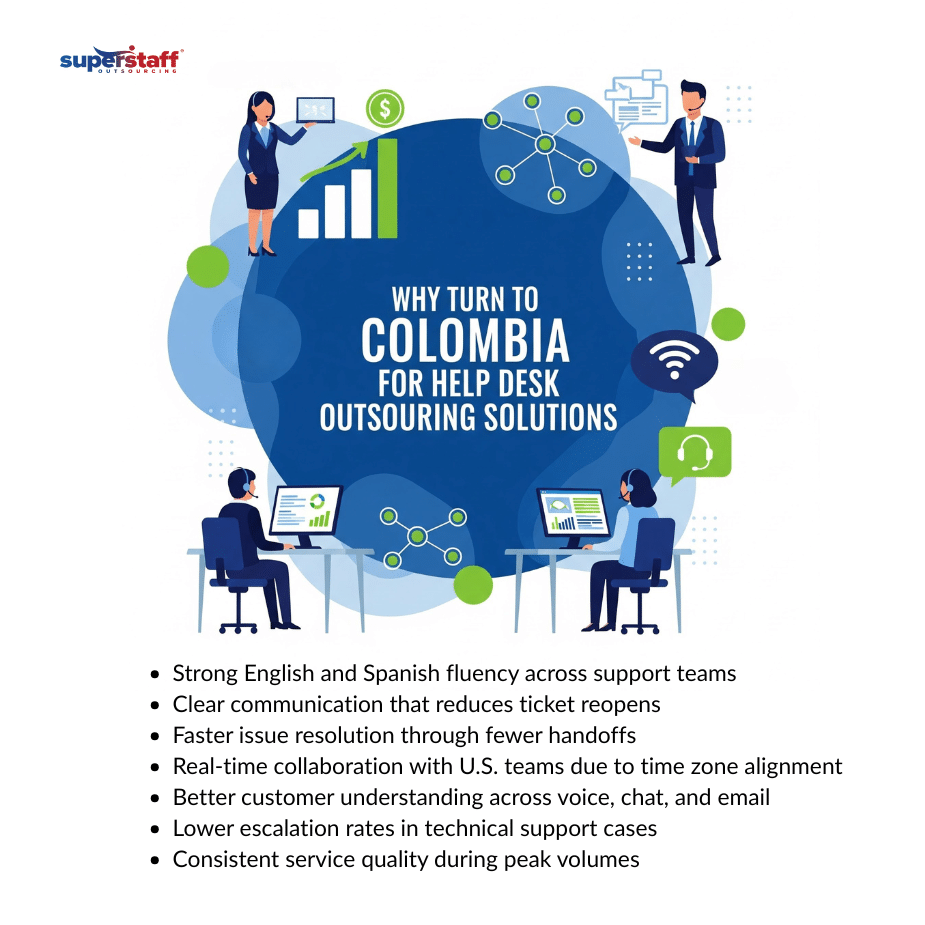
Bilingual agents reduce that risk. They eliminate the need for handoffs between language queues. They also prevent misunderstandings that often lead to repeat tickets.
In many help desk outsourcing solutions, language support is treated as an add-on. In Colombia, it is often built into the talent pool itself. That difference changes how support teams operate day to day.
Clear communication leads to faster diagnosis. Faster diagnosis leads to faster resolution. That sequence directly affects customer perception.
Colombia’s Bilingual Talent Advantage
Colombia’s education system and professional services sector have produced a growing base of bilingual professionals. Many agents have experience supporting North American customers across technical, retail, healthcare, and SaaS environments.
Time zone alignment strengthens that advantage. Agents can collaborate in real time with U.S.-based teams. Issues do not wait overnight for clarification. Escalations move faster.
When bilingual capability and time alignment come together, help desk outsourcing solutions become more responsive and more predictable.
This model supports consistency, which is often more valuable than raw speed alone.
Operational Benefits for U.S. Support Teams
Bilingual agents do more than translate. They contextualize issues based on cultural and operational understanding. That skill reduces friction in complex support cases.
For U.S. companies using outsourced customer support services, this translates into measurable operational benefits.
- Fewer reopened tickets due to miscommunication
- Lower average handle times without rushing calls
- Smoother escalation paths between tiers
- Better documentation quality in ticketing systems
Each of these outcomes supports scalability. As ticket volumes grow, process stability becomes critical. Language clarity helps maintain that stability.
Over time, help desk outsourcing solutions built around bilingual talent tend to show stronger consistency across peak and off-peak periods.
Supporting Multichannel and Omnichannel Help Desks
Modern help desks no longer rely on voice alone. Customers expect support through chat, email, portals, and social platforms. Each channel introduces its own language challenges.
Bilingual agents handle these transitions more smoothly. Written communication requires nuance. Tone, clarity, and brevity matter as much as technical accuracy.
In bilingual call center services, agents are trained to adjust language style based on channel. That adaptability protects brand voice across touchpoints.
As a result, help desk outsourcing solutions in Colombia often integrate more easily with omnichannel strategies already in place at U.S. firms.
Reducing Escalation Risk in Technical Support
Technical help desks face higher stakes. A single misunderstanding can lead to downtime, data issues, or frustrated internal users.
Bilingual agents reduce escalation risk by asking clearer questions early in the interaction. They confirm understanding before moving forward. This approach limits assumptions.
For IT leaders evaluating help desk outsourcing solutions, this matters. Fewer escalations mean internal teams stay focused on higher-value work.
Over time, organizations see a shift. Support becomes a stabilizing function rather than a reactive one.
Customer Experience Gains Through Language Precision
Customer experience is shaped by small moments. Being understood is one of them. Customers who can explain an issue in their preferred language feel more confident in the process.
That confidence directly helps with improving customer experience with bilingual support agents. Resolution feels collaborative instead of transactional.
In cross-border markets or multilingual user bases, bilingual capability becomes essential. It allows companies to serve broader audiences without fragmenting their support structure.
This is where help desk outsourcing solutions move from cost control to experience enablement.
Scaling Support Without Adding Complexity
Growth often exposes weaknesses in support models. New markets bring new languages. New products bring new technical demands.
Bilingual help desk teams in Colombia allow companies to scale coverage without duplicating infrastructure. One team can support multiple regions. One workflow can serve multiple languages.
That simplicity matters for midmarket firms that cannot afford overly complex support architectures.
As volume grows, help desk outsourcing solutions anchored in bilingual talent remain manageable and resilient.
Compliance and Process Discipline in Nearshore Support
Language skill alone is not enough. Process discipline matters just as much. Colombian help desk teams supporting U.S. clients are often trained in structured ticketing, documentation standards, and security protocols.
This combination supports industries with higher compliance needs, including healthcare, fintech, and SaaS.
When bilingual agents follow clear workflows, help desk outsourcing solutions become easier to audit, optimize, and improve over time.
That predictability is critical for executive teams accountable for service performance.
Where SuperStaff Fits Into This Model
SuperStaff works with U.S. SMEs and midmarket companies to design support teams that align with real operational needs. While our roots are in the Philippines, our nearshore capabilities in Colombia extend that value.
We focus on building bilingual teams that integrate smoothly with existing systems. Training emphasizes clarity, accountability, and consistency.
Our approach to help desk outsourcing solutions prioritizes long-term partnership, not short-term fixes.
Clients gain access to bilingual agents who understand both the technical and human sides of support.
Help Desk Outsourcing Solutions: Making the Right Move Forward
Choosing a help desk partner is a strategic decision. Language capability, time zone alignment, and operational maturity all play a role.
Colombia’s bilingual workforce offers a compelling option for U.S. companies looking to strengthen customer support without adding internal strain.
When designed correctly, help desk outsourcing solutions improve performance, protect customer experience, and support growth. If you are exploring ways to modernize your support model, SuperStaff can help you assess whether bilingual nearshore teams are the right fit.
Talk to us about building a help desk operation that scales with your business and supports your customers with clarity and confidence.