Artificial intelligence is changing the type of work companies need. However, the bigger question for the Philippines is not simply whether AI will replace some tasks. It is whether the country can create enough higher-value work around the technology.
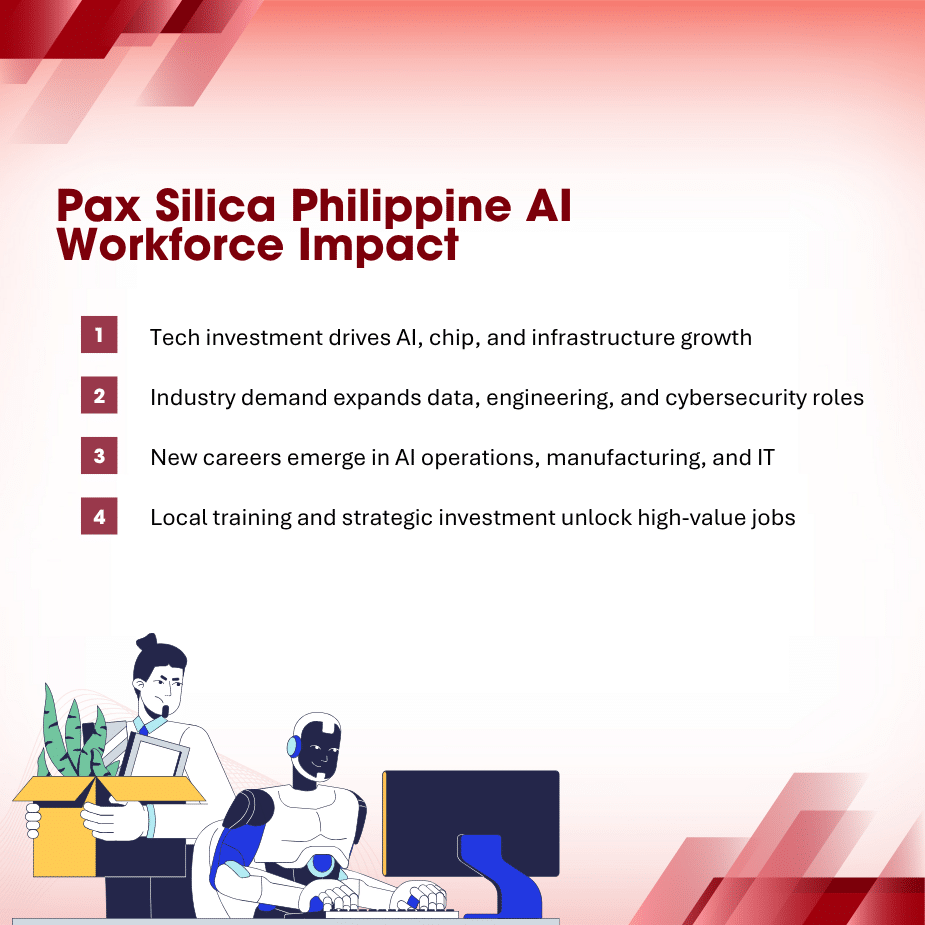
Pax Silica may become part of that answer. The Philippines joined the U.S.-led initiative in April 2026, with plans for an AI-focused industrial hub in New Clark City. The project could connect semiconductors, advanced manufacturing, AI infrastructure, logistics, and research in one location.
That could open new AI jobs in the Philippines. Still, job numbers alone will not determine success. The quality of those jobs, the skills Filipinos need, and access to those opportunities will matter just as much.
Where AI Jobs in the Philippines Could Grow
Pax Silica covers much more than software development. Because the planned hub connects AI with manufacturing and infrastructure, employment could spread across several technical fields.
1. AI Development and Data Roles
Companies operating in the hub could need AI developers, data analysts, machine learning specialists, and data engineers. These workers could build systems, prepare data, test models, and manage AI tools.
However, companies may also need people who understand business processes. Therefore, opportunities could extend beyond highly specialized AI engineers.
2. Semiconductor Engineering
AI systems depend heavily on semiconductors. Since Pax Silica includes semiconductor supply chains, the project could support jobs in electronics engineering, chip testing, quality control, and related production work.
The Philippines already has an established semiconductor and electronics export sector. New investment could build on existing skills and industrial experience while creating opportunities in the country’s evolving technology sector.
3. Advanced Manufacturing
The proposed hub could also create work in automated manufacturing. Engineers, technicians, equipment specialists, and maintenance teams may support factories using AI-enabled systems.
At the same time, factories will still need people to monitor equipment and solve production problems. As a result, technical training could become increasingly important.
4. AI Infrastructure
AI requires computing infrastructure, reliable networks, power systems, and secure digital environments. This could create work for network engineers, cloud specialists, cybersecurity professionals, and infrastructure technicians.
These roles may not involve building AI models directly. However, they provide the technical systems that allow AI operations to function.
5. Research and Technical Support
Pax Silica could also connect businesses with universities and research institutions. Such partnerships may create opportunities for researchers, laboratory staff, technical consultants, and project teams.
Moreover, research partnerships could help Filipino graduates gain practical experience before entering full-time technology roles.
What Could Turn Plans Into Real Jobs?
Large investment figures can attract attention, but investment does not automatically create lasting careers. Several conditions will affect whether Pax Silica creates meaningful AI jobs in the Philippines.
1. Skills Must Match Employer Needs
Universities and training institutions may need to update programs as employer requirements become clearer. AI, electronics, cybersecurity, data science, robotics, and advanced manufacturing could receive greater attention.
Short technical programs could also help existing workers. Therefore, reskilling should include both new graduates and experienced professionals.
2. Companies Need Reasons to Invest
Pax Silica will need companies that actually build facilities, hire teams, and maintain operations in the Philippines. At least 20 firms had expressed interest in the wider Luzon Economic Corridor by May 2026.
However, interest is different from completed investment. Infrastructure, regulation, operating costs, talent availability, and long-term policy will influence final business decisions.
3. Local Businesses Need Access
Large foreign companies may become major employers, but Filipino businesses could also participate. Local firms could provide software, technical support, logistics, engineering, cybersecurity, recruitment, and other services.
These opportunities may also extend to companies that need outsourced technical support and business operations to serve clients or manage growing workloads. Local providers could benefit if they develop the skills and systems required by technology-focused businesses.
4. Training Must Reach More Workers
AI opportunities should not remain limited to workers who already have advanced technical backgrounds. Training programs could provide different entry points based on education and experience.
For example, some workers could train for data operations or technical support. Others could move into engineering, programming, cybersecurity, or AI system management.
5. Job Quality Needs Attention
BCDA has said the proposed project could generate more than 130,000 high-quality jobs once fully developed. Still, the final number and type of jobs will depend on the companies and projects that move forward.
Therefore, policymakers should look beyond headline employment totals. Wages, career growth, worker protection, training, and long-term demand should also form part of the discussion.
Could BPO Workers Find New Opportunities?
The Philippine outsourcing sector already employs workers with experience in customer service, healthcare, finance, IT support, data processing, and back-office operations. Some of these skills could support the next stage of AI-enabled services.
1. Human-in-the-Loop AI Work
AI systems often need people to review results, handle unusual cases, and check accuracy. This can create human-in-the-loop roles that combine AI tools with human judgment.
For BPO companies, this could mean moving some teams from routine processing toward AI review and quality management. Human-in-the-loop teams can help with AI output validation, quality assurance, and exception handling.
2. Data Quality and Validation
AI models depend on usable data. Therefore, companies may need teams that review, organize, classify, and validate information.
BPO providers already manage large volumes of business data. With added training, some workers could move into specialized data quality roles.
3. AI-Assisted Customer Operations
Customer service may also change as AI handles simple requests. Human agents could then focus on complex cases, complaints, sensitive concerns, and decisions requiring judgment.
Consequently, AI jobs in the Philippines may include existing roles that develop new technical responsibilities rather than entirely new job titles.
4. Technical Outsourcing
Pax Silica could attract companies that need IT support, software testing, cybersecurity monitoring, cloud operations, and engineering support. Philippine outsourcing firms could compete for some of this work.
However, providers may need stronger technical teams and specialized training to meet these requirements.
5. New Career Paths for BPO Talent
Experienced BPO employees already understand processes, clients, quality standards, and service delivery. Additional AI skills could help some move into automation management, AI operations, data quality, or process design.
Therefore, the BPO sector does not necessarily sit outside the Pax Silica opportunity. It could become part of the supporting service network around AI investment.
What Could Limit the Employment Impact?
Pax Silica offers possible opportunities, but several issues could affect the final outcome. The project remains under development, and its first phase will take years to build.
- Skills gaps: Companies may struggle to hire locally if specialized training does not grow fast enough.
- Uneven access: Workers outside major technology and industrial centers may have fewer opportunities.
- Automation: Some AI investment may reduce certain routine jobs while creating specialized roles elsewhere.
- Infrastructure needs: Advanced facilities require dependable power, connectivity, transport, and other support systems.
- Project execution: Employment forecasts depend on investment commitments becoming operating businesses.
Environmental and community concerns also require attention as planning continues. Philippine officials have said project components must follow environmental rules and secure required approvals before construction. BCDA’s projected employment figures for the proposed Pax Silica development represent potential outcomes rather than guaranteed results.
Therefore, the discussion should consider both economic opportunities and how the project will operate in practice.
More AI Careers Need the Right Support
Could Pax Silica create more AI jobs in the Philippines? It has the potential to do so, especially if the project attracts long-term investment in semiconductors, AI infrastructure, advanced manufacturing, and related services.
However, the final impact will depend on execution. Training, local business participation, infrastructure, responsible development, and access to quality employment will determine how widely Filipinos benefit.
For outsourcing companies, this shift may also create new service opportunities. SuperStaff helps businesses build skilled outsourcing teams for changing operational and technology needs. As AI changes business processes, companies can combine technology with trained people to maintain quality, accuracy, and customer support.
Businesses planning to scale their teams can contact SuperStaff to discuss their outsourcing needs.