AI can reduce the time people spend on repetitive tasks. However, the savings can shrink when companies add too many review steps, too many people, or unclear approval rules. This creates a practical question for businesses that use automation: does human-in-the-loop support AI cost reduction, or does it simply add another layer of expense?
The answer depends on how companies use people in the process. Human review can prevent costly errors, improve quality, and handle cases that AI cannot manage well. However, it can also increase labor costs when every output requires manual approval. The goal should not be to remove people completely. Instead, businesses need to place human review where it protects quality, limits risk, and supports better use of automation.
Where Human Review Can Reduce Costs
Human oversight may appear to add expense at first. However, it can support AI cost reduction when it prevents errors, repeated work, and poor decisions. A well-designed human-in-the-loop model for AI operations helps businesses focus human effort on tasks where judgment and quality control matter most.
1. Preventing Expensive AI Errors
AI can make mistakes even when it produces confident answers. A wrong output may cause billing problems, customer complaints, compliance issues, or incorrect business decisions.
Human reviewers can catch high-risk mistakes before they move further into the process. As a result, companies may spend less on corrections, refunds, rework, and issue resolution.
2. Reducing Rework
Poor AI output often creates additional work later. Teams may need to correct customer records, rewrite responses, fix data, or review failed transactions.
Therefore, a short review step can sometimes cost less than fixing a larger problem later. Businesses should compare the cost of review against the cost of repeated errors.
3. Protecting Customer Experience
Automation can reduce service costs, but poor responses can increase complaints and escalations. Customers may contact support again when AI gives incomplete or incorrect answers.
Human agents can step in when the system detects a complex request. This can reduce repeat contacts while keeping simple questions automated.
4. Improving AI Accuracy Over Time
Human reviewers can correct weak outputs and record common errors. Technical teams can then use this information to improve prompts, workflows, or system rules.
Over time, the AI may handle more tasks correctly without help. Therefore, human feedback can support lower operating costs when businesses use it to improve the system.
5. Handling Exceptions Efficiently
AI works well when tasks follow clear patterns. However, unusual cases can create delays when the system cannot decide what to do.
Instead of forcing the AI to handle every situation, companies can route exceptions to people. This keeps routine tasks automated while human attention stays focused on cases that need judgment.
When Human in the Loop Adds Cost
Human oversight does not always improve efficiency. Poorly designed workflows can slow operations and weaken AI cost reduction.
1. Reviewing Every AI Output
Some companies require people to approve every result generated by AI. This approach can remove much of the labor savings that automation provides.
Instead, businesses should identify which tasks actually need review. Low-risk and predictable outputs may not require the same level of oversight as financial or customer-sensitive decisions.
2. Using Too Many Review Layers
A process becomes expensive when several people check the same output without a clear reason. Multiple approval steps can increase labor costs and slow completion times.
Companies should assign each review step a specific purpose. If one trained reviewer can manage the risk, additional approvals may not provide enough value.
3. Relying on Manual Work Too Long
Human in the loop can help during early AI deployment. However, businesses may continue using manual checks even after the system becomes more accurate.
Regular performance reviews can show whether some controls are no longer necessary. As confidence improves, companies may reduce review rates and allow more automated processing.
4. Sending Low-Risk Tasks to Specialists
Highly trained employees usually cost more than general operations staff. Using specialists to review simple AI outputs can increase operating expenses.
Instead, companies can match reviewer skills to task complexity. Specialists can focus on difficult cases while trained support teams manage basic validation.
5. Failing to Measure Review Costs
Businesses may add human oversight without tracking how much it costs. As a result, they may not know whether the process actually saves money.
Companies should monitor review time, labor cost, error rates, and correction costs. These numbers help determine whether human involvement still supports AI cost reduction. Clear outsourcing cost and service considerations can also help businesses evaluate the resources needed to support their operations.
How to Balance Automation and Human Input
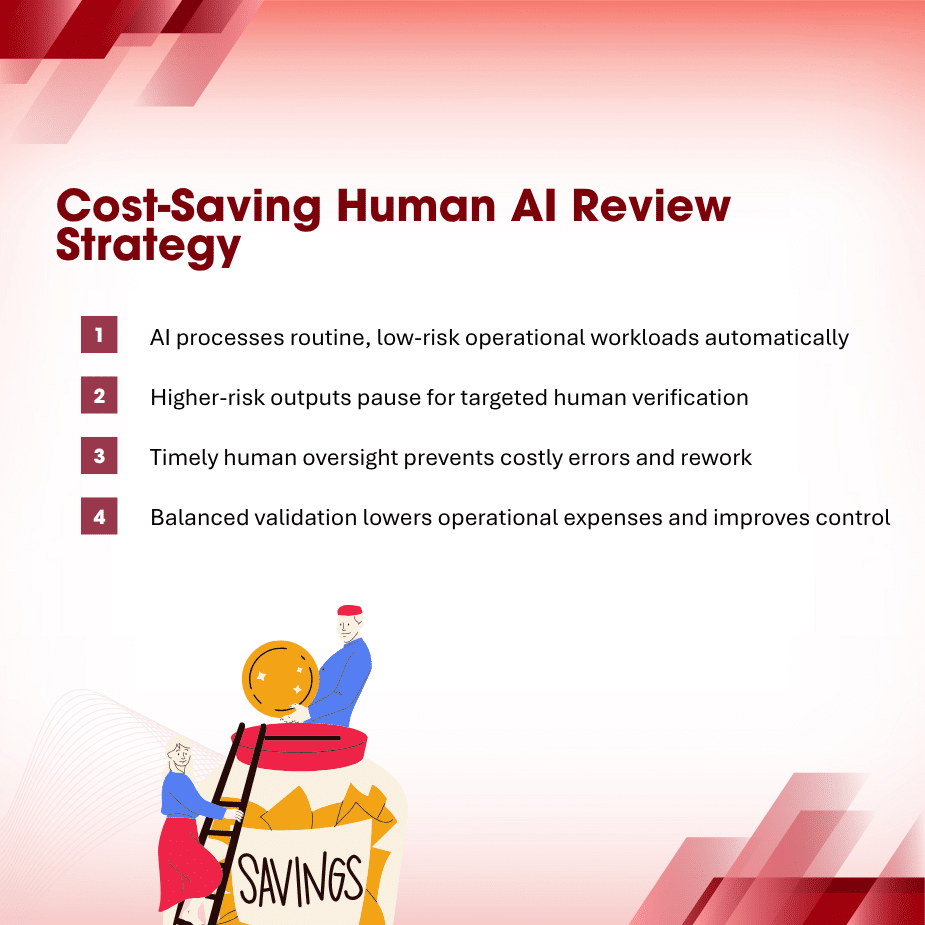
The most effective approach usually sits between full automation and full manual control. Businesses can build a process that sends only selected cases to people.
1. Classify Tasks by Risk
Companies can divide AI tasks into different risk levels. Routine work can run with little oversight, while higher-risk actions receive closer review.
For example:
- Low risk: Categorizing support tickets
- Medium risk: Drafting customer replies
- High risk: Approving refunds or account changes
This structure helps teams spend human time where errors may create larger costs. The NIST AI Risk Management Framework also provides guidance for identifying, assessing, and managing AI-related risks.
2. Use Confidence Thresholds
Many AI systems can provide confidence scores or other signals that show uncertainty. Businesses can use these signals to decide when human review is needed.
For example, high-confidence results may move forward automatically. Meanwhile, lower-confidence outputs can go to a reviewer before the company takes action.
3. Sample Instead of Reviewing Everything
Quality teams do not always need to inspect every AI result. Instead, they can review a sample of completed work to identify patterns and recurring problems.
This approach reduces labor costs while maintaining some level of quality control. It also helps teams detect whether system performance changes over time.
4. Create Clear Escalation Rules
Employees need to know when they should take over from AI. Companies can create triggers for complaints, sensitive information, high-value transactions, or unusual customer requests.
Clear rules make the process faster and more consistent. They also prevent staff from reviewing low-risk work without a clear reason.
5. Improve the Process With Data
Human review should produce useful information. Companies can track why reviewers reject AI outputs, which errors repeat, and where most escalations happen.
Teams can then improve the automated workflow using this data. Therefore, the review process can gradually reduce the amount of manual work required.
Where HITL Supports Long-Term Savings
Human in the loop works best when companies treat it as part of process design rather than a permanent manual checkpoint.
Customer Support
AI can answer simple questions, summarize conversations, and suggest responses. Human agents can then handle complaints, sensitive requests, or cases that require more context.
This setup can reduce the number of routine interactions handled by people. At the same time, customers still receive human support when automation reaches its limits.
Data Processing
AI can classify, extract, and organize large amounts of information. However, teams may still need to review unclear records or incorrect fields.
Businesses can route only uncertain cases to human reviewers. This approach supports scale without requiring people to check every record.
Finance Operations
AI can assist with invoices, expenses, payment reviews, and fraud alerts. Human teams can review unusual transactions or high-value decisions.
As a result, companies can automate repetitive work while keeping control over actions that may create financial risk.
Content and Quality Review
AI can draft content, summarize documents, and organize information. However, human reviewers can check accuracy, tone, compliance, and brand requirements before publication.
The cost benefit depends on the review level. A short quality check may support AI cost reduction, while full manual rewriting may remove much of the savings.
Use Human Review Where It Saves More
Human in the loop can either help or hurt AI cost reduction. The difference comes from where businesses place people, how often they require review, and whether they use human feedback to improve the system.
Too much oversight can slow work and raise labor costs. However, too little oversight can create expensive errors, customer problems, and repeated work. A balanced model allows AI to handle routine tasks while people focus on exceptions, sensitive cases, and higher-risk decisions.
SuperStaff helps businesses build outsourcing teams that support human-in-the-loop operations, data review, quality assurance, customer support, and AI-assisted workflows. Companies can combine automation with trained people while maintaining control over quality and costs.
Businesses looking to manage labor expenses while maintaining reliable operations can explore outsourcing solutions for their business needs and identify where additional support could improve efficiency. For tailored assistance, contact SuperStaff to discuss outsourcing options for AI-enabled operations and long-term cost reduction.