U.S. employers are rethinking how they hire. Labor markets remain tight. Internal recruitment teams are stretched. Agency fees continue to rise. In response, many leaders are reassessing the outsourcing recruitment process as a long-term operating model rather than a short-term fix.
Colombia has emerged as a key factor in that shift. Not because it is cheaper alone. Because it changes how recruitment economics work in practice.
Why Recruitment Economics Are Under Pressure in the U.S.
Recruitment costs have increased across the board. Salaries for experienced recruiters are higher. Agency fees remain significant. Time-to-fill continues to affect revenue and productivity.
When roles stay open, teams absorb extra work. Growth slows. Hiring managers lose confidence in the process. These hidden costs push leaders to look beyond traditional hiring structures and reconsider outsourcing recruitment process models that deliver predictability.
What Recruitment Process Outsourcing Was Meant to Fix
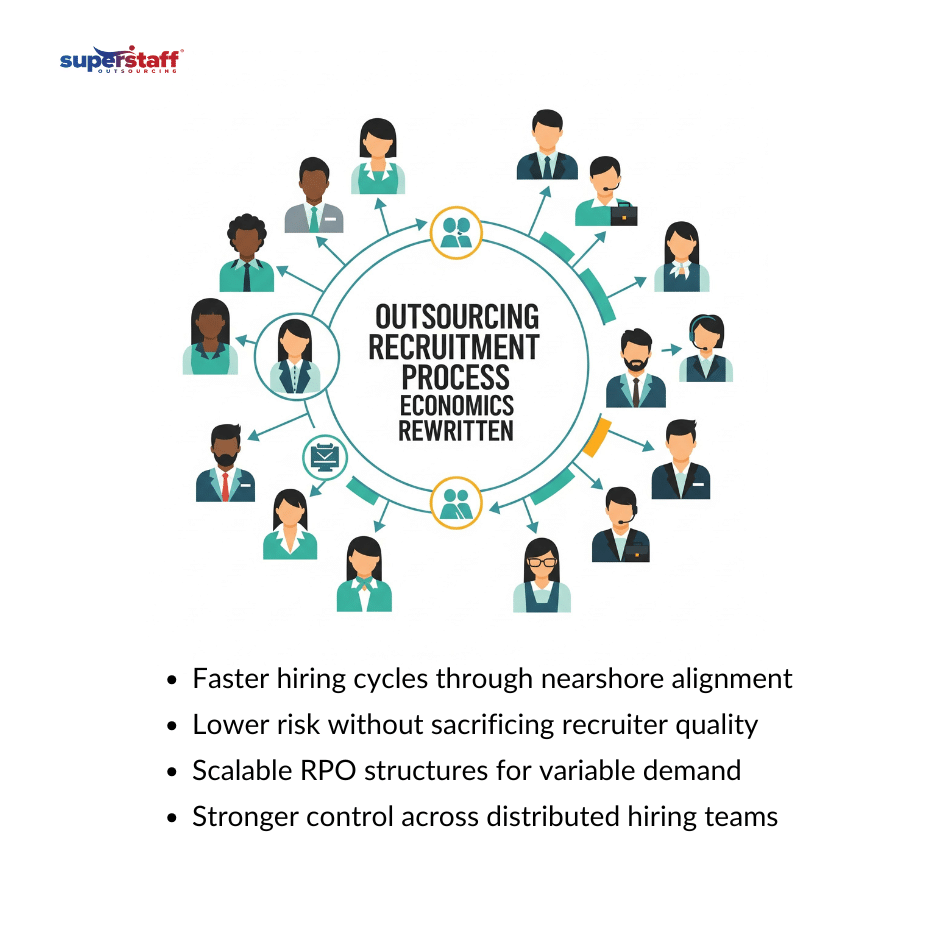
Recruitment process outsourcing was designed to stabilize hiring. The goal was consistency, scale, and measurable outcomes. Many early models focused narrowly on labor arbitrage.
That approach often failed. Poor alignment, slow communication, and fragmented delivery limited results. The lesson was clear. An effective outsourcing recruitment process requires operational alignment, not just lower costs.
Why Colombia Changes the Cost Structure
Colombia offers a different equation. Professional labor costs are competitive, but capability remains high. Recruiters are trained to work with U.S. stakeholders and complex hiring requirements.
Nearshore proximity reduces delays. Decisions move faster. Hiring cycles tighten. This is where how Colombia is changing recruitment outsourcing economics becomes visible in daily operations.
Time Zone Alignment as an Economic Lever
Time zone alignment reduces friction. Recruiters and hiring managers operate on the same business day. Feedback happens in hours, not days.
Candidate shortlists move faster. Interviews schedule sooner. Offers are extended without unnecessary pauses. This operational speed improves the outsourcing recruitment process in ways that cost comparisons alone cannot explain.
Colombia’s Talent Profile and Recruiter Capability
Recruiters in Colombia often support multinational clients. They are accustomed to structured sourcing, screening, and reporting. English proficiency supports direct communication with U.S. teams.
This capability allows remote recruiters to function as embedded partners. The outsourcing recruitment process feels integrated rather than external. Quality improves because context is preserved.
Remote Hiring Process Outsourcing Without Control Loss
Executives worry about losing visibility. That concern is valid. Remote hiring process outsourcing succeeds only when governance is intentional.
Clear intake processes, shared metrics, and regular reviews keep teams aligned. Colombia-based recruiters adapt well to this structure. Control remains with the employer, while execution scales efficiently.
RPO Solution Design That Scales With Demand
Hiring demand fluctuates. Growth phases require speed. Slow periods require flexibility. A rigid internal team struggles to adapt.
A well-designed RPO solution using Colombia allows companies to scale recruiters up or down without restructuring. The outsourcing recruitment process becomes elastic, protecting both budgets and momentum.
Risk Reduction Through Nearshore RPO
Risk matters as much as cost. Data security, compliance, and communication failures can erase savings quickly.
Nearshore delivery reduces these risks. Oversight is easier. Cultural alignment improves clarity. For many U.S. employers, Colombia offers a safer outsourcing recruitment process compared to distant offshore models.
How Colombia Is Changing Recruitment Outsourcing Economics in Practice
The impact appears over time. Hiring cycles stabilize. Candidate pipelines stay active. Hiring managers regain confidence.
Recruitment becomes predictable rather than reactive. This is the practical outcome of how Colombia is changing recruitment outsourcing economics across industries.
Where Colombia Fits Within a Global RPO Strategy
Colombia works best as part of a blended model. Nearshore recruiters handle sourcing and screening. Offshore teams manage coordination and reporting.
SuperStaff helps companies design this structure intentionally. By combining regions, employers create a resilient outsourcing recruitment process that supports growth without overextension.
A Smarter Way to Rethink Recruitment Outsourcing
Colombia is reshaping how U.S. employers evaluate the outsourcing recruitment process. Nearshore alignment improves speed, control, and long-term efficiency. The economics extend beyond labor costs into operational performance.
SuperStaff helps organizations design recruitment models that scale intelligently through a disciplined outsourcing recruitment process. Explore how SuperStaff can support your hiring strategy with structured, reliable recruitment outsourcing built for growth.