
Hiring used to happen within a company’s immediate surroundings. Businesses placed job ads in local newspapers, interviewed candidates nearby, and built teams from the same city or region. Many organizations believed this approach was the only practical way to grow a workforce.
Over time, business operations expanded beyond local borders. Companies began serving customers in different regions, countries, and time zones. As a result, hiring strategies also started to evolve.
New technology, remote collaboration tools, and digital communication platforms opened the door to new staffing models. Organizations could suddenly hire professionals who were thousands of miles away. Because of this shift, many companies adopted global workforce solutions to access skilled talent across different markets.
Modern staffing strategies now focus on flexibility, scalability, and access to specialized talent. Businesses are no longer limited to one location when building teams.
How Traditional Hiring Models Worked
For many decades, companies followed a simple hiring formula. They recruited employees from the same city or nearby areas.
Local hiring had several advantages:
- Easier interviews and onboarding
- Familiarity with local labor regulations
- Face to face communication
- Stronger community connections
However, this model also created limitations.
1. Limited Talent Pool
Companies could only hire people who lived nearby. As a result, businesses often struggled to find candidates with specialized skills.
2. Higher Labor Costs
Local labor markets sometimes had higher wage expectations. Smaller companies found it difficult to compete with larger employers in the same region.
3. Staffing Challenges During Growth
Expanding quickly required hiring many employees within a short period. Local talent shortages often slowed business growth.
Because of these limitations, organizations began exploring alternative hiring approaches.
The Rise of Global Workforce Solutions
Digital transformation changed how businesses operate. Communication tools such as video conferencing, cloud platforms, and project management software allowed teams to work together from different locations.
Because of these advancements, global workforce solutions became a practical strategy for building modern teams.
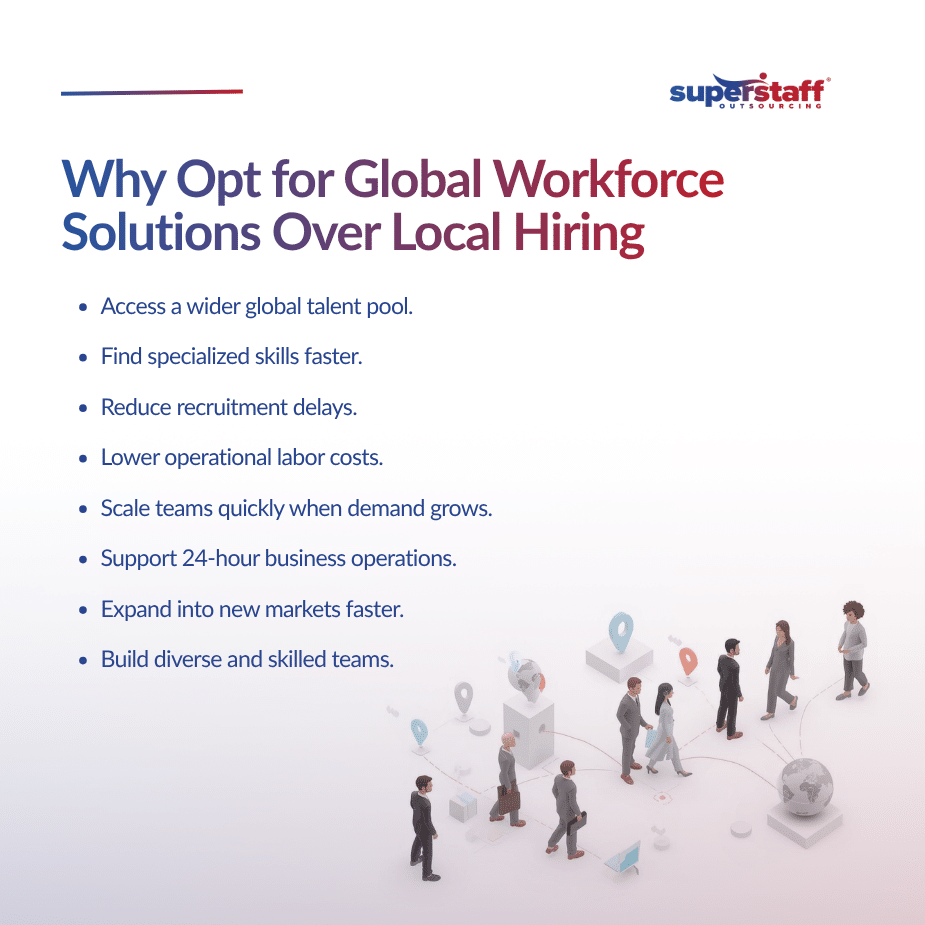
Companies discovered that hiring talent across borders provided several advantages:
- Access to specialized professionals
- Faster hiring cycles
- Flexible workforce scaling
- Reduced operational costs
As a result, global workforce solutions became a preferred strategy for companies looking to expand efficiently.
Many organizations now combine local hiring with global workforce solutions to build stronger and more diverse teams.
Key Drivers Behind Global Staffing Strategies
Several factors pushed companies toward global workforce solutions.
1. Technology and Remote Work Tools
Cloud platforms and collaboration software allow teams to communicate easily. Employees can now complete tasks, attend meetings, and manage projects without being physically present.
Because of this connectivity, companies can successfully implement global workforce solutions while maintaining productivity.
2. Access to Specialized Skills
Certain industries require niche expertise. Finding professionals with these skills locally can be difficult.
However, global workforce solutions allow companies to hire skilled professionals from international talent hubs.
Examples include:
- IT developers
- healthcare support staff
- finance specialists
- data analysts
- multilingual customer service agents
This access to specialized talent helps companies improve operational efficiency.
3. Workforce Flexibility
Market demand often changes quickly. Businesses may need additional staff during peak seasons or product launches.
With global workforce solutions, companies can scale teams up or down depending on operational needs.
This flexibility helps organizations remain competitive in dynamic markets.
4. Cost Efficiency
Hiring internationally often reduces labor costs without lowering quality standards.
Many companies adopt global workforce solutions to manage expenses while maintaining strong performance.
Operational savings can then be reinvested into business growth.
Common Roles in Global Workforce Solutions
Modern outsourcing and remote staffing models support many business functions. Organizations often use global workforce solutions to strengthen both operational and strategic roles.
Examples include:
- Customer support agents
- Technical support specialists
- Multilingual service representatives
- Data entry professionals
- Finance and accounting assistants
- HR administrative staff
- Software developers
- IT help desk teams
- Data annotation specialists
- Vendor management support
- Compliance monitoring staff
- Operations analysts
Through global workforce solutions, businesses can build distributed teams that support multiple departments.
The Strategic Benefits of Global Workforce Solutions
Adopting global workforce solutions offers long term advantages for growing companies.
Faster Market Expansion
Companies entering new markets often require multilingual support and regional expertise. Global teams help organizations serve international customers more effectively.
24 Hour Business Operations
Businesses operating across time zones can maintain continuous service.
For example:
- customer service teams provide round the clock support
- IT teams monitor systems overnight
- operations staff handle regional requests during different shifts
Because of this structure, global workforce solutions help companies deliver consistent service worldwide.
Improved Workforce Diversity
Hiring internationally brings together employees from different cultures and professional backgrounds.
Diverse teams often contribute new perspectives and innovative ideas. Organizations that adopt global workforce solutions benefit from this wider range of insights.
Operational Resilience
Companies that rely on a single location may face disruptions during economic shifts, natural events, or workforce shortages.
However, global workforce solutions allow organizations to distribute operations across multiple regions. This structure improves business continuity and stability.
Building a Successful Global Workforce Strategy
Organizations must plan carefully when implementing global workforce solutions. A structured approach helps ensure successful integration of remote teams.
Key considerations include:
Clear Communication Systems
- Use collaboration tools for real time discussions
- Establish regular team meetings
- Document workflows and processes
Strong Management Practices
- Set clear performance expectations
- Provide structured onboarding programs
- Offer ongoing training and development
Reliable Outsourcing Partners
Working with experienced outsourcing providers simplifies global hiring.
These partners handle important tasks such as:
- recruitment and talent sourcing
- compliance with labor regulations
- payroll administration
- workforce management
Because of this support, companies can focus on strategic business activities.
Why Businesses Are Choosing the Philippines for Global Workforce Solutions
Several countries serve as strong talent hubs for international staffing. Among these locations, the Philippines remains one of the most trusted destinations for global workforce solutions.
Many companies choose the Philippines because of:
- Strong English communication skills
- Highly educated workforce
- Cultural compatibility with Western markets
- Experience in outsourcing and customer service
Additionally, the country has built a strong reputation in industries such as customer support, healthcare services, finance operations, and IT support.
Through global workforce solutions, businesses can access skilled Filipino professionals who help organizations maintain high service standards.
Strengthen Your Workforce Strategy with SuperStaff
Modern staffing strategies continue to evolve as businesses expand across global markets. Local hiring still plays an important role. However, many organizations now combine local teams with global workforce solutions to achieve greater flexibility and operational efficiency.
Building international teams requires the right partner. SuperStaff helps companies design and implement reliable global workforce solutions tailored to their operational needs.
Our experienced professionals support a wide range of services, including customer experience, back office operations, healthcare support, and business process outsourcing.
If your company is exploring new staffing strategies, SuperStaff can help you build a scalable workforce that supports long term growth.
Contact SuperStaff today to learn how our global workforce solutions can help your organization access skilled talent, improve efficiency, and expand confidently in global markets.