
Customer experience leaders often focus on tools, scripts, and service levels. However, the voice behind the interaction shapes how customers feel about a brand. Language clarity and accent neutrality directly influence trust, comprehension, and satisfaction. This is where Filipino outsourcing becomes a strategic advantage for U.S. companies that rely on voice-based customer support.
Filipino professionals are widely recognized for their English proficiency and globally neutral speaking style. These strengths are not accidental. They come from education, cultural exposure, and decades of experience serving international customers. As a result, many U.S. businesses find that customer conversations handled in the Philippines feel natural, smooth, and easy for callers to understand.
Why Language Clarity Matters in Customer Experience
Customers call support lines when they need help, clarification, or reassurance. Confusion during the conversation often increases frustration. Clear communication reduces handling time and improves resolution rates.
Strong English fluency supports better outcomes in several ways:
- Customers understand instructions the first time
- Agents grasp concerns quickly without repeated explanations
- Miscommunication is reduced during complex issue resolution
- Call flow feels more conversational and less transactional
These factors explain why Filipino outsourcing is frequently chosen for voice programs that demand high comprehension and customer empathy.
The Advantage of a Neutral Accent in Voice Support
Accent neutrality plays a major role in how customers perceive service quality. Callers do not want to strain to understand the agent on the other end. They want an effortless exchange.
Filipino agents are trained to speak in a manner that aligns closely with American pronunciation. This alignment happens because English is used daily in schools, media, and workplaces across the Philippines.
This creates practical benefits for CX operations:
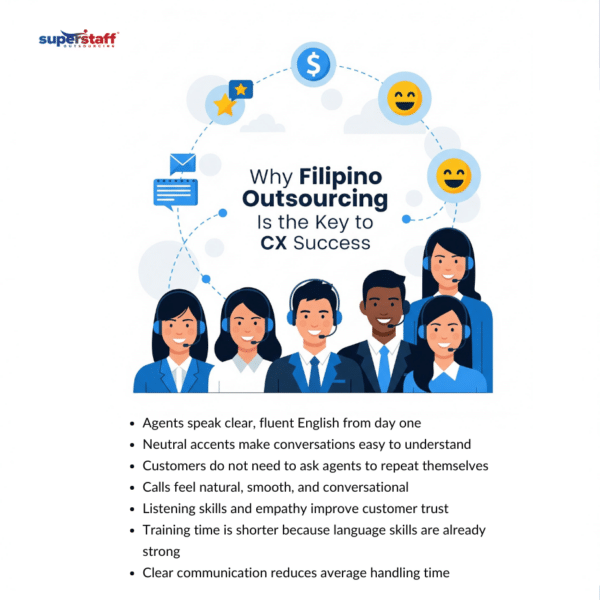
- Less need for customers to ask agents to repeat themselves
- Smoother conversations with elderly callers or non-native English speakers in the U.S.
- Reduced call fatigue for both the customer and the agent
- Improved customer confidence during the interaction
These subtle improvements accumulate over thousands of calls. Over time, they significantly raise customer satisfaction scores.
Education and Cultural Exposure Shape Communication Skills
English is one of the official languages of the Philippines. Students learn it from early education through university. Television, films, and digital media further reinforce American English patterns.
Cultural familiarity with Western norms also helps agents communicate naturally. Tone, phrasing, and expressions align closely with U.S. conversational styles. This reduces the sense of distance between the customer and the support representative.
Many companies discover that English fluent Filipino outsourcing delivers agents who require minimal language adjustment before going live on calls.
Listening Skills and Empathy Improve Call Quality
Language fluency alone is not enough. Agents must also listen carefully and respond with empathy. Filipino outsourcing customer service English professionals are known for patience and attentive listening, especially in service roles.
This combination improves customer interactions:
- Agents allow customers to finish explaining their concern
- Responses feel thoughtful rather than scripted
- Customers feel heard instead of rushed
- De-escalation happens naturally during tense calls
These soft skills enhance the technical ability to speak clearly. Together, they produce conversations that feel supportive rather than procedural.
Faster Training and Onboarding for Voice Programs
Training time often extends when agents struggle with pronunciation or comprehension. Companies spend weeks correcting speech patterns before focusing on product knowledge.
With Filipino outsourcing, onboarding can focus more on processes and tools because language fundamentals are already strong. Trainers spend less time on accent correction and more time on scenario practice.
This leads to:
- Faster readiness for live calls
- Lower training costs
- Shorter ramp-up periods for new programs
- Greater confidence among agents during early deployment
Operational efficiency improves when communication barriers do not slow down preparation.
Reduced Call Handling Time Through Clear Communication
Average handling time is influenced by how quickly both parties understand each other. Repetition and clarification add minutes to every interaction.
Clear speech and comprehension help shorten calls without sacrificing quality. Agents can guide customers step by step without needing to restate information.
Over thousands of daily calls, this efficiency becomes meaningful. Many companies attribute these improvements to Filipino outsourcing when analyzing voice program performance.
Better Customer Satisfaction and Brand Perception
Customers often judge a brand by how they feel after a support call. A pleasant and easy conversation leaves a lasting impression.
Neutral accents and fluent English contribute directly to positive feedback:
- Customers report that conversations feel natural
- Support feels professional and competent
- Brand trust increases after the interaction
- Repeat calls for the same issue decrease
These outcomes are difficult to achieve when communication feels strained. Strong language skills support consistent customer experiences.
Support for Complex and Sensitive Conversations
Healthcare, finance, and technical support require careful explanation. Customers ask detailed questions and expect precise answers.
Agents handling these programs must explain policies, procedures, or troubleshooting steps clearly. Misunderstandings in these areas can create serious issues.
This is another reason many organizations rely on Filipino outsourcing for high responsibility voice accounts where clarity is essential.
Alignment With U.S. Customer Expectations
U.S. customers are accustomed to a certain communication style. They expect politeness, clarity, and conversational flow.
Filipino agents naturally match these expectations because of cultural alignment and long experience serving American clients. Conversations feel familiar rather than foreign.
This alignment helps businesses maintain a consistent brand voice even when support is delivered offshore.
Why Voice Programs Continue to Choose the Philippines
Technology continues to improve customer service channels. However, voice support remains critical for complex issues and emotional situations.
Companies that prioritize voice quality often choose locations where agents can speak clearly and confidently. Filipino outsourcing remains a top choice because it addresses this requirement directly.
Decision-makers recognize that tools and scripts cannot compensate for communication barriers. The right voice talent matters.
Partnering With the Right BPO for Voice Excellence
Language ability is a national strength, but proper training and coaching still matter. The right BPO partner invests in continuous language refinement, call coaching, and quality monitoring.
At SuperStaff, agents receive communication training designed for U.S. audiences. Coaching focuses on pronunciation, tone, clarity, and conversational flow. Quality teams monitor calls to ensure standards remain high across programs.
This structured approach ensures that natural strengths translate into consistent CX performance.
Connect With SuperStaff for World-Class Filipino Outsourcing
Voice remains one of the most powerful channels in customer experience. Clear speech and easy conversations directly influence how customers perceive a brand. These factors explain why Filipino outsourcing continues to be a preferred strategy for U.S. companies running voice-based support.
SuperStaff combines the Philippines’ natural language strengths with structured training and coaching to deliver reliable CX outcomes. Are you wondering how to leverage the Filipino outsourcing neutral accent for better CX? Explore how SuperStaff can support your voice operations with agents who communicate clearly and confidently.