
U.S. finance leaders face growing pressure to deliver sharper insight with leaner teams. Despite this reality, many remain hesitant to adopt offshore financial analysis services because their assumptions are rooted in outdated outsourcing models.
These views were shaped when offshore work was largely transactional, not analytical. As finance functions evolve toward forecasting, scenario modeling, and decision support, those assumptions deserve reconsideration.
Offshore analysis is often mistaken for basic support
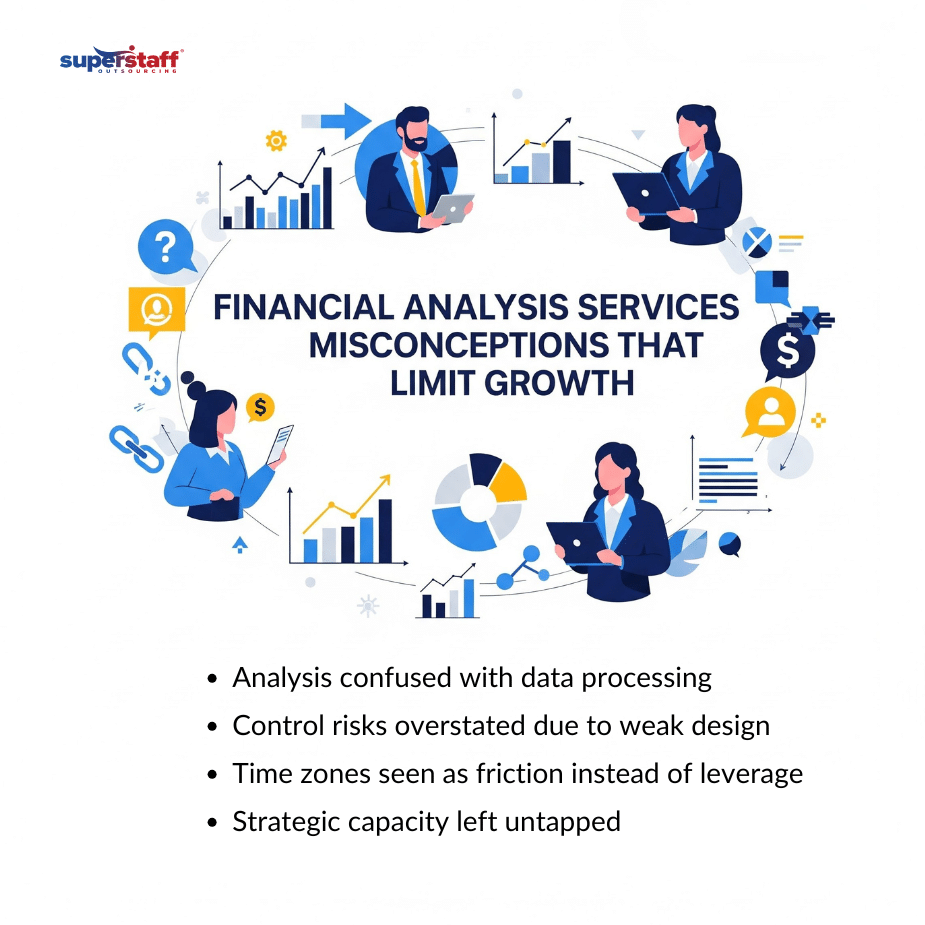
Many finance leaders still equate offshore financial analysis services with spreadsheet updates and report formatting. That narrow view limits how organizations design their finance operating models. When offshore teams are confined to task execution, internal analysts remain overloaded, and leadership receives less timely insight.
Modern delivery models clearly separate data preparation from analysis. Offshore financial analysts increasingly support variance reviews, trend interpretation, and management reporting preparation. The value they deliver comes from structured analytical processes rather than isolated tasks, allowing finance leaders to focus on higher-level decision-making.
Analytical judgment is shaped by systems, not geography
A common concern is that offshore teams lack the judgment required for financial analysis. In practice, judgment is not tied to location but to governance. Well-run financial analysis services rely on defined assumptions, standardized methodologies, and review mechanisms that guide how analysis is performed and escalated.
Offshore financial analysts operate within clear analytical guardrails. Their role is to surface insights, highlight anomalies, and prepare structured outputs that internal leaders review and approve. This approach ensures consistency and reliability without transferring decision authority away from the core finance team.
Specialization is deeper than many leaders expect
Another misconception is that offshore teams are composed of generalists rotating across unrelated tasks. In reality, many financial analysis BPO models are built around specialization. Analysts are aligned to specific functions, business units, or reporting streams, which improves context retention and analytical quality over time.
Dedicated offshore financial analysts can support budgeting cycles, forecast updates, and performance monitoring. As familiarity with the business grows, the quality of insights improves. This continuity strengthens reporting and analysis without requiring additional internal hires.
Control concerns reflect design gaps, not delivery risk
Loss of control remains one of the biggest barriers to adopting offshore financial analysis services. These concerns usually stem from weak operating design rather than the offshore model itself. Without clear documentation and ownership, any distributed team will struggle to deliver consistent results.
Effective governance includes standardized templates, version control, and approval workflows. These mechanisms create transparency across locations and ensure accountability. Finance leaders retain control over assumptions and outputs while benefiting from distributed analytical execution.
Time zones can accelerate insight when structured properly
Time zone differences are often framed as an obstacle to collaboration. For finance teams, they can become a source of speed when workflows are designed intentionally. Offshore financial analysts can complete recurring analysis and model updates outside U.S. business hours.
This enables finance leaders to start the day with refreshed reports and updated forecasts. Executive discussions happen faster because preparation work is already complete. Instead of slowing decisions, time zone differences can shorten reporting cycles.
Vendor thinking limits analytical impact
Many organizations still treat offshore teams as external vendors rather than integrated contributors. This mindset restricts accountability and limits analytical depth. High-performing financial analysis services operate as extensions of the finance function, not transactional suppliers.
Embedded models assign dedicated analysts to specific stakeholders and reporting needs. Performance is measured against business outcomes rather than task volume. Over time, this structure supports deeper analysis and stronger alignment with leadership priorities.
Cost-first thinking obscures strategic value
Cost efficiency is often the initial reason finance leaders consider offshore financial analysis services. While cost matters, focusing solely on savings can lead to underutilized analytical capacity. The greater value lies in freeing internal teams to focus on strategic priorities.
When offshore financial analysts manage recurring analysis and reporting, internal leaders gain time for scenario planning and performance interpretation. This shift improves the quality of finance conversations across the organization. The result is better decision support, not just lower operating costs.
Scaling internally is slower than expected
Hiring experienced analysts in the U.S. remains competitive and time-consuming. Even after hiring, onboarding and knowledge transfer extend the ramp-up period. This makes it difficult for finance teams to respond quickly to growth or volatility.
Offshore financial analysis services offer faster scaling through pre-trained talent pools and established delivery structures. Knowledge is retained within the offshore team, reducing disruption when staffing changes occur. This continuity supports long-term planning and reporting stability.
Misconceptions persist because models have quietly evolved
Many common misconceptions about outsourcing financial analysis to the Philippines persist because change has been incremental rather than visible. Over time, offshore roles have become more specialized, and tool adoption has improved significantly. Analysts now work directly within client systems and reporting environments.
Offshore financial analysts are increasingly fluent in finance platforms and internal reporting tools. They follow client-defined methodologies and documentation standards. This alignment reduces friction and increases confidence in offshore-delivered analysis.
Outcomes depend on operating model, not location
Geography alone does not determine the success of financial analysis services. Outcomes are driven by onboarding depth, communication cadence, and performance management. When expectations are clear and governance is strong, offshore delivery becomes a reliable extension of the finance team.
Well-designed models integrate offshore analysts into planning cycles, reporting timelines, and review meetings. Accountability is shared, and insight quality improves over time. The result is consistent analytical support aligned with business goals.
Rethinking Offshore Financial Analysis With Clearer Assumptions
Many U.S. finance leaders underestimate the role offshore financial analysis services can play in strengthening decision-making.
Misconceptions around control, capability, and integration continue to limit adoption. When designed intentionally, offshore models expand analytical capacity while maintaining clarity and oversight.
SuperStaff partners with finance leaders to build structured, embedded offshore financial analysis services aligned to real business needs.
Explore how SuperStaff can help your organization strengthen financial insight while preserving control and confidence.