
U.S. companies face persistent pressure to deliver technology outcomes faster while managing costs and internal capacity. Hiring locally often introduces delays, budget strain, and operational bottlenecks.
For many leaders, finding remote tech talent has become a strategic requirement rather than a short-term workaround.
The Philippines has emerged as a reliable destination for companies that need technical capability, workforce stability, and operational clarity without adding complexity to their core business.
Why U.S. Tech Hiring Has Become Increasingly Difficult
Domestic hiring cycles continue to stretch longer than most product and infrastructure timelines can tolerate. Compensation expectations remain high, even for mid-level roles. Internal teams are often asked to cover gaps while leadership searches for talent that may not arrive on schedule.
These conditions push companies to explore alternatives that preserve momentum. Finding remote tech talent offshore allows leadership teams to regain control over delivery without compromising quality or accountability.
Offshore Tech Talent as a Capacity Strategy
Offshore staffing has evolved into a long-term capacity solution. Companies now use distributed teams to support ongoing development, system maintenance, and platform optimization. The focus has shifted from short-term savings to sustained execution.
For organizations evaluating finding remote tech talent, the key question is no longer whether offshore works. The question is where it works best and how it integrates with existing operations.
Why the Philippines Continues to Stand Out
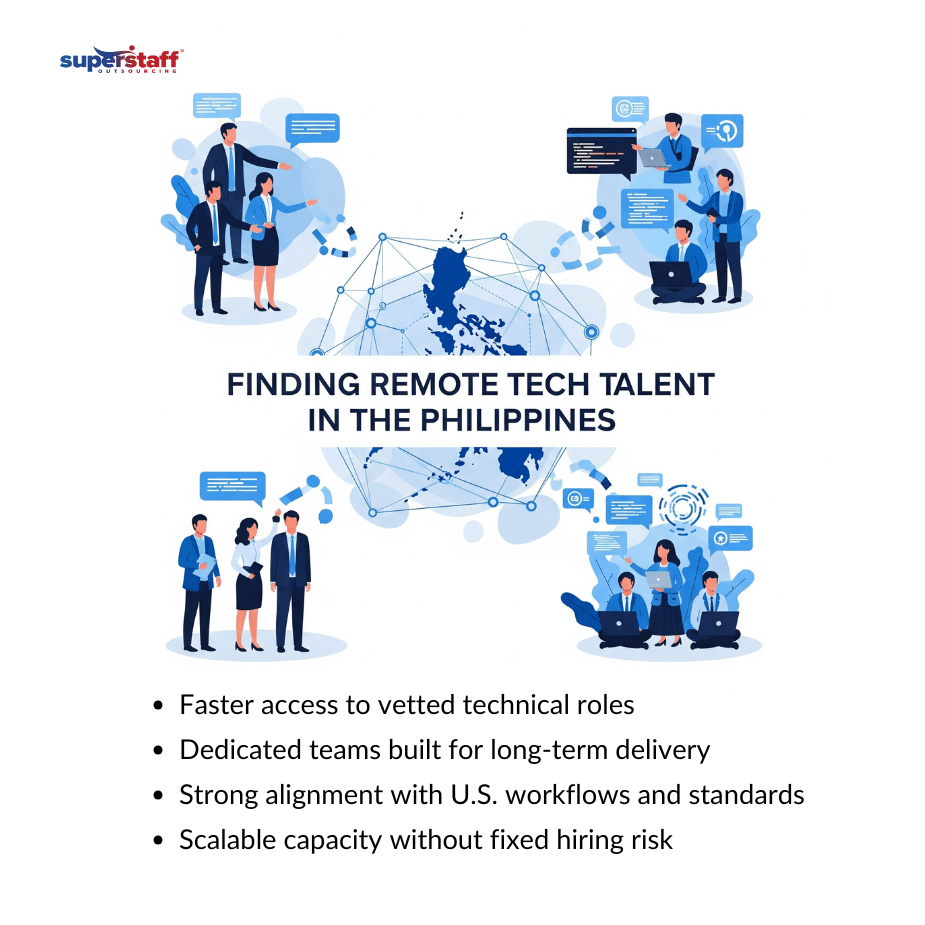
The Philippines offers a deep pool of professionals trained in software development, IT support, QA, and related disciplines. Many have experience supporting U.S.-based companies across different industries and business models.
For companies looking for remote tech talent Philippines, the advantage lies in workforce maturity. Teams are accustomed to structured workflows, documentation standards, and cross-functional collaboration with U.S. counterparts.
Communication and Cultural Alignment Reduce Risk
Clear communication plays a critical role in distributed technology teams. Filipino professionals bring strong English proficiency and familiarity with U.S. business norms. This reduces misunderstandings that can derail technical projects.
Cultural alignment also supports accountability. When finding remote tech talent, leaders benefit from teams that value responsiveness, follow-through, and consistent reporting. These traits contribute to predictable delivery and stronger working relationships.
Defining the Right Roles Before Hiring
Successful offshore initiatives begin with clear role definition. Companies that struggle offshore often skip this step and expect remote teams to self-organize around vague responsibilities.
When leadership teams approach finding remote tech talent, they should start by identifying roles that align with existing workflows. Common entry points include application development, quality assurance, DevOps support, and internal IT services.
Clear scope simplifies onboarding and accelerates productivity.
Dedicated Teams Create Stability
Dedicated offshore teams function as extensions of internal departments. They are assigned to a single client, follow defined processes, and build institutional knowledge over time.
This model supports finding remote tech talent that delivers consistency rather than short-term output. Dedicated teams reduce turnover risk, protect continuity, and allow leaders to plan capacity with confidence.
Onboarding Determines Early Success
Early-stage integration sets the tone for long-term performance. Structured onboarding ensures offshore teams understand tools, standards, and expectations from day one.
Companies that succeed with finding remote tech talent invest time in documentation, clear communication channels, and defined performance metrics. This approach shortens the ramp-up period and reduces rework during the first months of engagement.
Governance Keeps Quality High as Teams Scale
As offshore teams grow, governance becomes essential. Leadership teams need visibility into performance, security, and compliance without micromanaging day-to-day tasks.
Strong governance frameworks support finding remote tech talent that scales responsibly. Regular reporting, defined KPIs, and review cadences ensure offshore teams remain aligned with business objectives as complexity increases.
Scaling Without Long-Term Risk
One of the most practical advantages of offshore teams is flexibility. Companies can scale capacity up or down based on demand without absorbing the fixed costs of domestic hiring.
For executives evaluating finding remote tech talent, this flexibility supports better risk management. It allows companies to respond to growth opportunities while maintaining financial discipline during periods of uncertainty.
Choosing the Right Partner Matters
Execution quality depends heavily on the offshore partner. A capable partner provides recruitment expertise, workforce management, and compliance oversight. They also act as a buffer between operational execution and administrative burden.
Companies asking how to find remote tech talent in the Philippines should look for partners with proven delivery frameworks, transparent management practices, and experience supporting U.S. businesses at scale.
How SuperStaff Supports Remote Tech Teams
SuperStaff works with U.S. SMEs and midmarket companies to build structured offshore teams in the Philippines. Our approach emphasizes role clarity, dedicated staffing, and operational transparency.
Clients that hire remote developers Philippines through SuperStaff benefit from stable teams, clear governance, and integration models designed to support long-term growth rather than short-term fixes.
Strategic Use Cases for Offshore Tech Teams
Offshore teams support a range of business objectives. Some companies use them to accelerate product roadmaps. Others rely on offshore teams to stabilize IT operations or extend internal development capacity.
Across these scenarios, finding remote tech talent enables leadership teams to align resources with priorities while protecting internal focus on strategy and customer outcomes.
Managing Expectations and Performance
Clear expectations create strong results. Leaders should define success metrics early and revisit them regularly. Offshore teams perform best when goals are measurable and feedback loops are consistent.
Organizations that succeed with finding remote tech talent treat offshore teams as strategic contributors rather than transactional vendors. This mindset supports accountability and sustained performance.
A Practical Path Forward for U.S. Tech Leaders
For U.S. businesses navigating talent shortages and operational pressure, finding remote tech talent in the Philippines offers a practical and scalable path forward.
With the right structure, governance, and partner support, offshore teams can strengthen delivery without increasing risk. SuperStaff helps U.S. companies build and manage remote tech teams that integrate seamlessly with existing operations.
Explore how SuperStaff can support your technology goals through structured offshore staffing designed for long-term success.