U.S. companies are navigating one of the most constrained labor environments in decades. Hiring timelines are longer. Candidate pools are thinner. Internal teams are being asked to absorb more work while maintaining service quality.
A global staffing solution gives leaders a way to respond with speed and structure. It allows businesses to fill operational gaps without waiting for domestic labor markets to correct themselves. For SMEs and midmarket firms, this approach has become a practical extension of workforce planning rather than a last-resort option.
The Reality Behind Persistent Talent Gaps
Many organizations still plan as if hiring challenges are temporary. In practice, shortages are proving structural.
Customer service roles remain difficult to staff. Back-office support functions experience steady turnover. At the same time, night and weekend coverage strains internal teams. These pressures compound as companies grow.
Traditional hiring methods struggle to keep up. Recruiters compete for the same limited talent. Managers delay initiatives because support roles remain unfilled. Over time, these delays impact customer experience and revenue protection.
Why Speed Matters More Than Ever
Unfilled roles create operational drag. Every week a position stays open increases pressure on existing employees. Response times slow, and errors rise.
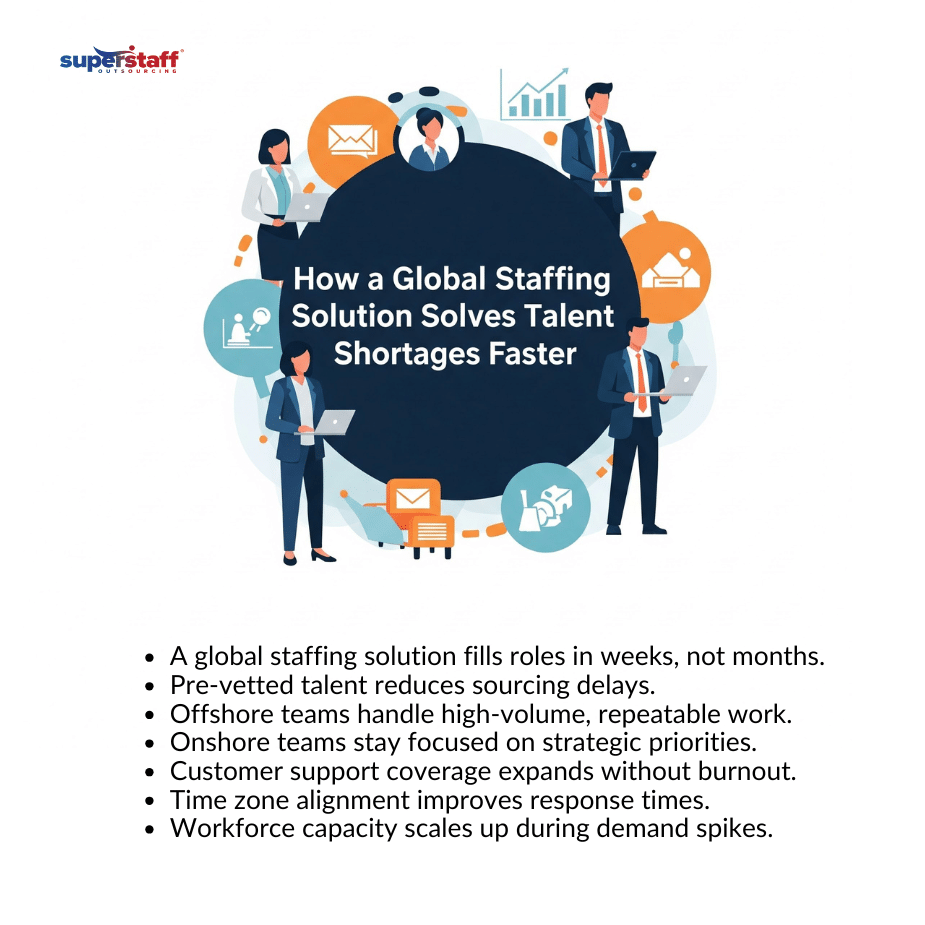
A global staffing solution shortens this gap. Offshore teams are recruited from established talent pools that are trained for service-driven work. Hiring cycles move faster because sourcing, screening, and onboarding processes are already in place.
This speed gives leadership breathing room. Decisions are made proactively rather than reactively. Growth plans stay intact.
Rethinking Workforce Design
Modern workforce planning is less about location and more about function. Leaders are learning to separate tasks that require physical presence from tasks that require consistency and scale.
Customer inquiries. Order processing. Account updates. These activities follow defined workflows. They benefit from repetition and measurement.
By allocating these responsibilities to offshore teams, companies free up internal staff for work that demands local context and strategic judgment. This balance strengthens onshore workforce support without inflating headcount.
How Global Staffing Reinforces Onshore Teams
Concerns about offshore staffing often center on displacement. In reality, the most successful models focus on reinforcement.
Onshore employees gain relief from volume-heavy tasks. They spend more time resolving complex issues and improving processes. Engagement improves because workloads become more manageable.
This dynamic is one of the most effective talent shortage solutions available today. It protects institutional knowledge while expanding execution capacity.
Why the Philippines Remains a Strategic Choice
The Philippines offers a mature service environment. Decades of experience supporting U.S. businesses have shaped a workforce that understands accountability, documentation, and escalation discipline.
English proficiency supports clear communication. Cultural familiarity with U.S. business norms reduces friction. Agents are accustomed to performance metrics and quality monitoring.
For companies implementing a global staffing solution, these factors reduce ramp-up risk and support long-term stability.
Maintaining Governance and Visibility
Effective staffing models do not trade control for capacity. Governance remains central.
Offshore teams operate under the same service-level expectations as internal staff. Reporting structures mirror onshore operations, with managers retaining oversight of performance and outcomes.
When alignment is designed intentionally, offshore work becomes transparent rather than opaque. This clarity reassures executives who value accountability.
Flexibility During Demand Shifts
Demand volatility challenges fixed staffing models. Seasonal peaks, promotions, and unexpected surges can overwhelm internal teams.
A global staffing solution introduces elasticity. Capacity scales up during high-demand periods and stabilizes afterward. Businesses avoid the cost and disruption of constant hiring and layoffs.
This flexibility supports operational resilience. Teams adjust without sacrificing morale or service standards.
Time Zone Coverage Without Burnout
Customer expectations extend beyond traditional business hours. Providing extended coverage locally often leads to fatigue and attrition.
Offshore teams enable round-the-clock support without forcing internal staff into unsustainable schedules. Customers receive timely responses. Employees maintain work-life balance.
This structure strengthens onshore workforce support while improving customer satisfaction.
Training as a Strategic Investment
Performance differences are rarely geographic. They stem from preparation.
Strong global staffing programs invest heavily in onboarding. Processes are documented. Brand values are reinforced. Feedback loops are active.
Training ensures offshore teams operate as true extensions of the organization. Consistency follows preparation, not proximity.
Cost Discipline Without Compromise
Cost efficiency remains a consideration, but it is not the sole driver. The goal is predictability.
A global staffing solution offers stable cost structures paired with reliable output. Lower labor costs combine with high retention and standardized workflows.
Savings support reinvestment. Technology upgrades. Product enhancements. Customer experience initiatives. This reinvestment cycle fuels growth.
Reducing Operational Risk Through Diversification
Concentrating all operations in one labor market creates exposure. Economic shifts, policy changes, and regional disruptions can impact continuity.
Distributed staffing reduces that risk. Work continues even when one location faces constraints.
This redundancy strengthens business continuity planning and reassures stakeholders focused on long-term stability.
Strategic Use Cases Across Functions
While customer service is a common entry point, global staffing supports multiple functions.
Email and chat support. Order management. Billing coordination. CRM maintenance. These roles share structured workflows and measurable outcomes.
By deploying a global staffing solution across these areas, companies build operational depth without expanding domestic payroll.
Leadership Alignment Is Critical
Adoption succeeds when leaders communicate purpose clearly. Offshore teams should understand how their work supports business goals. Onshore teams should understand how support enhances their roles.
Transparency builds trust. Trust accelerates collaboration.
When leadership frames global staffing as a strategic decision rather than a cost tactic, alignment follows.
The Executive View on Modern Talent Strategies
Executives today are expected to do more with less. Hiring budgets face scrutiny. Growth targets remain.
Global staffing aligns with this reality. It offers access to skilled talent without the delays and risks of domestic hiring alone.
For many organizations, this approach has shifted from optional to foundational.
Measuring Success Beyond Headcount
The impact of a global staffing solution is measured through outcomes. Faster response times. Improved service consistency. Reduced employee turnover.
These indicators matter more than where work is performed. They reflect operational health.
Companies that track these metrics gain clarity on return and performance.
Find Your Ideal Global Staffing Solution With SuperStaff
Talent shortages are not slowing down. Businesses must adapt their staffing models to maintain momentum.
A global staffing solution enables faster gap coverage while strengthening internal teams. It balances speed, control, and flexibility in a way traditional hiring cannot.
SuperStaff partners with SMEs and midmarket companies to build high-performing offshore teams in the Philippines that integrate seamlessly with onshore operations.
Ready to reap the benefits of using global staffing services for talent shortages? Explore how SuperStaff can support your workforce strategy and help you address talent gaps with confidence.