
Healthcare access increasingly depends on communication speed. Patients want answers quickly, follow-ups that actually happen, and fewer moments where they feel lost between departments. Many providers still rely on fragmented systems that were never designed for today’s volume or channel mix.
A well-designed multichannel contact center gives healthcare organizations the structure to manage complexity without slowing care. It connects voice, email, chat, SMS, and secure messaging into a single operating model that prioritizes clarity, ownership, and response time.
Why patient wait times remain stubbornly high
Long waits rarely stem from one failure. They build up through small inefficiencies that compound across the patient journey.
Calls arrive during peak hours with no overflow strategy. Messages land in shared inboxes with unclear ownership. Scheduling teams rely on callbacks instead of confirmations. Follow-ups depend on memory instead of workflow.
These breakdowns delay care before a clinician ever enters the picture. They also create frustration for staff who spend time managing communication instead of resolving issues.
A multichannel contact center addresses these problems by standardizing how requests enter the system and how they move from intake to resolution.
Centralized intake brings order to high volumes
Dispersed intake creates invisible queues. Centralized intake creates control.
In a multichannel contact center, all patient communications feed into one unified queue. Requests are categorized, timestamped, and assigned based on clear rules.
This approach prevents messages from being overlooked. It also ensures that routine requests do not block urgent ones.
Centralization improves predictability. Teams know what is coming in, what is pending, and what must be handled next. Patients experience faster acknowledgment instead of silence.
Channel flexibility reduces unnecessary calls
Many patients call simply because other channels fail to respond. That behavior increases call volume and wait times for everyone.
An omnichannel healthcare customer service outsourcing team allows patients to use the channel that fits their situation. Appointment changes, prescription questions, and billing inquiries often work better through messaging or email.
When those channels are monitored and managed with the same rigor as phone calls, patients stop calling to chase answers. Call volume stabilizes. Agents spend more time resolving issues instead of repeating information.
This balance improves access without adding headcount.
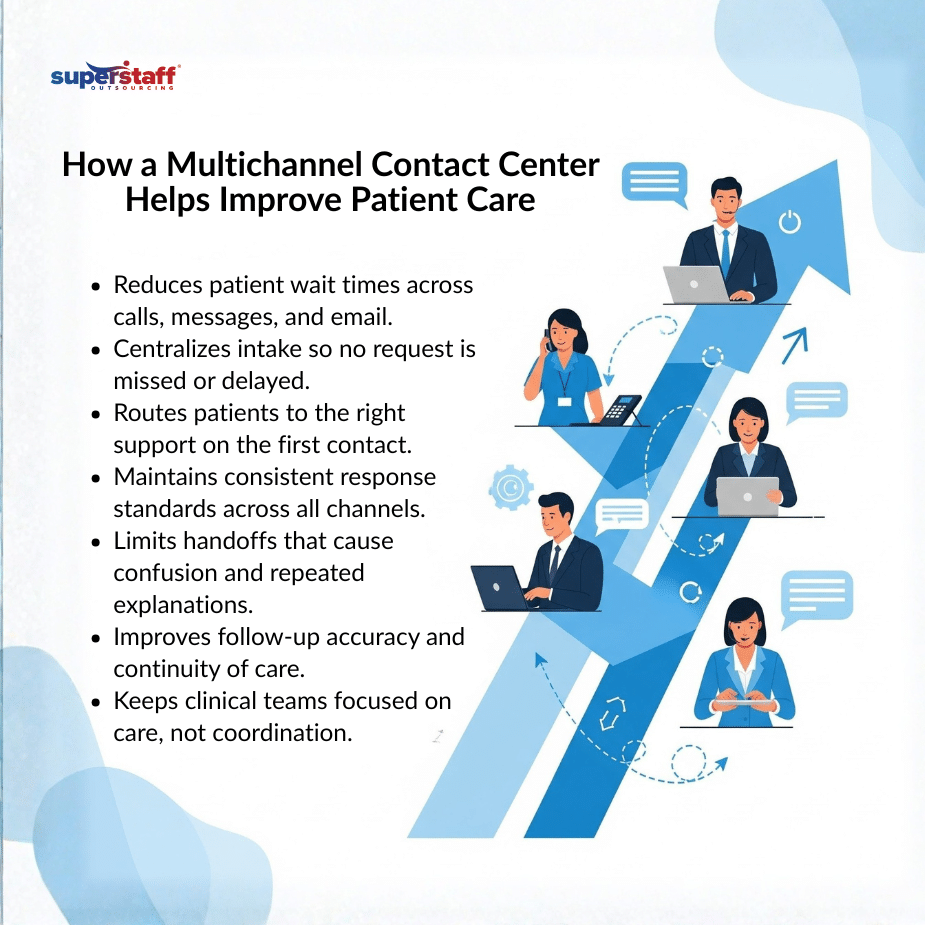
Consistent workflows prevent communication gaps
Gaps often appear when different teams follow different rules. One department responds within hours. Another responds days later. Patients experience these differences immediately, even when the issue is minor.
A multichannel contact center applies consistent service levels across every channel. Response expectations are clearly defined. Ownership is assigned at intake. Escalation paths are documented and enforced.
Agents follow the same workflow whether a patient calls, sends a message, or submits a request online. That alignment reduces confusion, duplicate work, and unnecessary follow-ups. It also prevents requests from being passed between teams without resolution.
Patients notice the difference quickly. Communication feels structured and dependable. Trust improves because responses arrive when promised, not when someone happens to see the message.
Smarter routing improves first contact resolution
Speed matters, but accuracy matters just as much. Fast responses that lead to transfers only shift frustration.
A multichannel contact center uses intent-based routing to connect patients with the right support from the start. Scheduling requests go to scheduling specialists. Billing questions go to trained billing support. Clinical concerns escalate properly.
This structure increases first contact resolution. It also protects clinical teams from being pulled into administrative conversations.
Agents work within defined scopes. Patients get answers without bouncing between departments.
Shared visibility strengthens accountability
Many healthcare organizations struggle to see what is happening across channels in real time. Phone metrics exist. Digital channels remain fragmented.
A multichannel contact center creates shared dashboards that show queue depth, response times, and backlog aging across all channels.
Supervisors can intervene before delays escalate. Leaders can identify patterns instead of relying on anecdotes.
Visibility builds accountability. Teams understand expectations. Performance conversations focus on data rather than assumptions.
Offshore teams expand coverage without burnout
Extended hours are difficult to sustain with onshore teams alone. Burnout increases. Coverage gaps appear.
A multichannel contact center supported by offshore teams in the Philippines solves this challenge operationally. Coverage extends into evenings and nights without exhausting internal staff.
Filipino agents are well suited for healthcare support roles. They communicate clearly. They follow the process with discipline. They handle sensitive interactions with professionalism.
Patients receive timely responses regardless of time zone. Internal teams return to manageable workloads.
Reducing handoffs improves continuity
Every handoff introduces risk. Information gets lost. Context disappears. Patients repeat themselves.
A multichannel contact center reduces handoffs by keeping interactions within a single system. Agents see full histories across calls, messages, and emails.
Escalations include complete context. Follow-ups reference previous conversations.
This continuity shortens resolution times and improves patient confidence in the organization.
Operational gains extend beyond access
Improved communication creates downstream operational benefits.
A multichannel contact center reduces administrative interruptions for clinicians. Front-end teams manage coordination, reminders, and documentation.
Scheduling efficiency improves. No-show rates decline when confirmations and reminders reach patients through preferred channels.
Leadership gains insight into demand patterns. Staffing decisions align with actual volume rather than assumptions.
Compliance and quality remain intact
Speed should never compromise compliance. Healthcare communication requires discipline.
Providers offering healthcare call center services operate within defined compliance frameworks. Scripts guide conversations. Access controls protect patient data. Quality monitoring reinforces standards.
Agents receive ongoing training. Supervisors review interactions across channels.
This structure ensures that faster communication does not introduce risk.
Designing the right model requires intention
Success depends on more than technology selection. It requires clear design.
A multichannel contact center works when roles are defined, workflows documented, and escalation paths enforced.
Leadership commitment matters. Metrics must guide improvement. Feedback loops must remain active.
When designed intentionally, multichannel operations become a strategic capability rather than a reactive fix.
Elevate Patient Care With a Dedicated Multichannel Contact Center
Patient wait times often reflect communication design more than staffing levels. A multichannel contact center creates the structure needed to move faster without sacrificing clarity or compliance.
SuperStaff helps U.S. healthcare organizations build and manage multichannel contact center teams in the Philippines that deliver consistent access, extended coverage, and operational discipline.
If communication gaps are slowing care or straining your teams, now is the time to explore how SuperStaff can support your operational strategy. Get in touch with us to learn more about multichannel healthcare contact center solutions for faster patient care!